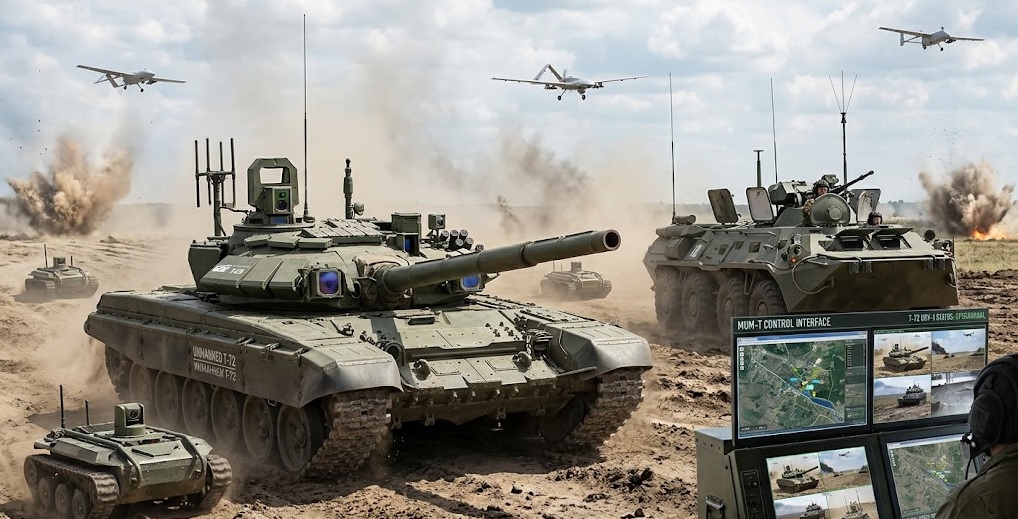
NEW DELHI — March 24, 2026 : The Indian Army is progressing with a programme to convert its fleet of legacy T-72 main battle tanks into remotely operated and autonomous armoured combat platforms, aiming to extend their operational service life by 15 to 20 years beyond the planned retirement timeline beginning around 2030.
The initiative targets a fleet of approximately 2,400 Soviet-origin T-72 tanks, which have formed the backbone of the Army’s armoured corps since their induction in 1979, including units licence-produced domestically. These tanks have been deployed across varied operational environments, including plains, desert sectors, and high-altitude regions such as Ladakh, as well as in overseas missions like the Indian Peacekeeping Force deployment in Sri Lanka.
Programme Objective and Strategic Rationale
The conversion effort is designed as a cost-effective alternative to immediate large-scale procurement of new main battle tanks, while supporting the Army’s transition toward network-centric and technology-driven warfare. By repurposing existing platforms into unmanned systems, the Army intends to maintain force levels and operational capability during the transition to future platforms such as the Future Ready Combat Vehicle (FRCV), expected to begin induction from 2030 onward.
Under the plan, the upgraded T-72 platforms will be capable of operating as optionally manned or fully unmanned systems. The conversion focuses on preserving the tanks’ existing mechanical reliability while integrating advanced digital and autonomous capabilities.
Operational Role and MUM-T Integration
The programme is aligned with the Army’s Manned-Unmanned Teaming (MUM-T) doctrine, which integrates crewed and uncrewed systems to improve battlefield effectiveness. Within this framework, the converted T-72 units are intended to operate alongside manned platforms such as the T-90, functioning as force multipliers.
Operational roles identified for the unmanned T-72 platforms include minefield entry and breaching, forward assault operations, reconnaissance patrols, and decoy missions. These roles are specifically suited for high-risk environments where reducing crew exposure is a priority. The platforms are expected to operate ahead of manned formations, absorbing initial engagement, identifying enemy positions, and enabling safer maneuvering for crewed units.
The MUM-T concept, including the use of such “loyal wingman” ground systems, was validated during field exercises conducted in 2025.
Development Framework and ADITI Scheme
The project has moved from conceptual planning into the development phase following the release of a requirements document by Defence Minister Rajnath Singh on March 19, 2026. The programme is being executed under the fourth edition of the Acing Development of Innovative Technologies with iDEX (ADITI) scheme, part of the Ministry of Defence’s Innovations for Defence Excellence (iDEX) initiative aimed at promoting domestic defence industry participation.
The Ministry has opened the programme to private defence companies and technology firms, initiating a competitive process for industry collaboration.
Technical Requirements and Prototype Development
According to the Army’s requirements, selected industry partners will be tasked with developing an autonomous conversion kit that enables the T-72 to operate in both optionally manned and fully unmanned modes. A key requirement is the integration of an IP-based digital interface, allowing seamless connectivity with higher-level command and control networks while retaining the platform’s core mechanical systems.
The scope of development includes multiple advanced technology domains such as robotics, sensor fusion, automation, guidance, navigation, and control systems. These technologies are intended to provide situational awareness, remote operation capability, and varying degrees of autonomy.
As part of the initial phase, industry participants are required to deliver two fully functional prototypes of the autonomous kit. These prototypes will undergo validation and field testing before any decision is made on large-scale retrofitting across the T-72 fleet.
Current Status and Parallel Upgrades
As of the release of the requirements document, no contracts have been awarded and no prototypes have been produced. The selection of industry partners and subsequent development process will proceed under the ADITI framework.
In parallel with the unmanned conversion programme, the Army continues to implement upgrades to portions of the existing T-72 fleet. These include the recent installation of indigenously developed Thermal Imaging Fire Control Systems on 96 tanks, aimed at improving targeting and night-fighting capability. These upgrades are separate from the autonomous conversion effort.
Role in Future Force Structure
The T-72 conversion programme is positioned as an interim capability enhancement as the Army prepares for the gradual induction of next-generation armoured platforms. By extending the utility of existing assets and integrating them into a MUM-T operational architecture, the Army aims to maintain operational readiness while adapting to evolving battlefield requirements.
The initiative reflects a broader shift toward incorporating unmanned systems into conventional armoured operations, with an emphasis on reducing risk to personnel and enhancing operational flexibility through technology integration.
——— End of Article ———