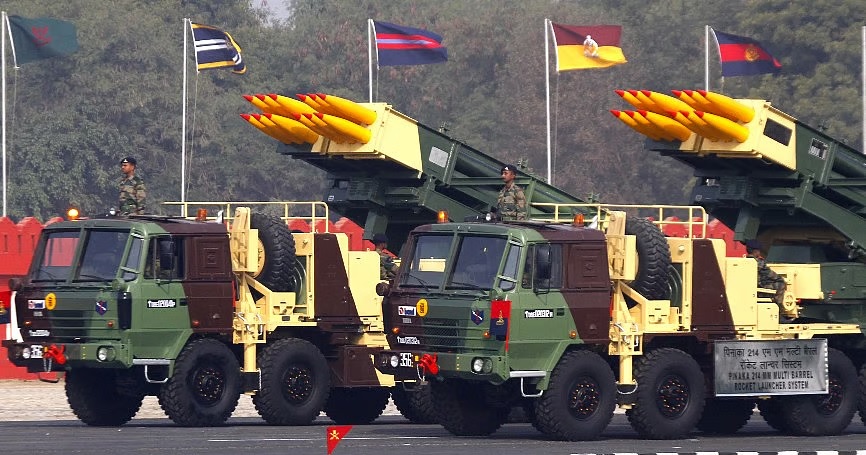
NEW DELHI — March 16, 2026 : The Indian Army has operationalised its seventh regiment equipped with the indigenous Pinaka multi-barrel rocket launcher (MBRL) system, continuing the service’s effort to expand long-range rocket artillery capabilities and replace older Soviet-origin Grad systems.
According to senior defence officials, an eighth Pinaka regiment has already been raised and has received more than half of its equipment. The unit is currently undergoing conversion and operational training and is expected to achieve full combat readiness before the end of 2026.
The expansion forms part of a broader artillery modernization program designed to increase the Army’s long-range strike capacity along both the northern and western borders.
Expansion of Indigenous Rocket Artillery
The Pinaka system, developed by the Defence Research and Development Organisation (DRDO), is India’s primary indigenous rocket artillery platform. The Army plans to field 10 Pinaka regiments by 2027, with a long-term objective of expanding the fleet to around 22 regiments.
This force expansion is intended to gradually replace the BM-21 Grad multiple rocket launchers, many of which were inducted decades ago and are approaching the end of their operational life.
Two additional regiments from a batch of six regiments ordered in 2020 are expected to be operationalised in 2027. Deliveries from these contracts are continuing as part of the ongoing regiment buildup.
Each Pinaka regiment typically consists of three batteries, with six launchers in each battery. Every launcher carries 12 rockets, allowing a single battery to fire 72 rockets in approximately 44 seconds. A full salvo can cover an area of roughly 1,000 meters by 800 meters, providing large-scale suppression capability against enemy troop concentrations, logistics areas, and artillery positions.
The launchers are mounted on high-mobility vehicles produced by Bharat Earth Movers Limited (BEML) using the Tatra chassis platform, allowing rapid deployment and relocation after firing.
Pinaka Variants and Strike Ranges
The Pinaka family of rockets includes several variants designed to provide progressively longer ranges and improved accuracy.
The Mk-I variant, which formed the initial operational configuration, has a strike range of approximately 37 to 40 kilometers.
An extended-range Mk-II variant increases the engagement distance to about 60 kilometers, allowing artillery units to strike deeper targets while remaining outside the range of many enemy systems.
More recent Guided Pinaka rockets incorporate navigation and guidance systems that combine an Inertial Navigation System (INS) with satellite navigation using GPS and India’s NavIC system. These guided rockets are capable of engaging targets at distances between 75 and 90 kilometers with significantly improved accuracy compared with unguided rockets.
The guidance system reduces the Circular Error Probable (CEP) and enables the system to strike specific targets such as command centers, supply depots, air defense sites, and artillery batteries rather than relying solely on area saturation fire.
Development of the Long-Range Guided Rocket (LRGR-120)
India is also extending the range of the Pinaka family through the Long Range Guided Rocket (LRGR) program.
In December 2025, successful trials of the LRGR-120—often described as the Pinaka Mk-III variant—were conducted at the Integrated Test Range in Chandipur, Odisha. During these tests, the rocket demonstrated a range of approximately 120 kilometers with high accuracy.
The LRGR significantly increases the stand-off strike capability of rocket artillery units. The system is designed to provide a cost-effective precision strike option compared with tactical ballistic missiles while allowing sustained deep-strike operations against enemy infrastructure and high-value targets.
Integration into the Rocket-cum-Missile Force
The growing fleet of Pinaka systems is being integrated into the Indian Army’s newly announced Rocket-cum-Missile Force, a specialized formation created to manage long-range strike assets under a unified command structure.
The concept for the force was outlined by Army Chief General Upendra Dwivedi in January 2026. The organization is intended to integrate multiple categories of strike systems, including:
-
Conventional ballistic missiles
-
Cruise missiles
-
Multi-barrel rocket launchers such as Pinaka
The objective is to improve coordination of long-range fires and enhance the Army’s ability to conduct precision strikes against targets across contested border regions.
Deployment of these systems is expected to support deterrence requirements along the Line of Actual Control (LAC) with China and the Line of Control (LoC) with Pakistan, where long-range artillery can be used to target logistics nodes, command centers, and artillery positions.
Industrial Production and Procurement
The Pinaka program is supported by a consortium of Indian defence manufacturers, reflecting a public-private partnership model for artillery production.
Key production responsibilities include:
-
Tata Power Strategic Engineering Division (SED) and Larsen & Toubro (L&T) – production of launchers and command posts
-
Bharat Earth Movers Limited (BEML) – heavy-duty mobility vehicles and transport platforms
-
Solar Industries – production of specialized rocket ammunition
Earlier procurement approvals included contracts valued at approximately ₹25.8 billion (₹2,580 crore) for additional regiments cleared in 2018 and ordered in 2020.
Role in Artillery Modernization
The ongoing induction of new Pinaka regiments forms part of a broader modernization effort within the Regiment of Artillery, aimed at increasing range, mobility, and precision of the Army’s firepower.
The system’s “shoot-and-scoot” capability, enabled by high-mobility wheeled launch platforms, allows batteries to fire rockets and relocate quickly to avoid enemy counter-battery fire.
With the operationalisation of the 7th Pinaka regiment and the 8th regiment expected to become combat-ready by the end of 2026, the Indian Army continues expanding indigenous rocket artillery capacity while transitioning from legacy systems to modern, longer-range guided rocket platforms.
——— End of Article ———