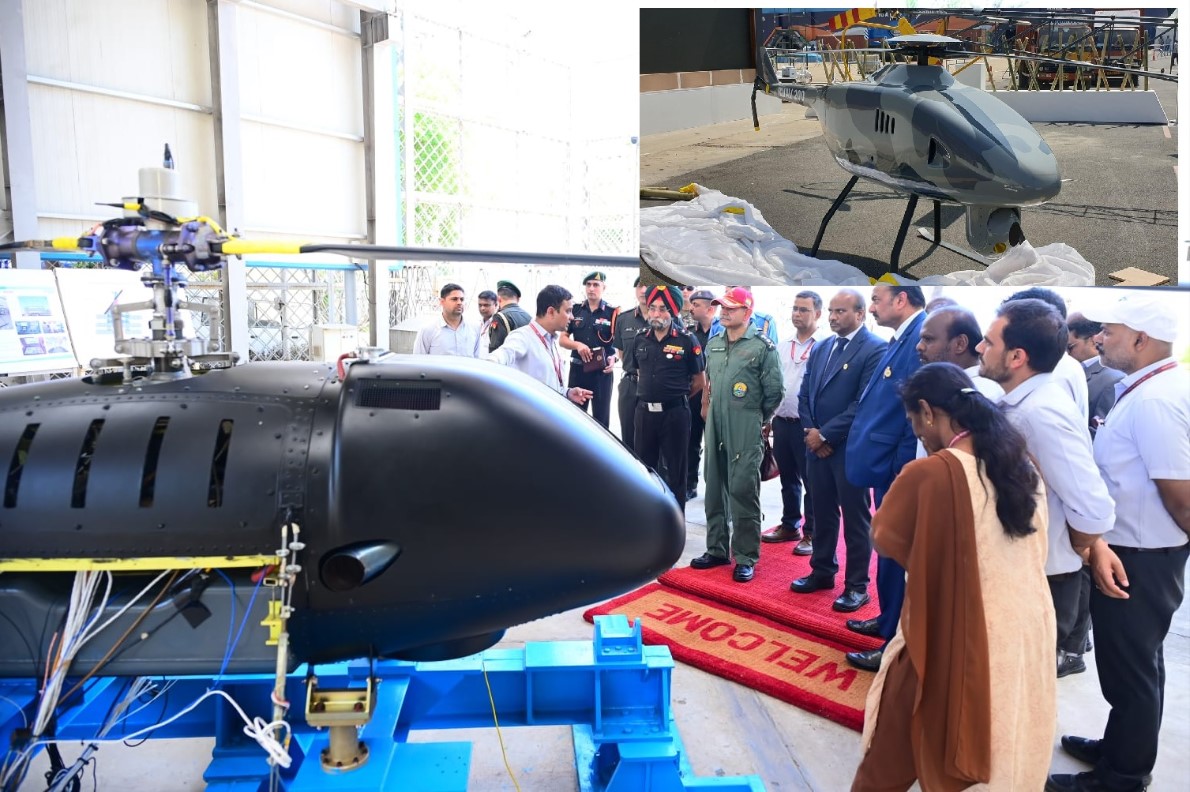
BENGALURU, — April 8, 2026 : General Upendra Dwivedi, Chief of the Army Staff, visited the rotary unmanned aerial vehicle (RUAV) hangar at Hindustan Aeronautics Limited (HAL) to review the development progress and operational potential of the RUAV-200 platform, an indigenous rotary-wing unmanned system designed for high-altitude missions.
The visit focused on a detailed assessment of the full-scale RUAV-200 prototype, including its design configuration, onboard systems, and mission capabilities. Senior officials from HAL briefed the Army Chief on the programme’s current status, highlighting its role in meeting operational requirements for both the Indian Army and Indian Navy, particularly in challenging and inaccessible terrains.
Development Background and Collaboration
The RUAV-200 is being developed through a collaborative effort involving HAL, the Defence Research and Development Organisation (DRDO), specifically its Aeronautical Development Establishment (ADE), and the Indian Institute of Technology Kanpur. The programme was first publicly demonstrated as a full-scale model during Aero India 2019, and has since progressed with a focus on autonomy, mission systems integration, and high-altitude performance.
Officials indicated that the platform is part of a broader national effort to expand indigenous unmanned aerial capabilities while reducing reliance on imported systems for critical defence roles.
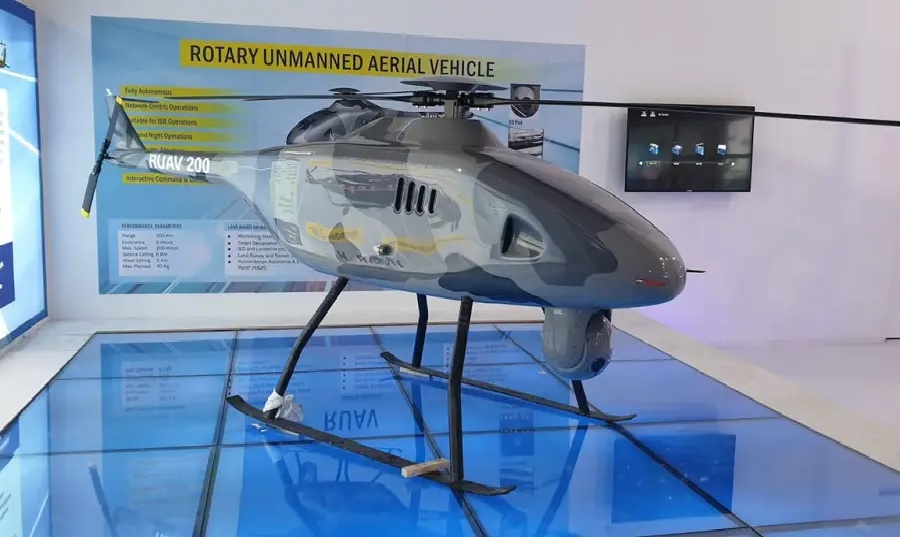
Design Configuration and Technical Specifications
The RUAV-200 is a rotary-wing unmanned helicopter with an approximate length of 4.2 metres. The current prototype incorporates a two-blade rotor configuration and is powered by a locally developed petrol aero-engine producing approximately 34 kW.
The platform is designed to operate across a wide environmental envelope, with an operating temperature range from -35°C to +55°C, enabling deployment in extreme conditions such as those found in high-altitude regions.
According to programme specifications presented during the visit, the RUAV-200 has the following performance characteristics:
-
All-up weight: 200 kg (250 kg at sea level)
-
Payload capacity: 30 kg (80 kg at sea level)
-
Endurance: 4.5 hours
-
Service ceiling: 6,000 metres
-
Maximum speed: 100 km/h
-
Data link range: 100 km
The system is equipped with an electro-optical and infrared payload, supporting day and night operations for intelligence, surveillance, and reconnaissance (ISR) missions.
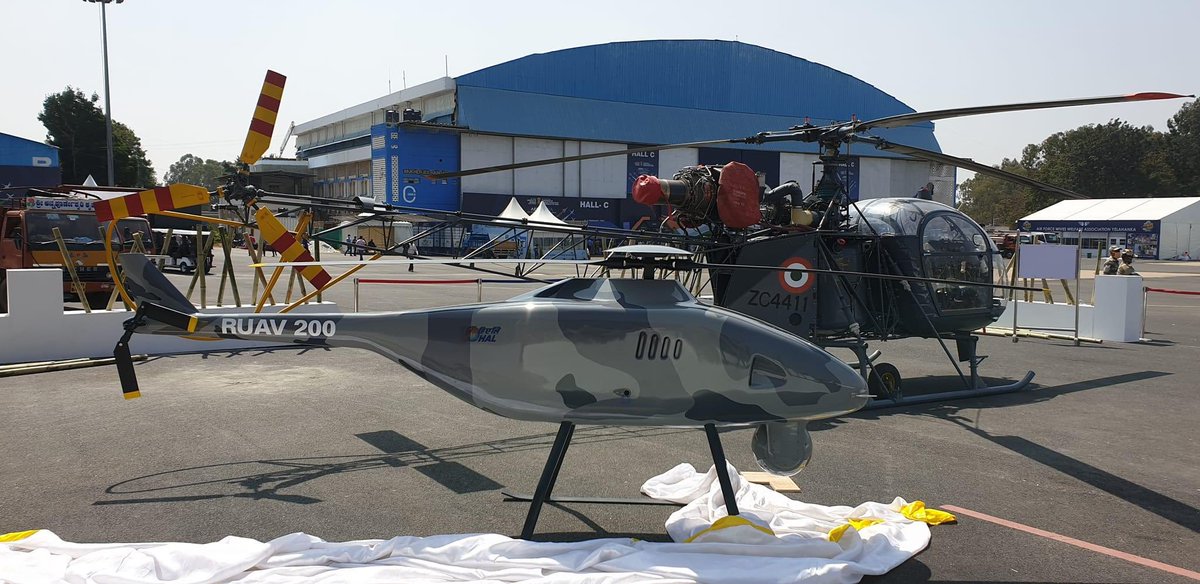
Autonomous Capabilities and Avionics
A key aspect of the RUAV-200 highlighted during the review was its autonomous operational capability. The platform is integrated with a Full Authority Digital Engine Control (FADEC) system and uses an SLR-DC datalink to maintain communication with its ground control station.
The UAV is designed for fully autonomous mission execution, including take-off, navigation through pre-programmed waypoints, landing, and return-to-home recovery. These features are intended to reduce operator workload while enabling sustained operations in contested or GPS-degraded environments.
Operational Role and Logistics Applications
In addition to ISR missions, the RUAV-200 is being developed to support logistics operations in high-altitude and remote areas. The platform is intended to function as a “mule drone”, capable of transporting essential supplies such as ammunition, medical equipment, and other critical materials to forward-deployed troops in regions such as Siachen and Ladakh.
Its modular and crashworthy design is aimed at ensuring operational reliability, ease of transport, and rapid deployment under field conditions.
Future Integration and Programme Outlook
HAL officials outlined that the RUAV-200 programme aligns with ongoing procurement initiatives by India’s Ministry of Defence to acquire high-altitude and medium-altitude logistics UAVs with a minimum of 50 percent indigenous content.
The development roadmap includes further enhancements in mission management systems and potential integration into network-centric warfare architectures. Future variants of the platform may also incorporate armed capabilities, including the ability to carry anti-tank and air-to-surface munitions.
General Dwivedi’s visit marks a formal review stage as the RUAV-200 approaches subsequent testing phases. No specific timelines for flight testing completion or induction into service were disclosed following the visit.
——— End of Article ———