NEW DELHI — March 24, 2026 : According to theprint , India and Japan are nearing the finalisation of co-production and co-development arrangements for the UNICORN mast system, in what is set to become the first major joint defence manufacturing project between the two countries under their technology transfer framework.
The development was outlined by Japanese Ambassador to India Ono Keiichi during remarks at the International Conference on India-Japan Cooperation in the Indo-Pacific, organised by the India Foundation in New Delhi. The envoy stated that bilateral security cooperation, particularly in the maritime domain, has matured significantly, and both countries are now focusing on enhancing interoperability across land, sea, air, and emerging technological domains.
Advancing a Flagship Defence Technology Project
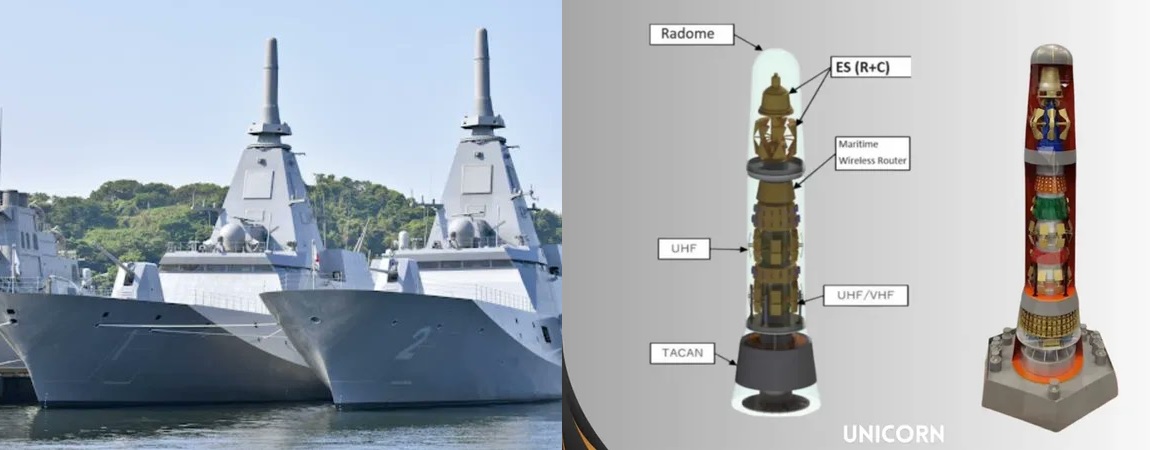
The UNICORN (Unified Complex Radio Antenna), also known as NORA-50, represents one of the most advanced integrated naval antenna systems currently in operational use. Developed by a Japanese industrial consortium led by NEC Corporation, alongside Sampa Kogyo K.K. and The Yokohama Rubber Co., Ltd., the system has been deployed on the Japan Maritime Self-Defense Force’s Mogami-class multirole frigates.
The system consolidates a wide range of communication and sensing functions—including radar-waveband omnidirectional detection, communication-waveband direction finding, Wi-Fi-band connectivity, Link 16 data links, UHF/VHF transmission and reception, Tactical Air Navigation (TACAN), and Identification Friend or Foe (IFF) response—into a single enclosed radome structure mounted on a unified mast.
This design replaces the conventional arrangement of multiple exposed antennas, resulting in measurable operational advantages.
Performance Gains in Stealth and Detection
The UNICORN mast’s enclosed architecture significantly reduces a vessel’s radar cross-section (RCS) by eliminating external antenna clutter and enclosing systems within a fibre-reinforced plastic radome designed for low observability. This reduction in electronic signature enhances survivability by making naval platforms more difficult to detect and track.
In addition, the internal configuration optimises antenna placement, reducing electromagnetic interference between systems. This improves bandwidth efficiency and enables secure, high-speed communications across multiple frequency ranges. It also enhances the maximum detection range for incoming radio-frequency signals, strengthening early warning capabilities against threats such as incoming missiles and unmanned systems.
The system incorporates features such as integrated lightning protection and weather-resistant construction, improving durability in maritime environments. Its modular design allows for entire mast units to be replaced as a single component, simplifying maintenance cycles and enabling damaged units to be serviced onshore without prolonged vessel downtime.
Integration into India’s Naval Capability
Under the planned agreement, Bharat Electronics Limited (BEL) will co-develop and co-produce the UNICORN mast in collaboration with Japanese partners. The system is expected to be integrated into Indian Navy platforms, replacing legacy solutions such as the Advanced Composite Communication System (ACCS).
The introduction of the UNICORN system is expected to provide Indian naval vessels with improved stealth characteristics, enhanced maritime domain awareness, and more robust communication capabilities. These upgrades are particularly relevant for operations in the Indo-Pacific, where electronic warfare and detection avoidance are increasingly critical.
Evolution of India-Japan Defence Ties
The UNICORN project builds on a defence relationship that has evolved steadily since the signing of the Agreement on Transfer of Defence Equipment and Technology (2015). Ambassador Ono noted that bilateral ties have expanded across four key pillars encompassing diplomatic, security, economic, and technological cooperation.
A Memorandum of Cooperation (MoC) for the UNICORN mast was signed in November 2024, making India the second Asian country after the Philippines to enter into such an arrangement with Japan. Discussions on technology transfer were further advanced during talks between External Affairs Minister S. Jaishankar and Japan’s then Foreign Minister Toshimitsu Motegi during a visit to New Delhi in January.
Economic Security and Industrial Cooperation
Beyond defence manufacturing, both countries are also increasing engagement in economic security. Ambassador Ono highlighted ongoing efforts to build resilience against supply chain disruptions and economic coercion. The first business-to-business (B2B) dialogue on economic security between Indian and Japanese stakeholders is scheduled to take place later this week.
Japan, under Prime Minister Sanae Takaichi, is accelerating its defence modernisation agenda. Tokyo is on track to raise defence spending to two percent of GDP by FY2026. The government is also expediting the revision of three key national security documents, aiming to complete the process one year ahead of schedule.
Regional Security Context
The deepening India-Japan partnership is unfolding against a backdrop of evolving security challenges in the Indo-Pacific. Ambassador Ono reiterated Japan’s concerns regarding regional stability, including the presence of a nuclear-armed North Korea and increasing strategic competition with China.
Japan has maintained its position against unilateral attempts to alter the regional status quo by force. Recent tensions between Tokyo and Beijing have intensified following remarks by Prime Minister Takaichi indicating that Japan’s Self-Defense Forces (SDF) could be mobilised in the event of a contingency involving Taiwan.
Although Japan, like India and many other countries, does not formally recognise Taiwan as an independent state, the comments prompted a series of responses from China. These included the deployment of naval assets, restrictions on rare earth exports, curbs on Chinese tourist travel, and the recall of two giant pandas previously loaned to Japan.
Expanding Strategic Alignment
Japan also reaffirmed its commitment to multilateral frameworks such as the Quad, viewing them as mechanisms to promote a free, open, and rules-based Indo-Pacific. Ambassador Ono stated that India and Japan are aligning both militarily and economically to address shared challenges, while strengthening interoperability and industrial cooperation.
The finalisation of the UNICORN mast co-production agreement is expected to mark a significant step in this broader trajectory, linking advanced defence technology collaboration with long-term strategic alignment between the two countries.
——— End of Article ———