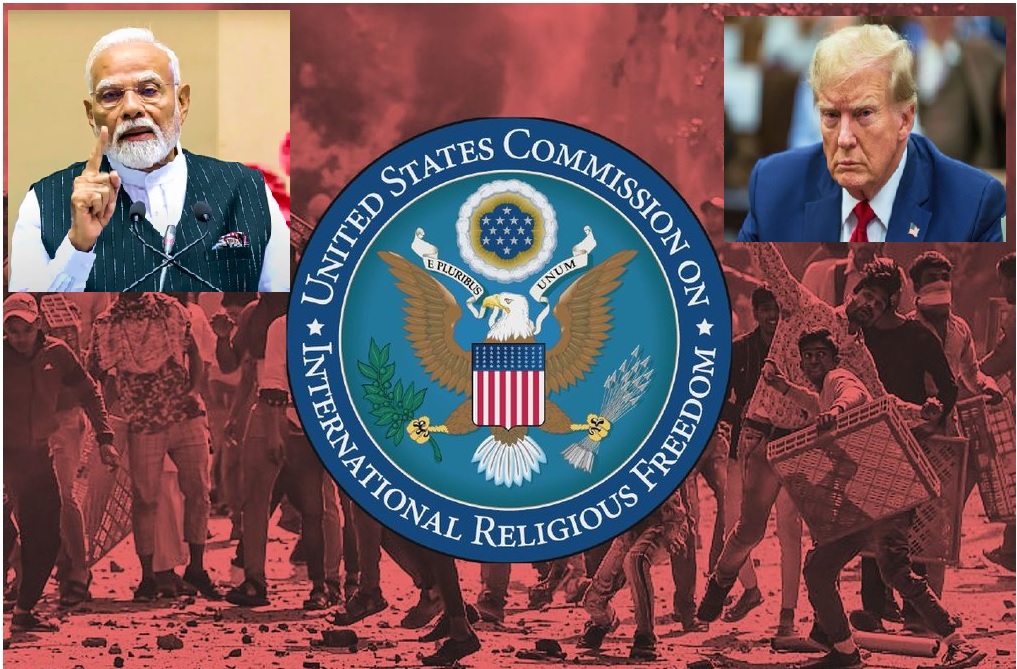
NEW DELHI — March 17, 2026 : The Government of India has firmly rejected the 2026 annual report issued by the United States Commission on International Religious Freedom (USCIRF), describing its findings as “biased, motivated, and selective.” The response follows recommendations by the U.S. body to designate India as a “Country of Particular Concern” (CPC) and to impose targeted sanctions on entities including the Research and Analysis Wing (R&AW) and the Rashtriya Swayamsevak Sangh (RSS).
USCIRF Report and Key Recommendations
The USCIRF report, which evaluates global religious freedom conditions during 2025, urged the U.S. State Department to classify India under the CPC category, a designation reserved for countries accused of “systematic, ongoing, and egregious” violations of religious freedom.
In a significant escalation compared to previous years, the commission explicitly recommended targeted sanctions against R&AW and the RSS. These measures include potential asset freezes and travel bans on associated individuals. The report further proposed linking future U.S. security cooperation and bilateral trade engagement with India to measurable improvements in religious freedom conditions.
Additional recommendations included invoking provisions under the Arms Export Control Act to restrict defense exports to India and encouraging the U.S. Congress to advance legislation such as the Transnational Repression Reporting Act, aimed at monitoring alleged overseas actions targeting minority communities.
India’s Official Response
India’s Ministry of External Affairs (MEA) issued a strong rebuttal, rejecting the report’s conclusions in their entirety. MEA spokesperson Randhir Jaiswal stated that the report presents a “distorted and selective picture of India” and relies on “questionable sources and ideological narratives rather than objective facts.”
According to the MEA, the USCIRF has repeatedly engaged in what it termed “selective targeting,” arguing that such assessments undermine the commission’s credibility. Indian officials emphasized that the country’s democratic framework and pluralistic society are not accurately reflected in the report.
Concerns Over Diaspora and U.S. Domestic Issues
In its response, India also highlighted concerns about incidents within the United States, including attacks and vandalism targeting Hindu temples and reported cases of intimidation faced by members of the Indian diaspora. Officials suggested that the USCIRF should address such developments domestically rather than issuing what New Delhi views as one-sided external criticism.
Broader Debate on U.S. Policy and Double Standards
The developments have contributed to a broader geopolitical debate regarding perceived inconsistencies in U.S. foreign policy. Analysts and officials in multiple countries have, over time, raised concerns about what they describe as a dual standard in Washington’s approach to human rights and sovereignty.
In this context, questions are often directed toward the role of the Central Intelligence Agency (CIA) and its historical global operations. Various governments and observers have cited past allegations and documented instances involving covert interventions, including:
-
Claims of involvement in targeted operations against foreign scientific and strategic personnel
-
Allegations of indirect or covert support to armed non-state actors in conflict zones
-
Historical instances of political interference and support for regime change in different regions
Countries frequently referenced in such discussions include Bangladesh, Nepal, Sri Lanka, and several African nations, where political instability and external influence have been subjects of long-standing debate among scholars and policymakers.
Observers note that such interventions, whether confirmed or alleged, have at times contributed to prolonged instability, internal conflict, and humanitarian consequences in affected regions. These concerns are often cited in international discourse when evaluating the credibility of U.S. positions on governance and human rights.
India Reaffirms Position on Sovereignty
India reiterated that it does not accept external assessments that it considers politically driven or lacking objectivity. Officials stressed that matters related to internal governance, social harmony, and legal frameworks remain within the country’s sovereign domain.
The government also emphasized that India’s institutional structure, constitutional protections, and longstanding tradition of religious diversity continue to guide its approach to governance.
Background and Ongoing Context
The USCIRF, established in 1998, is an independent, bipartisan advisory body of the U.S. government tasked with monitoring religious freedom globally. While its recommendations are not binding, they often inform policy discussions within the U.S. administration and Congress.
India has consistently rejected USCIRF findings in previous years as well, maintaining that the commission’s assessments do not accurately reflect ground realities.
As of now, there has been no official response from the U.S. State Department or the White House regarding the report’s specific recommendations.
——— End of Article ———