NEW DELHI — March 6, 2026 : India has signed a ₹2,182 crore (approximately $236 million) defence contract with Russia for the procurement of Shtil-1 naval air defence missiles and associated missile holding frames, the Ministry of Defence confirmed. The agreement was concluded on March 3, 2026 with Russia’s state arms export agency JSC Rosoboronexport.
According to the Ministry of Defence, the acquisition will strengthen the layered air defence capability of Indian Navy frontline warships by providing rapid-reaction, all-weather engagement capability against a wide range of aerial threats. The procurement forms part of a broader ₹5,083 crore defence acquisition package that also includes Advanced Light Helicopter (ALH) Mk-III maritime variants for the Indian Coast Guard.
Officials stated that the missile systems are intended to enhance survivability of naval platforms operating in contested maritime environments by improving their ability to counter aircraft, drones, and anti-ship missiles.
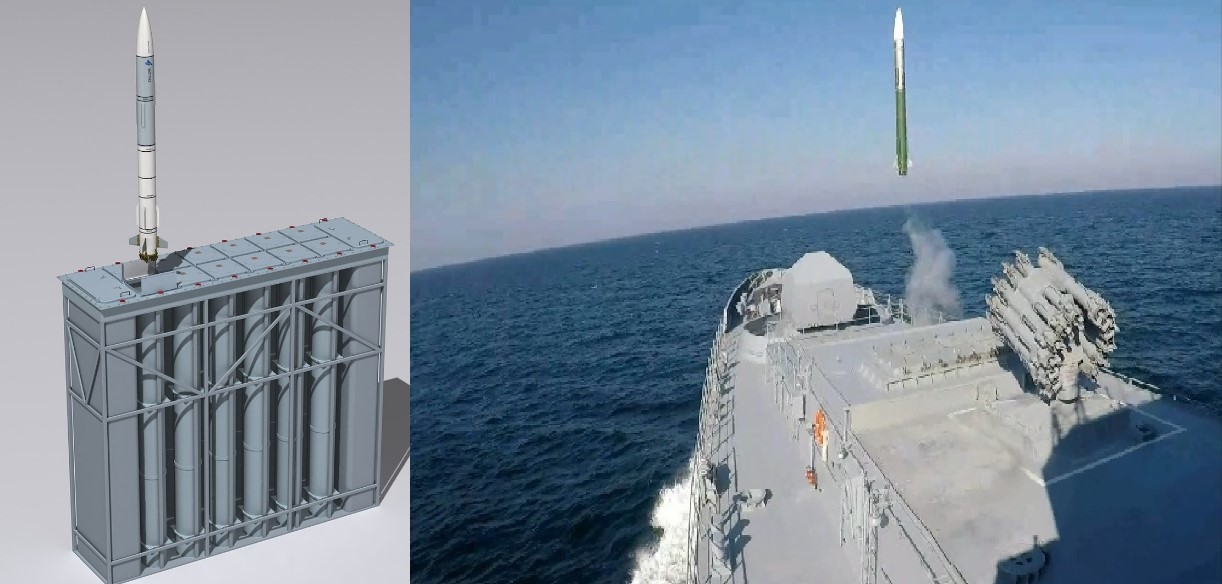
Shtil-1 Naval Air Defence System
The Shtil-1 is a naval area air defence missile system developed by Russian defence manufacturer Almaz-Antey. It is designed primarily for light warships and frigates and represents an evolution of the earlier Shtil and Uragan naval air defence systems.
Earlier variants used a single-arm rail launcher system that required mechanical rotation toward incoming targets. The Shtil-1 replaces this with a modular below-deck cellular Vertical Launch System (VLS). The vertical launch architecture allows missiles to be launched in any direction, providing full 360-degree coverage and eliminating the delay associated with rotating launchers.
The system is capable of launching interceptor missiles at intervals of approximately two to three seconds, enabling warships to respond rapidly to multiple incoming threats.
9M317ME Missile
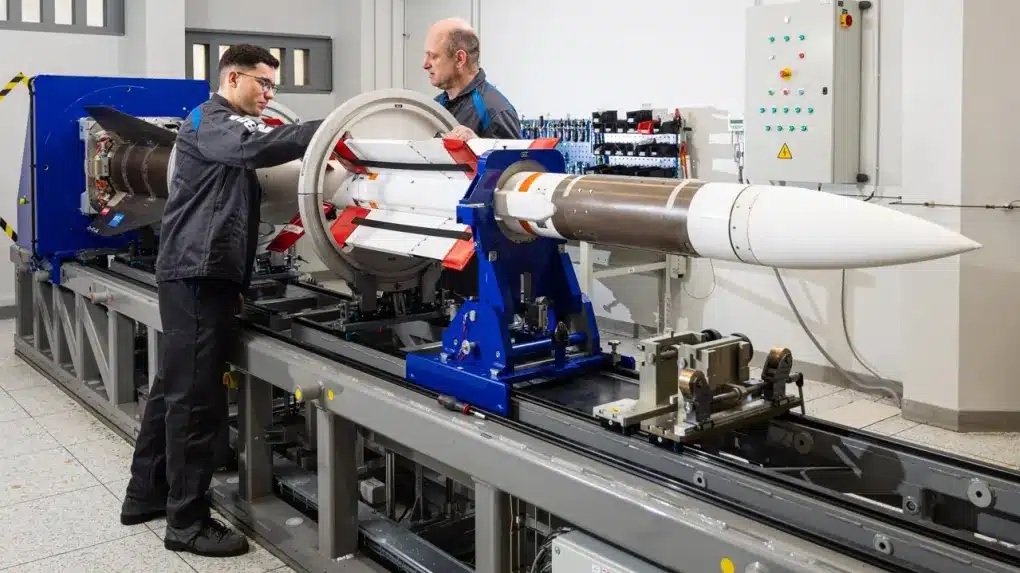
The Shtil-1 system employs the 9M317ME surface-to-air missile, a specialised naval adaptation of the interceptor used in Russia’s Buk-M2 land-based air defence system.
The missile is a single-stage solid-fuel interceptor equipped with folding aerodynamic fins so it can fit inside compact vertical launch canisters. During its mid-course flight phase, the missile relies on inertial navigation guidance before transitioning to terminal homing.
Operational parameters
- Range: approximately 3.5 km to 50 km
- Altitude engagement envelope: 5 metres to 15 km
- Target spectrum: aircraft, helicopters, unmanned aerial vehicles, and anti-ship missiles
- Maximum target speed: up to Mach 4.5
- Simultaneous engagements: up to 12 targets per system installation
The system is designed to counter saturation attacks and high-speed anti-ship missiles approaching at low altitude, including sea-skimming threats.
Semi-Active Radar Homing Guidance
The 9M317ME missile uses a semi-active radar homing (SARH) guidance method. In this configuration, the missile relies on radar illumination provided by the host ship’s fire-control radar throughout the terminal phase of engagement.
Indian Navy vessels operating the Shtil-1 system use dedicated fire-control radars such as the MR-90 Orekh radar to illuminate targets. The missile’s onboard seeker detects radar energy reflected from the target and guides itself toward the impact point.
Engineering considerations
The SARH guidance approach involves several technical trade-offs when compared with active radar homing (ARH) systems:
-
Cost and design efficiency: SARH seekers are simpler and cheaper to manufacture because they do not require an onboard radar transmitter, cooling systems, or large power units. Eliminating these components allows designers either to reduce the missile’s physical size or allocate additional internal space for fuel or a larger warhead.
-
Radar illumination power: In a SARH engagement, the ship provides high-power radar illumination. By contrast, ARH missiles rely on a small battery-powered transmitter within the missile itself, which produces weaker radar signals.
-
Electronic warfare resilience: Because the SARH seeker only receives reflected radar signals and does not transmit its own signal, it is generally harder to jam directly. To interfere with the engagement, an adversary would have to overcome the power of the ship’s fire-control radar.
Operational limitations
SARH systems require continuous radar illumination of the target until interception. This means the host warship must maintain line-of-sight tracking throughout the engagement. The requirement can complicate interception of sea-skimming missiles flying below the radar horizon.
In addition, radar reflection strength decreases with distance due to the inverse square law, which can reduce signal strength at longer ranges.
Integration with Indian Navy Warships
The Shtil-1 system is already installed on the Indian Navy’s Tushil-class frigates, derivatives of Russia’s Project 11356 design.
Several existing Indian Navy warship classes that currently operate earlier Shtil or Uragan launchers are undergoing modernization programs to integrate the vertical-launch Shtil-1 system.
Talwar-class frigates (Batch I and II)
The ships include:
- INS Talwar
- INS Trishul
- INS Tabar
- INS Teg
- INS Tarkash
- INS Trikand
These vessels were originally equipped with the 3S-90 single-arm launcher positioned forward of the bridge and carrying 24 missiles.
Delhi-class destroyers
The destroyers scheduled for upgrades include:
- INS Delhi
- INS Mysore
- INS Mumbai
These ships originally operated two 3S-90 launchers—one located forward and one aft—capable of firing earlier 9M38M1 missiles. Their mid-life refit programs include integration of the Shtil-1 system as well as upgrades to the Fregat-M2EM radar, improving detection and engagement capability against modern saturation attacks.
Shivalik-class stealth frigates
The Indian Navy’s three Shivalik-class stealth frigates are also undergoing or scheduled for Shtil-1 upgrades:
- INS Shivalik
- INS Satpura
- INS Sahyadri
These ships were originally equipped with the older single-arm launcher configuration.
Comparison with MR-SAM (Barak-8)
The Indian Navy currently operates two primary naval area air defence systems: the Russian-origin Shtil-1 and the Indo-Israeli MR-SAM (Barak-8).
The MR-SAM system uses an active radar homing (ARH) seeker and provides fire-and-forget capability. It is equipped with a dual-pulse rocket motor that improves manoeuvrability in the terminal phase and offers an operational range of approximately 70 kilometres.
In contrast, the Shtil-1 relies on SARH guidance and uses a single-stage, single-pulse solid-fuel motor. While its engagement range is shorter, the system is considered more cost-effective and suitable for smaller warships such as frigates.
Indian naval planners therefore use both systems as part of a layered air defence architecture, with MR-SAM typically deployed on high-value capital ships and Shtil-1 providing coverage for additional fleet platforms.
Broader Defence Procurement Package
The Shtil-1 acquisition forms part of a wider defence procurement package approved by the Government of India valued at approximately ₹5,083 crore.
In addition to the missile procurement, the package includes Advanced Light Helicopters Mk-III (Maritime Role) intended for service with the Indian Coast Guard. These helicopters will support maritime surveillance, search and rescue operations, and coastal security missions.
India–Russia Defence Cooperation
The contract reflects continuing defence cooperation between New Delhi and Moscow, which has historically included naval systems, combat aircraft, submarines, and missile technology.
High-level engagement between the two countries has continued in recent years. Russian President Vladimir Putin and Indian Prime Minister Narendra Modi held discussions on bilateral cooperation during the Shanghai Cooperation Organisation Summit 2025 in Tianjin on September 1, 2025.
Indian defence officials stated that the Shtil-1 procurement will support the modernization of the Indian Navy’s surface fleet air defence capabilities and strengthen protection of frontline warships against evolving aerial threats.
——— End of Article ———