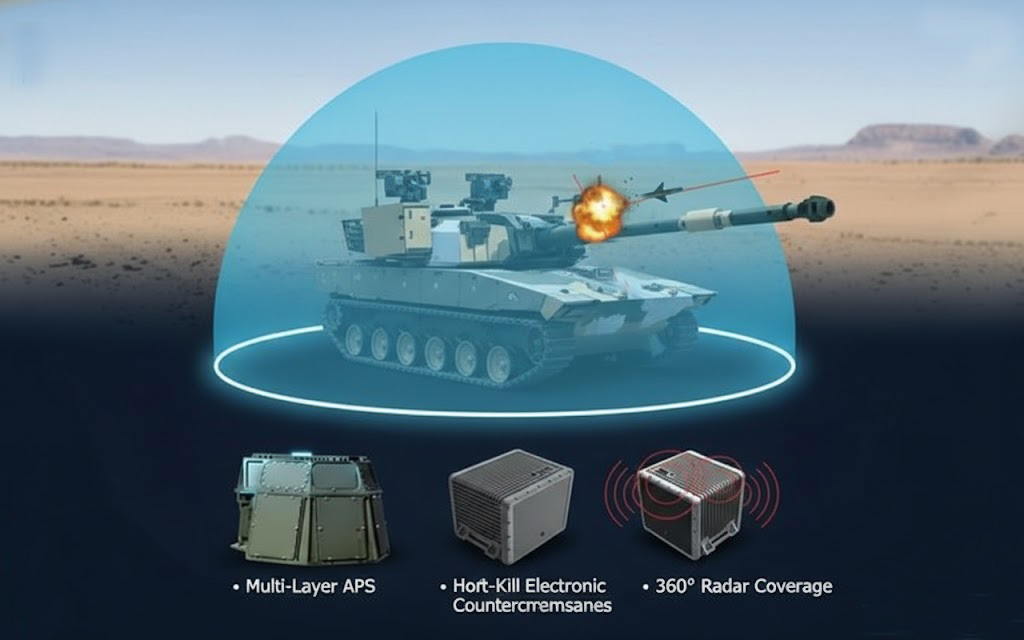
NEW DELHI : India’s forthcoming light tank Zorawar is set to incorporate a multi-layered Active Protection System (APS) as part of a broader effort to enhance survivability in high-altitude combat environments. The approach reflects a doctrinal shift away from passive armour toward active interception and electronic counter-measures against contemporary threats such as anti-tank guided missiles (ATGMs), loitering munitions, and armed drones.
Officials familiar with the programme say the APS architecture is being pursued in two phases, combining an off-the-shelf combat-proven solution for early induction with an indigenous system under development for later production lots.
Initial Induction with Trophy APS
The first batch of 59 Zorawar tanks planned for induction into the Indian Army will be equipped with the Trophy Active Protection System. Trophy is a hard-kill APS developed by Rafael Advanced Defense Systems and has been operationally deployed on multiple armoured platforms.
The system employs a radar-based detection suite that continuously scans the vehicle’s surroundings to identify incoming threats. Once a hostile projectile is classified, Trophy launches a kinetic countermeasure to intercept and neutralise the threat at a safe stand-off distance. The configuration provides near-spherical coverage, including protection against top-attack munitions, a vulnerability highlighted in recent armoured warfare.
By integrating Trophy from the outset, the Army aims to ensure that the first operational Zorawar units enter service with established protection against RPGs, ATGMs, and selected loitering munitions, without waiting for indigenous solutions to mature.
Indigenous APS Development for Follow-On Batches
In parallel, India is developing a domestic APS intended for subsequent Zorawar production runs. The programme is being led by the Defence Research and Development Organisation and involves several specialised laboratories.
The Laser Science and Technology Centre is responsible for sensor development and laser-based counter-measures, while the Terminal Ballistics Research Laboratory focuses on interception physics and warhead effectiveness. Platform integration, including interfaces with the fire-control system and onboard electronics, is being handled by the Combat Vehicles Research and Development Establishment.
Officials indicate that the indigenous APS will be a hybrid system, combining soft-kill and hard-kill elements. Soft-kill measures are designed to disrupt or deceive missile guidance through electronic warfare, while hard-kill components physically intercept incoming threats. This dual-layer approach is intended to counter drone swarms and loitering-munition attacks, assessed as increasingly relevant in mountainous terrain.
Design Role and Operational Context
Zorawar is a 25-tonne-class light tank designed specifically for high-altitude operations in regions such as Ladakh and the eastern Himalayan sector. The platform addresses the mobility and deployment limitations faced by heavier main battle tanks (MBTs) in steep, oxygen-depleted environments.
The tank emphasises a high power-to-weight ratio, a reduced logistical footprint, and the ability to operate across narrow roads, bridges, and soft ground. It is also amphibious, enabling limited water-crossing operations without extensive engineering support.
Armament and Systems Integration
Zorawar is armed with a 105 mm rifled main gun, capable of firing gun-launched ATGMs for extended engagement ranges. The platform supports integration with unmanned systems, including tethered drones for over-the-horizon surveillance, and incorporates digital fire-control systems and decision-support tools to assist crew members in target acquisition and engagement.
Trials and Induction Timeline
User evaluation trials for Zorawar are expected to begin in 2026, following the completion of development and initial system integration. The trials will assess mobility, firepower, protection, and endurance under high-altitude conditions.
If the trials proceed as planned, limited induction of the Trophy-equipped batch is expected to follow, with later production lots incorporating the indigenous APS once development and validation are complete. The phased induction strategy is intended to balance near-term operational readiness with long-term self-reliance in critical protection technologies.
With the integration of active protection systems, the Zorawar programme aims to ensure that a lighter armoured platform maintains survivability standards comparable to heavier tanks while remaining optimised for India’s mountainous theatres of operation.
——— End of Article ———