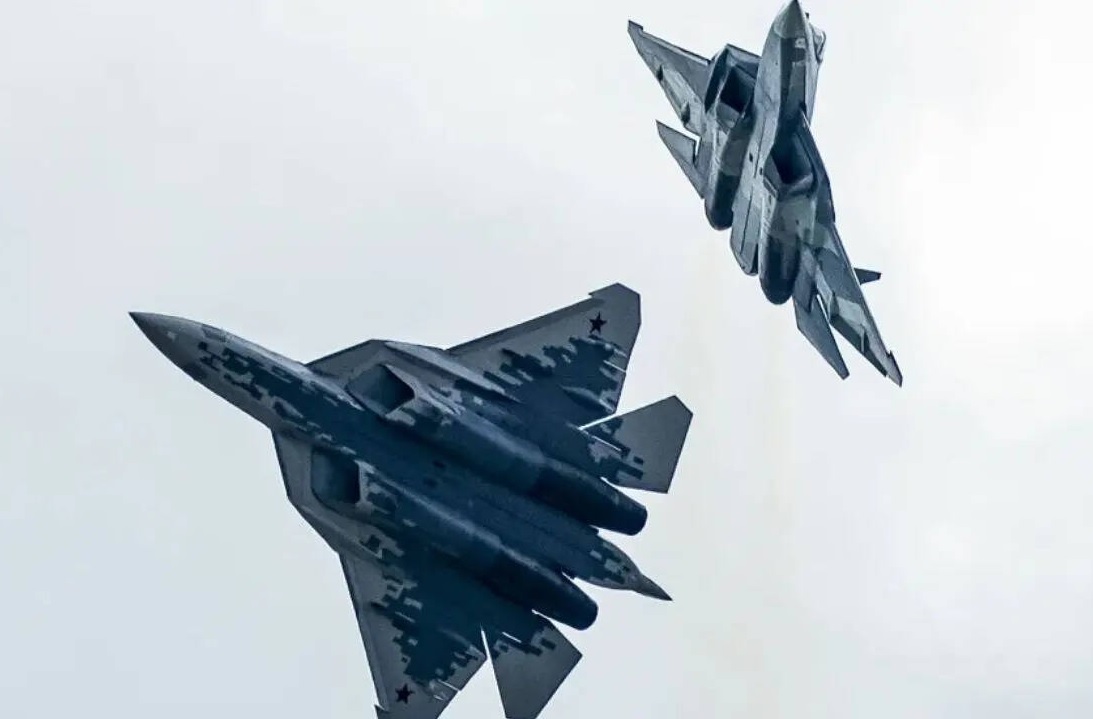
NEW DELHI, February 23, 2026 : India is preparing to formalise the procurement of a fifth-generation stealth fighter aircraft, with Russia’s Sukhoi Su-57 identified as the primary option to meet the Indian Air Force (IAF) interim operational requirements. The move follows the recent clearance of an expanded Dassault Rafale acquisition from France and is intended to bridge the capability gap until the indigenous Advanced Medium Combat Aircraft (AMCA) enters service in the mid-2030s.
The Ministry of Defence (MoD) and the IAF have held discussions on the immediate requirement for a fifth-generation platform amid evolving regional security dynamics. China currently operates the Chengdu J-20 and Shenyang J-35 fifth-generation fighters and has offered the J-35 to Pakistan. Beijing announced the offer as its first major measure of support to Islamabad following the India–Pakistan conflict in May 2025.
Interim Capability Before AMCA Induction
The Su-57 is being evaluated as a stopgap arrangement pending the induction of the AMCA, India’s indigenous fifth-generation fighter programme led by the Aeronautical Development Agency (ADA) and Hindustan Aeronautics Limited (HAL). The AMCA programme targets prototype rollout between late 2026 and 2028, first flight between 2028 and 2029, and service induction around 2034–2035.
Defence sources indicated that no formal negotiations with Russia have commenced. Discussions are expected to begin only after IAF technical teams complete a detailed operational and technical evaluation of the Russian offer.
The Su-57 conducted a flying demonstration at Aero India 2025 in Bengaluru in February 2025, following which Russia extended a formal offer for the aircraft.
Production and Industrial Participation
A Russian delegation recently visited the Hindustan Aeronautics Limited facility in Nashik to assess existing infrastructure. The Nashik plant currently manufactures the Sukhoi Su-30MKI under licence production. Officials indicated that the production line could be adapted for licensed manufacturing of the Su-57 with significant Indian industry participation, including co-production and technology transfer arrangements.
Russia has reportedly offered full source code access and customisation options for an Indian variant of the Su-57. Such an arrangement would enable integration of Indian-origin systems and weapons and ensure supply chain security.
Maintenance commonality with the Su-30MKI fleet is considered a key operational advantage. The IAF’s Su-30MKI aircraft have already integrated the BrahMos supersonic cruise missile, a configuration employed during Operation Sindoor. The ability to integrate indigenous weapons is viewed as an important requirement in the evaluation process.
US F-35 Not Under Consideration
The United States’ Lockheed Martin F-35 Lightning II is not under consideration. Defence sources cited concerns over potential operational restrictions, including limitations on integrating Indian weapons such as BrahMos, requirements for US monitoring of sorties, and the possible presence of US engineers at Indian airbases for maintenance oversight.
Officials referenced the existing arrangement between the United States and Pakistan regarding the General Dynamics F-16 Fighting Falcon, under which sortie monitoring and maintenance protocols involve US oversight. Such constraints are viewed as incompatible with India’s operational autonomy requirements.
In February 2025, during a joint press conference in Washington DC with Prime Minister Narendra Modi, then US President Donald Trump stated that the United States was prepared to expand defence sales to India and was paving the way to eventually provide F-35 stealth fighters. However, current assessments indicate that the platform is not being pursued.
Historical Background: FGFA Programme
India and Russia previously collaborated on a fifth-generation fighter initiative under the Fifth Generation Fighter Aircraft (FGFA) programme. In 2007, the two countries signed an agreement for joint development, with an initial financial commitment of $6 billion. India withdrew from the project in 2018, citing concerns related to cost, work-share distribution, and capability parameters.
Fifth-Generation Fighter Characteristics
A fifth-generation fighter aircraft is characterised by low-observable stealth technology, advanced onboard sensors, sensor fusion, high levels of software integration, and internal weapons bays designed to reduce radar signature. These features provide decision superiority and cannot be retrofitted into earlier-generation platforms.
The generational classification of fighter aircraft is broadly defined as follows:
- First-generation subsonic jets (mid-1940s to mid-1950s);
- Second-generation (mid-1950s to early 1960s);
- Third-generation (early 1960s to 1970);
- Fourth-generation (1970 to late 1980s);
- Four-and-a-half generation (subsequent advanced upgrades);
- Fifth-generation, which began with the induction of the Lockheed Martin F-22 Raptor in 2005.
The Su-57 is a twin-engine, single-seat multirole fighter equipped with supercruise capability, advanced avionics, and internal weapons bays. Russia’s proposal includes provisions for technology transfer and industrial cooperation at the Nashik facility.
The proposed procurement forms part of the Indian Air Force’s broader modernisation plan aimed at maintaining operational balance in the region while the AMCA programme progresses toward indigenous fifth-generation capability.
——— End of Article ———