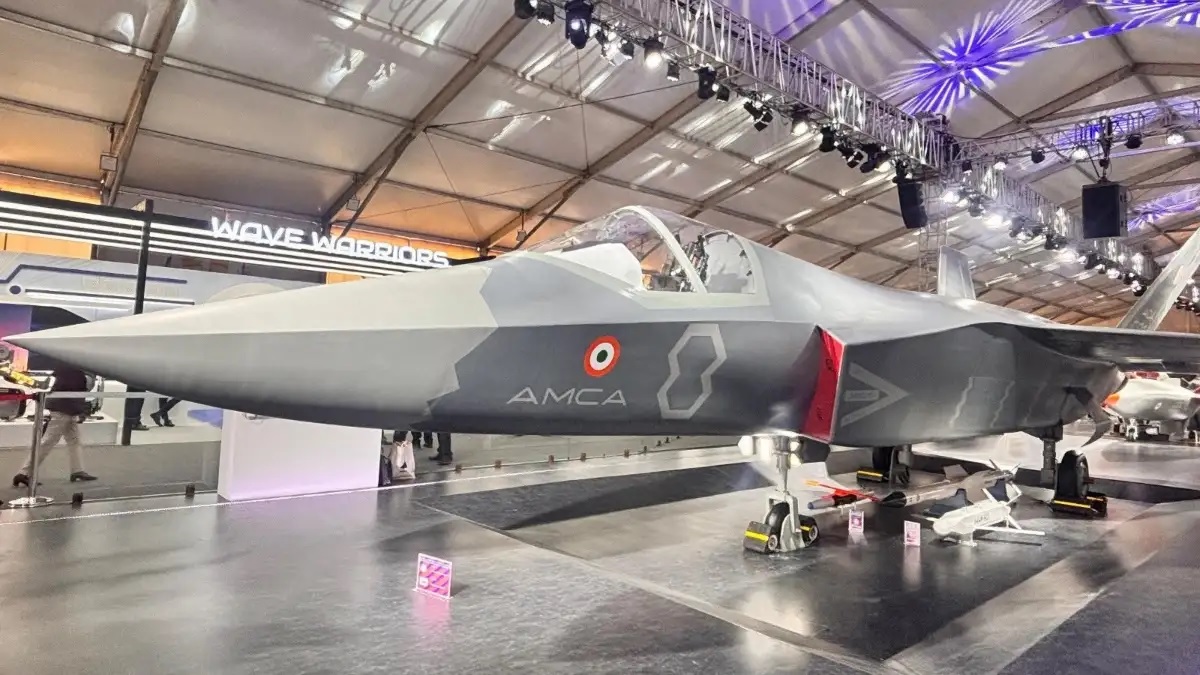
NEW DELHI — May 27, 2026 : India’s Ministry of Defence has issued a Request for Proposal (RFP) for the prototype development phase of the indigenous fifth-generation Advanced Medium Combat Aircraft (AMCA) programme, marking a significant step in the country’s effort to establish an advanced domestic combat aircraft manufacturing ecosystem.
The RFP, administered through the Defence Research and Development Organisation (DRDO)’s Aeronautical Development Agency (ADA), has been issued to three shortlisted private-sector-led bidders following technical and commercial evaluations completed earlier in 2026. Defence officials confirmed the development on May 27, 2026, according to reports by ANI.
The shortlisted contenders include Tata Advanced Systems, bidding independently; a consortium led by Larsen & Toubro (L&T) in partnership with Bharat Electronics Limited (BEL) and Dynamatic Technologies; and a Bharat Forge-led consortium that includes BEML and Data Patterns. These firms emerged after an assessment process involving seven original competitors.
The RFP covers the development and manufacture of five flying AMCA prototypes, one structural test specimen, and the supporting testing ecosystem required for full-scale engineering development. The selected industry partner will work in collaboration with the ADA, which remains the nodal agency responsible for programme design, technical oversight and execution under DRDO.
The prototype and engineering development phase is valued at approximately ₹15,000 crore and received approval from the Cabinet Committee on Security in 2024. Under the execution model approved by Defence Minister Rajnath Singh in May 2025, both public and private sector entities were allowed to compete on equal terms for participation in the programme.
The three shortlisted entities are expected to submit detailed techno-commercial proposals within approximately two months. Following technical and financial evaluation, the government is expected to select the lowest qualifying bidder (L1), with contract negotiations projected to conclude by early 2027. Under the current execution framework, the selected consortium will be required to establish a dedicated special purpose company exclusively for the AMCA programme within three months of selection.
A notable aspect of the process is the exclusion of state-run Hindustan Aeronautics Limited (HAL), which was not shortlisted for the production partner role. Defence officials indicated that concerns regarding HAL’s manufacturing bandwidth contributed to the decision, as the company is currently engaged in major programmes including Tejas Mk-1A production, Su-30MKI upgrades, Light Combat Helicopter manufacturing and the Indian Multi Role Helicopter (IMRH) project.
The AMCA is planned as a 25-tonne, twin-engine, multirole fifth-generation stealth fighter intended for the Indian Air Force’s future combat fleet. The aircraft is designed to incorporate low observable shaping, radar-absorbent materials, internal weapons bays, advanced sensor fusion, artificial intelligence-enabled decision support systems, network-centric warfare capability and an Active Electronically Scanned Array (AESA) radar. The platform is also expected to feature supercruise capability and a combat radius of around 1,000 kilometres.
Under current plans, initial prototypes and early production variants will be powered by American GE-F414 engines. Future versions are expected to transition to a customised 120-kN-class powerplant being explored through international cooperation, including discussions with France’s Safran.
To support prototype development and flight testing, dedicated infrastructure is also being developed. On May 15, 2026, Defence Minister Rajnath Singh and Andhra Pradesh Chief Minister N. Chandrababu Naidu laid the foundation stone for the ADA’s Core Integration & Flight Testing Centre in Puttaparthi, Sri Sathya Sai district. The facility, being built at an estimated cost of around ₹2,000 crore, is expected to support prototype integration, testing and future programme requirements.
Programme officials currently target the first prototype rollout in the 2028–29 timeframe, followed by extensive stealth validation, engine integration and weapons testing. Full-scale serial production and induction into Indian Air Force service are projected around the mid-2030s, with current planning aimed at operational induction by approximately 2035.
——— End of Article ———