NEW DELHI — April 20, 2026 : India has initiated negotiations for Phase 3 of the K9 Vajra self-propelled howitzer programme, with the Ministry of External Affairs (MEA) and the Ministry of Defence (MoD) confirming plans to procure an additional 100 to 200 units. The expansion is intended to strengthen the Indian Army’s heavy artillery capabilities along the Line of Actual Control (LAC) and the western borders, while advancing domestic manufacturing under the Aatmanirbhar Bharat initiative.
The proposed phase places a strong emphasis on increasing indigenous content. Earlier batches of the programme achieved approximately 50 percent localisation, while some systems have reportedly crossed 60 percent and, in certain cases, reached up to 82 percent. Phase 3 negotiations are focused on establishing a consistent domestic content level of 60 to 70 percent, with particular attention on local production of engines, advanced sensors, and electronic warfare subsystems that were previously imported.
Programme Background and Current Status
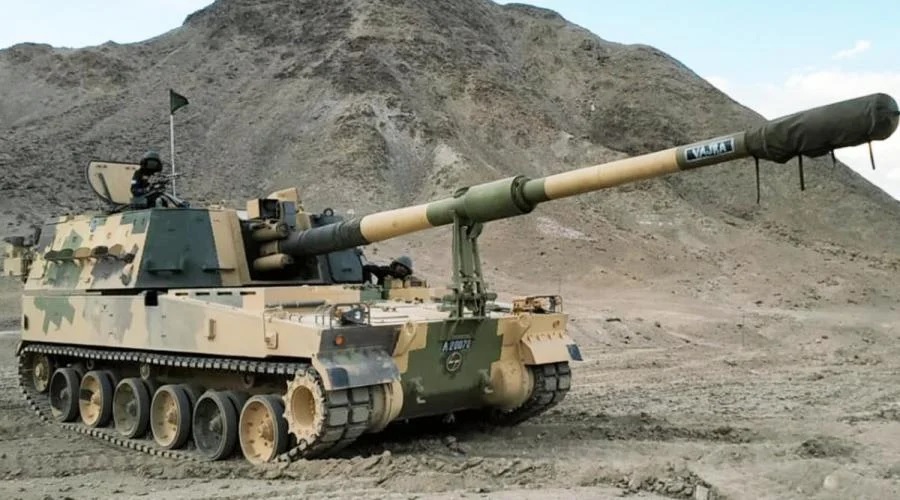
The K9 Vajra-T is the Indian variant of the South Korean K9 Thunder 155 mm/52-calibre tracked self-propelled howitzer. It is manufactured by Larsen & Toubro (L&T) at its Armoured Systems Complex in Hazira, Gujarat, under licence from Hanwha Aerospace. The system is designed for high mobility and automated fire control, and it has demonstrated operational capability in both desert and high-altitude environments, including deployments in Ladakh.
The howitzer carries 48 rounds and supports multiple firing modes, including burst firing of three rounds in 30 seconds, intense firing of 15 rounds in three minutes, and sustained firing of up to 60 rounds per hour.
The programme has progressed through two earlier phases. The initial contract, signed in 2017, covered 100 units, with the first 10 supplied from South Korea and the remaining 90 assembled in India. A second order for 100 units was approved by the Cabinet Committee on Security in December 2024 and contracted in early 2025. A follow-up component supply agreement valued at approximately $253 million was finalised between L&T and Hanwha Aerospace to support production. Deliveries from this second batch are expected to begin by late 2025, bringing the total fleet to 200 units upon completion.
Expanded Role and System Enhancements
While originally designed for indirect fire support, the K9 Vajra platform is undergoing capability upgrades in response to evolving battlefield requirements. The Phase 3 configuration is expected to introduce a multi-role profile combining artillery operations with enhanced survivability against aerial threats.
One of the key upgrades involves the integration of anti-drone electronic warfare systems under the D4 (Drone Detect, Deter and Destroy) framework. These systems include directional jammers and a 360-degree electronic protection suite designed to reduce vulnerability to reconnaissance drones and loitering munitions.
In addition, new units are expected to incorporate automated Remote Weapon Stations (RWS) to replace manual machine guns. These systems use thermal and electro-optical sensors and are capable of engaging aerial threats using programmable airburst ammunition.
The upgraded fleet will also be integrated with Project Akashteer, an artificial intelligence-driven air defence command-and-control network developed by Bharat Electronics Limited (BEL). This integration enables real-time data sharing with external sensors, including radars and satellites, allowing faster detection and response to aerial threats.
India–South Korea Defence Cooperation
Phase 3 discussions are being conducted in coordination with South Korean defence company Hanwha Aerospace, which has been a long-standing partner in the K9 programme. The MEA has indicated that additional artillery systems are under consideration as part of ongoing modernisation efforts.
Industry assessments suggest that discussions may also include short-range air defence technologies. Among the systems referenced is the K30 Biho (Flying Tiger), a South Korean self-propelled anti-aircraft platform equipped with twin 30 mm cannons and surface-to-air missile capability. There is ongoing analysis within defence circles regarding the feasibility of integrating similar air defence turrets onto the K9 tracked chassis, streamlining maintenance and logistics across mechanised formations. No procurement decision on this system has been confirmed.
Production and Industrial Impact
Production of Phase 3 units will continue at L&T’s Hazira facility, which has served as the primary manufacturing hub for the programme. The increased localisation of key components, particularly engines and sensors, is expected to reduce dependence on foreign supply chains and improve lifecycle support within India.
The push for higher indigenisation aligns with broader national objectives to strengthen domestic defence manufacturing capacity. By expanding local production and technology transfer, the programme supports operational readiness while enabling adaptation of systems to specific Indian requirements, including high-altitude deployment conditions along the LAC.
Strategic Significance
The expansion of the K9 Vajra fleet reflects the Indian Army’s ongoing artillery modernisation programme and the need to address emerging threats, particularly from unmanned systems observed in recent conflicts. The integration of electronic warfare and air defence features into a traditionally artillery-focused platform indicates a shift towards multi-role survivability in contested environments.
Negotiations for Phase 3 are ongoing, and no formal timeline for contract finalisation has been announced. However, the continuation of deliveries from earlier phases and the establishment of supply chain agreements indicate a steady progression toward expanded deployment in the coming years.
——— End of Article ———