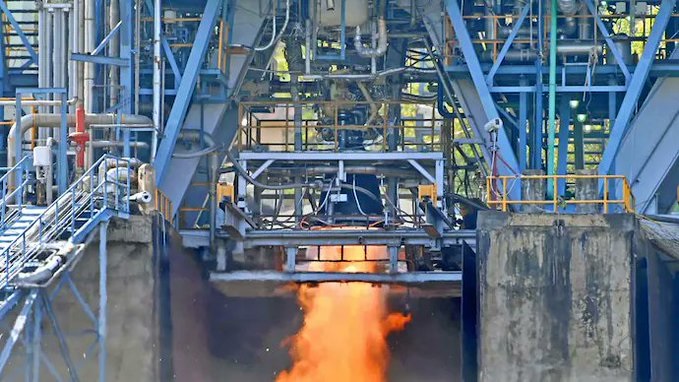
MAHENDRAGIRI, Tamil Nadu — March 12, 2026 : The Indian Space Research Organisation (ISRO) has successfully conducted a sea-level ground hot test of its CE-20 cryogenic engine at an uprated thrust level of 22 tonnes, marking a key milestone in the effort to enhance the payload capability of India’s heavy-lift launch vehicle, the Launch Vehicle Mark‑3 (LVM3).
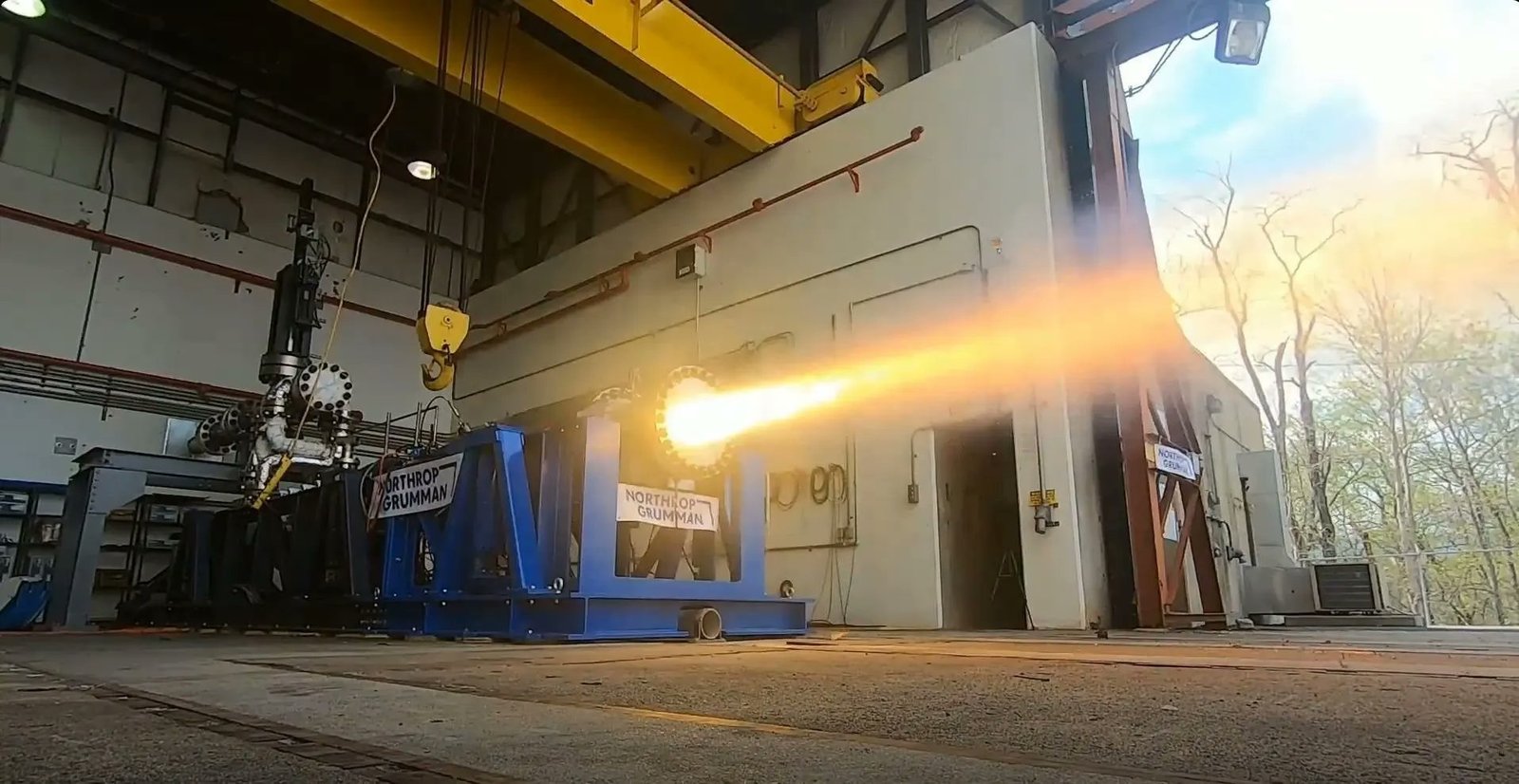
The test was carried out on March 10, 2026, at the ISRO Propulsion Complex (IPRC) in Mahendragiri, Tamil Nadu, and lasted 165 seconds. The engine operated with a Nozzle Protection System (NPS) and a multi-element igniter, allowing engineers to validate performance parameters required for future flight operations at the higher thrust level.
Engine Role and Technical Characteristics
The CE-20 is an indigenously developed cryogenic upper-stage engine designed by Liquid Propulsion Systems Centre, a major propulsion development center of ISRO. The engine powers the cryogenic upper stage of the LVM3 launch vehicle and operates using a gas-generator cycle with liquid oxygen (LOX) and liquid hydrogen (LH2) as propellants.
In its baseline configuration, the CE-20 produces a vacuum thrust of approximately 186.36 kilonewtons, equivalent to about 19 tonnes, and delivers a specific impulse of about 442 seconds. In the uprated configuration tested during the recent campaign, the engine reaches approximately 216 kilonewtons of thrust, corresponding to 22 tonnes.
The propulsion system consists of several major subsystems, including a thrust chamber, gas generator, LOX and LH2 turbopumps, ignition systems, mixture-ratio control mechanisms, thrust control systems, start-up systems, control components, and pyro valves.
Supporting the C32 Cryogenic Upper Stage
The thrust upgrade is associated with the development of the C32 cryogenic upper stage, a reconfigured version of the existing C25 stage currently used on LVM3 missions. The C32 stage is designed to carry increased propellant loading, enabling the launch vehicle to carry heavier payloads and support more demanding missions.
Operating the CE-20 engine at 22 tonnes of thrust is a key requirement for the C32 stage. The increased thrust allows the launch vehicle to place larger satellites into orbit and supports future missions involving heavier payloads and deep-space exploration objectives.
As part of this transition, flight acceptance testing of CE-20 engines must now be conducted at the higher 22-tonne thrust benchmark.
Previous Qualification and Test Campaign
Before the current upgrade effort, the CE-20 engine was qualified at a nominal thrust level of 19 tonnes, which supported six operational LVM3 missions. The engine was later qualified for 20-tonne thrust operation to support the Gaganyaan human spaceflight programme.
The latest qualification programme for the 22-tonne configuration involved a sequence of ground tests conducted on the E13 engine hardware. These included:
-
An engine tuning hot test lasting 50 seconds
-
A long-duration hot test of 720 seconds
-
A flight-duration test of 670 seconds at full 22-tonne thrust
The recently completed 165-second sea-level hot test represents the final stage of the ground qualification campaign required for flight use at the upgraded thrust level.
Sea-Level Testing Challenges and Engineering Measures
Testing a cryogenic engine designed for high-altitude or vacuum conditions at sea level introduces significant engineering challenges.
The CE-20 engine uses a high area-ratio nozzle optimized for operation in near-vacuum environments, where the exhaust exit pressure is around 50 millibar. When fired at sea level, the higher atmospheric pressure can cause flow separation within the nozzle, potentially generating severe vibrations, thermal loads, and mechanical stress.
To mitigate these risks, ISRO engineers integrated a Nozzle Protection System (NPS) into the test configuration. The system allows the engine to maintain stable flow conditions and protects the nozzle structure during sea-level operation. During the recent test, the engine functioned normally throughout the full 165-second duration, with all parameters remaining within expected limits.
Durability of Test Hardware
The CE-20 engine unit used in the current campaign has undergone 20 successful hot tests, representing the highest number of firings for a single engine hardware set in the programme. Using the same engine for multiple trials enabled engineers to validate several technologies and operational features.
These tests supported the evaluation of multi-element ignition systems, ignition margin demonstrations required for the Gaganyaan programme across a wide range of propellant tank pressures and pre-ignition chamber conditions, and bootstrap-mode engine start capability, which allows in-flight restart without an external auxiliary start system.
Additional work during the campaign also included the qualification of indigenous turbopump bearings and sensor systems, contributing to improved reliability and greater domestic content in the propulsion system.
Readiness for Future LVM3 Missions
With the completion of the latest ground hot test, ISRO has confirmed that the CE-20 engine is qualified for single-start operation across a thrust range from 19 to 22 tonnes. The qualification process has included vacuum ignition trials, sea-level hot tests, and bootstrap-mode start demonstrations under simulated high-altitude conditions.
The successful test enables integration of the uprated CE-20 engine into the C32 cryogenic stage planned for future missions of the Launch Vehicle Mark-3, India’s heaviest operational launch vehicle. The CE-20 remains the only indigenous cryogenic upper-stage engine currently used in the LVM3 configuration, supporting India’s independent capability for heavy-lift space launch missions.
——— End of Article ———