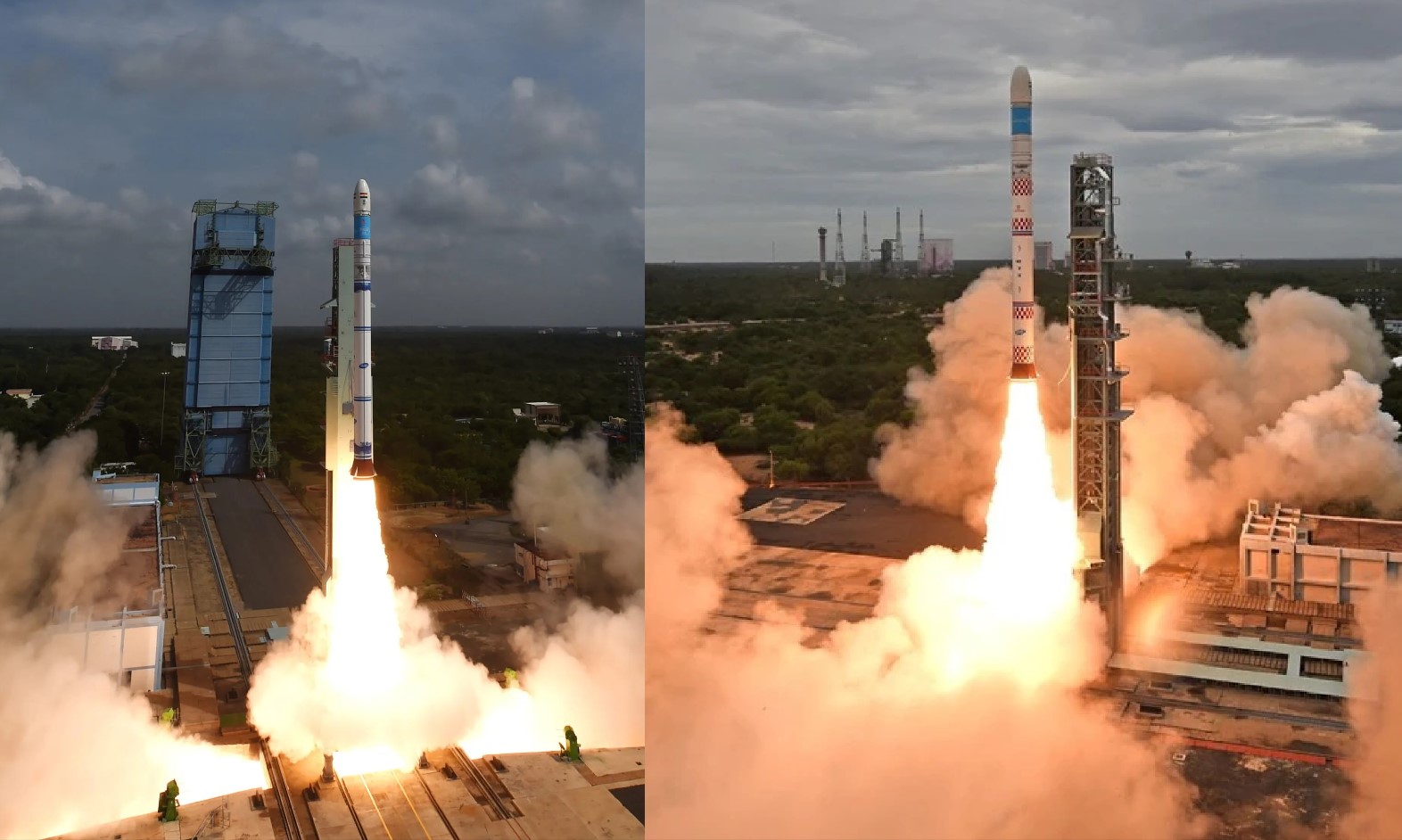
Sriharikota/Bengaluru: The Indian Space Research Organisation (ISRO) has successfully conducted a static ground test of an improved version of the third stage (SS3) of its Small Satellite Launch Vehicle (SSLV), marking a significant upgrade to India’s dedicated small-satellite launch system. The test was carried out at the Satish Dhawan Space Centre, validating critical design changes aimed at increasing payload capability and operational robustness.
The static firing of the upgraded SS3 lasted 108 seconds, during which all key performance parameters—including chamber pressure, thrust profile and structural behaviour—closely matched pre-test predictions. ISRO officials said the results confirm that the redesigned stage meets qualification requirements for induction into future SSLV missions.
Lighter Stage, Higher Payload
The most notable improvement in the new SS3 is the introduction of a carbon-epoxy composite motor case, replacing heavier metallic structures used earlier. This reduction in inert mass directly enhances vehicle performance. According to ISRO, the upgraded third stage enables an additional 90 kg of payload capability for SSLV, a substantial gain in the small-launch segment where every kilogram counts.
SS3 is the uppermost solid propulsion stage of SSLV and plays a decisive role in delivering the final velocity required for orbital insertion. In its standard configuration, the stage uses HTPB-based solid propellant, delivers a maximum vacuum thrust of about 160 kN, burns for approximately 107 seconds, and contributes nearly 4 km/s of velocity to the launch vehicle. The improved version retains these core characteristics while benefiting from reduced structural mass and refined subsystems.
Design Refinements And Reliability Focus
Beyond the composite motor case, ISRO has incorporated improvements in the igniter system, nozzle configuration, and control hardware of SS3. The nozzle actuation system has been strengthened with fault-tolerant electro-mechanical mechanisms and low-power control electronics, aimed at enhancing mission reliability while keeping the launcher simple and cost-effective.
The upgraded motor case was realised at ISRO’s composites facilities, while casting and integration were completed at Sriharikota. Officials highlighted that the test also reflects the maturity of India’s indigenous solid-propulsion ecosystem, which has seen recent capacity expansion in propellant production and large-scale mixing infrastructure.
Importance For SSLV Programme
SSLV has been developed as a quick-response, low-cost launcher for the growing global market of small satellites. The four-stage rocket, which is about 34 metres long, 2 metres in diameter, and has a lift-off mass of roughly 120 tonnes, is designed to place up to 500 kg into a 500-km low-Earth orbit. Enhancements such as the upgraded SS3 are intended to give mission planners greater flexibility, either by accommodating heavier spacecraft or by providing additional performance margins.
The successful SS3 static test comes as SSLV moves further towards regular operational and commercial missions, with industry participation expected to scale up production and launch cadence in the coming years.
Next Steps
With the completion of the 108-second firing, ISRO said the improved third stage is cleared for flight use. The upgraded SS3 is expected to be integrated into upcoming SSLV launches, strengthening India’s position in the competitive small-satellite launch market and reinforcing the reliability of its newest launch vehicle.
——— End of Article ———