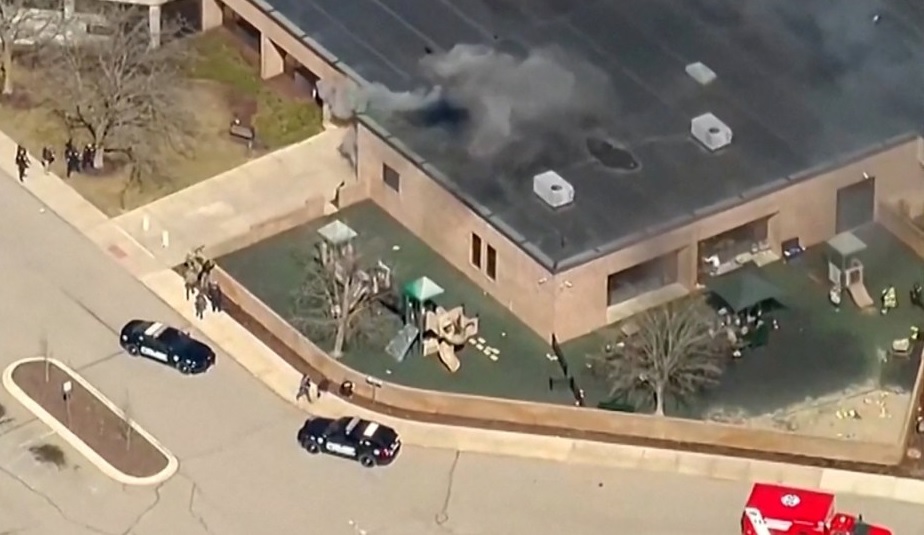
WEST BLOOMFIELD, Michigan — March 15, 2026 : Israeli military officials said Sunday that the brother of the man who carried out a vehicle-ramming attack on a synagogue in Michigan earlier this month was a Hezbollah commander killed in an Israeli airstrike in Lebanon. Authorities in the United States continue to investigate the incident as a targeted act of violence against the Jewish community.
According to the Israel Defense Forces (IDF), intelligence analysis determined that Ibrahim Mohamad Ghazali served as the leader of a Hezbollah weapons team within the Badr unit, part of the organization’s southern command responsible for launching rockets toward Israel. The IDF said Ibrahim was killed in an airstrike conducted on March 5, 2026, in the town of Mashgharah in Lebanon’s Beqaa Valley.
Israeli officials stated the strike targeted a Hezbollah “military structure” where weapons were stored and operatives were present. The IDF confirmed Ibrahim’s role within the group but did not provide details about the intelligence used to identify him and did not reference the deaths of other family members in its public statement. Israeli authorities also did not directly link the Michigan synagogue attacker to Hezbollah.
However, a Hezbollah official speaking anonymously to The New York Times denied that Ibrahim or his relatives were affiliated with the group. The official said the attack in Michigan was motivated by anger over the deaths of family members killed in the Israeli strike.
Airstrike in Lebanon Kills Four Relatives
The March 5 airstrike struck a residential home in Mashgharah shortly after sunset during Ramadan, when family members had gathered to break their fast. According to a local Lebanese official and community sources in Michigan, four relatives of the Michigan attacker were killed.
Those killed were identified as Ibrahim Mohamad Ghazali, Kassim (Qassem) Mohamad Ghazali, and Ibrahim’s two children, Ali and Fatima. Ibrahim’s wife was severely injured in the strike and remains hospitalized.
Local authorities in Mashgharah confirmed the deaths. The town’s mayor stated that the Ghazali family was not known to be affiliated with any political organization and noted that the community includes residents from several religious backgrounds, including Shia Muslims, Sunnis, Druze, and Christians.
Reports from Lebanese officials indicated that Kassim Ghazali worked as a soccer coach and personal trainer, while Ibrahim was employed as a school bus driver. A local journalist later told CBS News that both brothers had reportedly been members of a Hezbollah rocket unit operating in southern Lebanon.
Vehicle-Ramming Attack at Temple Israel
One week after the airstrike, Ayman Mohamad Ghazali, a 41-year-old Lebanese-born naturalized U.S. citizen, carried out a vehicle-ramming attack at Temple Israel, a Reform synagogue in West Bloomfield Township, a suburb of Detroit.
On March 12, Ghazali drove a truck through the synagogue’s entrance and into an interior hallway. Surveillance footage and law enforcement reports indicated that he had waited in the parking lot for more than two hours before carrying out the attack.
The truck eventually became lodged inside the building. Security personnel exchanged gunfire with Ghazali, and the vehicle’s engine compartment caught fire. Authorities later confirmed that Ghazali died at the scene from a self-inflicted gunshot wound.
Temple Israel is one of the largest Reform synagogues in the United States and includes an early childhood education center.
At the time of the attack, approximately 140 people were inside the synagogue complex, including 106 children aged five and younger and more than 30 staff members. No children, teachers, or synagogue staff were injured.
One security officer was struck by the vehicle and briefly knocked unconscious but did not suffer life-threatening injuries. During the evacuation and fire response, roughly 30 responding law enforcement officers were treated at local hospitals for smoke inhalation.
Materials Found in the Vehicle
Investigators from the Federal Bureau of Investigation (FBI) and local police said the truck contained containers of flammable liquid along with fireworks valued at approximately $2,250. Authorities said Ghazali had purchased the fireworks from a store in Livonia, Michigan, two days before the attack.
The FBI is leading the investigation and classified the incident as a targeted attack against the Jewish community.
Background of the Attacker
Ayman Mohamad Ghazali was born in Lebanon and immigrated to the United States in May 2011 on an IR-1 immigrant visa, which is issued to spouses of U.S. citizens. He applied for naturalization in 2015 and became a U.S. citizen in February 2016.
Ghazali lived in Dearborn Heights, Michigan, a Detroit-area suburb with a large Lebanese-American community. He had worked at Hamido, a Mediterranean restaurant, but had reportedly been absent from work in recent weeks.
Court records indicate he was divorced and had at least one child. According to community members, Ghazali had become increasingly withdrawn after learning about the deaths of his relatives in Lebanon.
U.S. investigators previously flagged Ghazali in government databases because of connections to individuals linked to Hezbollah, although officials said he was not believed to be a member of the group. He had reportedly been questioned multiple times during reentry to the United States after overseas travel.
Events Leading Up to the Attack
Investigators examining Ghazali’s digital activity found that he had shared images online showing children killed in Israeli strikes shortly before the attack.
Shortly before driving to the synagogue, Ghazali placed a phone call to his ex-wife regarding their children that she considered concerning. She contacted police and requested a welfare check.
Authorities say Ghazali then drove to Temple Israel and remained parked outside for more than two hours before carrying out the attack.
Community and Government Response
Local religious leaders and officials condemned the incident.
Imam Hassan Qazwini, a Muslim leader in Michigan who met with Ghazali days before the attack, said Israeli actions abroad did not justify violence against a synagogue in the United States.
Michigan Governor Gretchen Whitmer described the event as an act of antisemitism targeting a place where young children were present. U.S. Senator Elissa Slotkin praised the synagogue’s security personnel and emergency responders for preventing greater casualties.
Rabbi Arianna Gordon of Temple Israel thanked security staff, teachers, and law enforcement officers for carrying out a rapid evacuation of the building. Cassi Cohen, the synagogue’s director of strategic development, said staff locked themselves inside offices after hearing a loud crash.
Parents were notified of the incident while children were evacuated safely. Allison Jacobs, a parent whose child attended the center, said she received a message confirming her child was safe shortly after the evacuation.
Steven Ingber, chief executive of the Jewish Federation of Detroit, said the incident occurred during a period of heightened security concerns for Jewish institutions.
Broader Regional Context
The attack occurred during a period of increased military tensions involving Israel and Hezbollah.
Hezbollah began launching hundreds of rockets and drones toward Israel on March 2, according to Israeli officials, following U.S.–Israeli missile strikes on Iran on February 28. Israel has since carried out extensive airstrikes and ground operations in southern Lebanon targeting Hezbollah infrastructure and personnel.
U.S. federal authorities had previously issued warnings about potential threats linked to the regional conflict, including possible attacks targeting Jewish institutions. As a result, synagogues and Jewish community facilities across the United States and internationally have increased security measures.
The FBI continues to review Ghazali’s digital communications, travel history, and personal contacts while investigators also examine the broader circumstances surrounding the Lebanon airstrike and its possible influence on the attack in Michigan.
——— End of Article ———