NEW DELHI — April 3, 2026 : The Indian Air Force (IAF) has initiated a new procurement and development program for an Air-Dropped Canisterised Swarm (ADC-S) system, advancing its push toward autonomous, long-range strike capabilities in contested environments. The project is being pursued under the Make-II category of the Defence Acquisition Procedure (DAP) 2020, with Air Headquarters’ Directorate of Operations (Remote) designated as the nodal agency.
The program, referenced as CF No/ Air HQ/C 18488/69/DAD, focuses on the design, development, and manufacture of an indigenised, multi-use swarm munition system capable of engaging high-value and time-sensitive targets deep inside adversary territory.
Deployment Concept and Launch Platforms
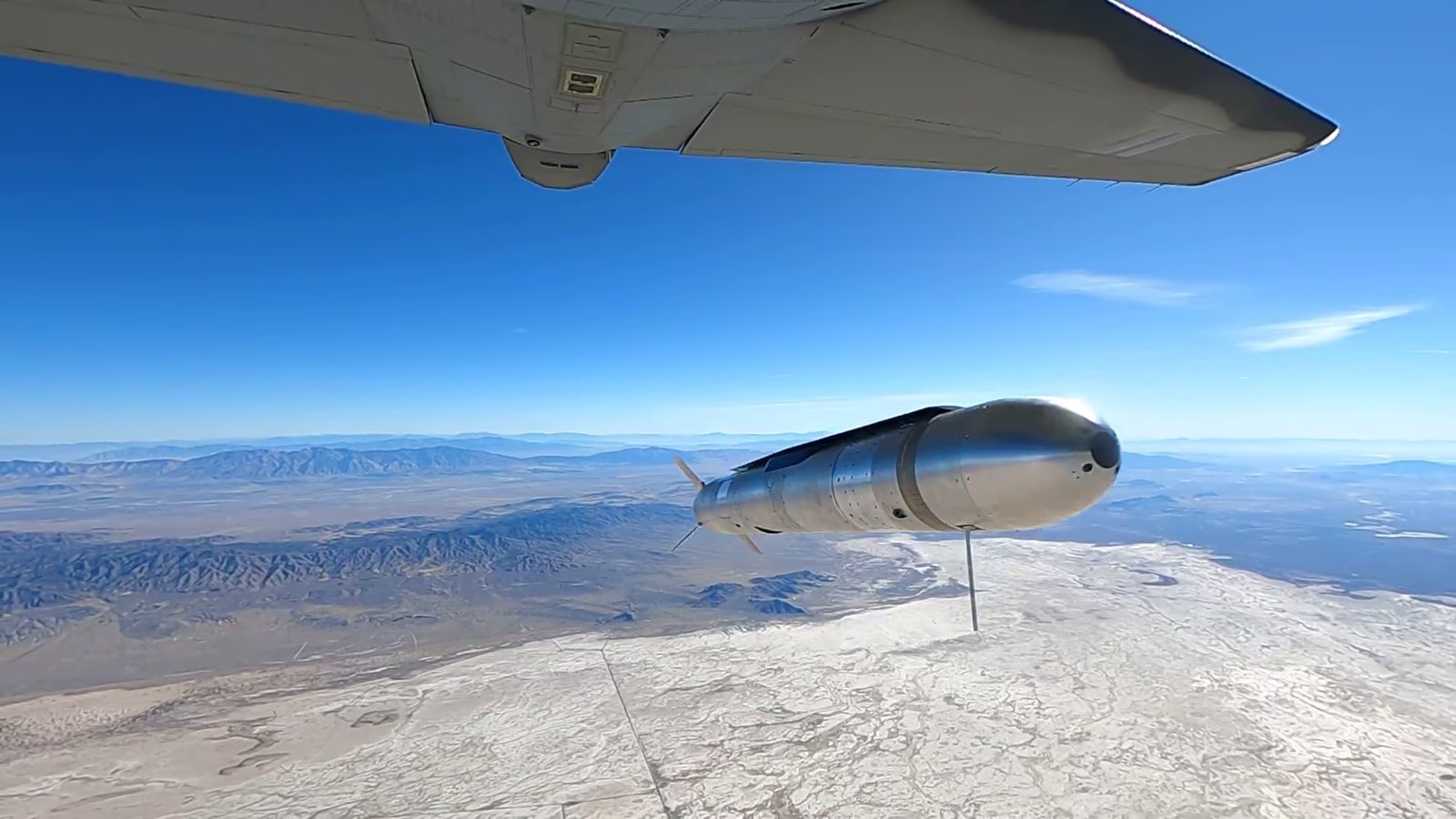
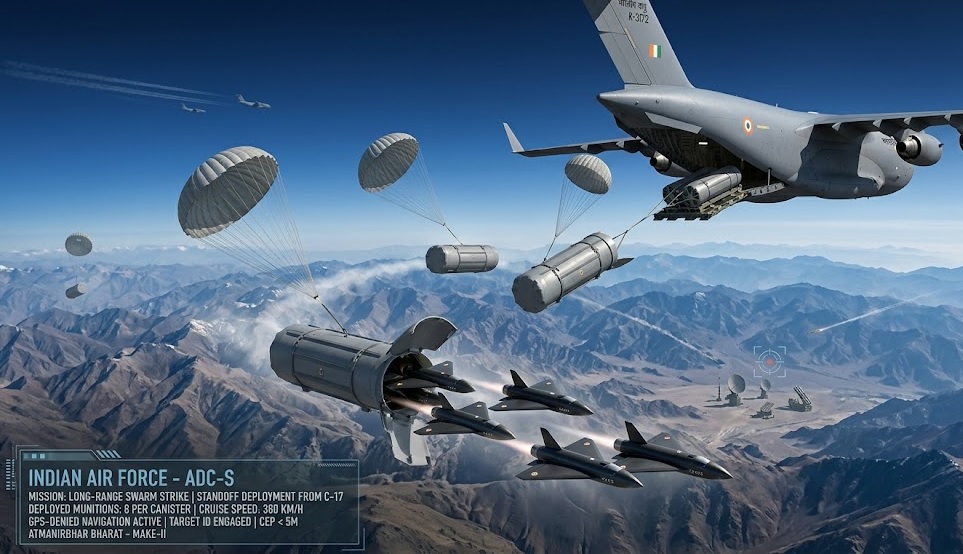
The ADC-S system will be deployed using a palletised weapon airdrop mechanism from the IAF’s existing transport aircraft fleet, including the C-17 Globemaster III, C-130J Super Hercules, and C-295. This approach allows the use of transport aircraft as stand-off launch platforms rather than relying on frontline fighter jets.
The system is designed to achieve a minimum operational range of approximately 500 kilometers from the point of release. This stand-off distance enables launch aircraft to remain outside hostile air defence engagement zones, particularly in anti-access/area denial (A2/AD) environments. The final range parameter will be confirmed following feasibility studies.
System Architecture and Swarm Composition
Each air-dropped canister will contain a minimum of six to eight swarm munitions, with the possibility of higher payload configurations depending on system design. Once deployed, the canister disperses these munitions, which operate as a coordinated swarm.
Individual swarm units are required to achieve cruise speeds between 350 and 400 km/h and carry a munition payload of at least 30 kilograms. The design also incorporates modularity, allowing integration of additional sensors or mission-specific payloads alongside the primary munition package.
Autonomy, Navigation, and Precision Requirements
The ADC-S system is designed to operate in contested electromagnetic environments, including areas where Global Navigation Satellite Systems (GNSS) may be denied or degraded due to electronic warfare.
To address this, the system incorporates advanced artificial intelligence and autonomous capabilities. These include autonomous navigation, target search, detection, identification, and engagement decision-making. The swarm must also be capable of continuing mission execution even in the absence of communication links.
Precision requirements specify a Circular Error Probable (CEP) of 5 meters or less, supported by terminal guidance systems to ensure accuracy against designated targets.
Operational Role and Battlefield Application
In operational scenarios, the ADC-S is intended to provide the IAF with a stand-off strike capability against high-value, time-sensitive targets such as radar installations, surface-to-air missile systems, command and control nodes, and other critical infrastructure.
The use of swarm tactics enables multiple munitions to be deployed simultaneously, creating a saturation effect that can overwhelm adversary air defence systems. This distributed attack profile is particularly relevant in heavily defended environments where conventional strike aircraft may face higher risk.
The reliance on autonomous operation further enhances survivability and mission reliability in conditions where electronic warfare may disrupt communications or navigation systems.
Industrial Participation and Procurement Pathway
The project is being executed under the Make-II category, which requires Indian industry to undertake design and development using its own funding. The initiative mandates a minimum indigenous content of 50 percent, aligning with the government’s Atmanirbhar Bharat policy for self-reliance in defence manufacturing.
Following successful prototype development and validation, the program is expected to transition to procurement under the “Buy Indian–IDDM” (Indigenously Designed, Developed and Manufactured) category.
The IAF has indicated an anticipated minimum order quantity ranging between 1,000 and 2,000 units, subject to the outcomes of feasibility studies and recommendations from the Project Facilitation Team.
Industry Engagement and Timeline
A project questionnaire was uploaded on the Make in India Defence Production portal on 1 April 2026. Indian companies interested in participating in the program have been invited to submit responses by 30 April 2026.
Further refinement of system specifications and preliminary service qualitative requirements will be carried out following industry consultations and feasibility assessments.
The ADC-S program represents a step in expanding the IAF’s capability portfolio in autonomous warfare systems, with a focus on extending operational reach, reducing risk to manned platforms, and enabling precision engagement in contested airspace.
——— End of Article ———