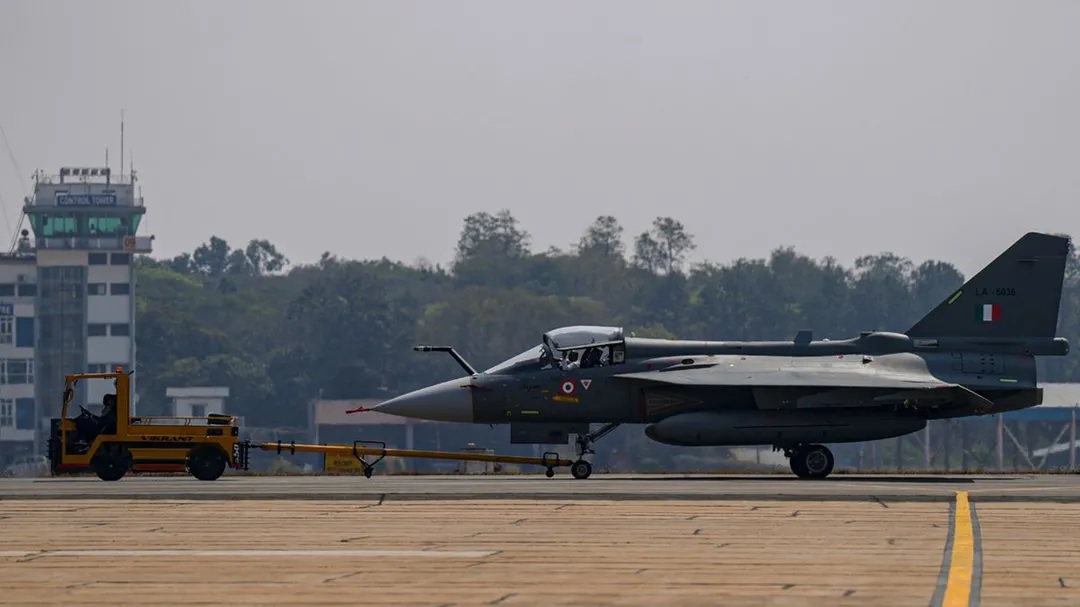
NEW DELHI — March 13, 2026 : The Indian Air Force (IAF) has determined that a software malfunction in the onboard computer of a Light Combat Aircraft (LCA) Tejas was responsible for a runway excursion that occurred on February 7, 2026, at a forward airbase along India’s western sector. The conclusion follows a detailed technical investigation and fleet-wide inspections that ruled out any structural or mechanical faults in the aircraft.
The incident involved a single-seat Tejas fighter jet that veered off the runway during the take-off roll and slid into an adjacent mud ditch. The pilot survived the event but sustained injuries. Officials clarified that the pilot ejected from the aircraft during the incident.
Incident Classification and Aircraft Status
Hindustan Aeronautics Limited (HAL), the manufacturer of the Tejas platform, classified the event as a minor technical incident on the ground, rejecting early reports that described the event as a crash.
According to officials involved in the investigation, the aircraft departed the runway during the take-off phase before coming to rest in a muddy area adjacent to the runway. The precise level of structural damage sustained by the airframe remains under evaluation as engineers assess whether the aircraft can be repaired and returned to service.
Investigation and Technical Review
Following the incident, the IAF temporarily grounded its fleet of approximately 35 operational single-seat Tejas fighter jets to conduct precautionary inspections and technical evaluations.
The investigation included the convening of a Court of Inquiry, which carried out a comprehensive examination of multiple aircraft systems. The review focused on three primary technical areas:
- Metallurgy of the undercarriage and landing gear assembly
- Electromagnetic braking system
- Core avionics software and flight control protocols
Investigators concluded that all mechanical and structural components were functioning as designed. No defects were identified in the landing gear structure or braking mechanisms.
The fault was ultimately traced to a software glitch within the aircraft’s onboard computer system, which affected the aircraft’s behavior during the take-off roll.
Officials involved in the review noted that software anomalies can occur in advanced digital avionics systems and are typically addressed through software revisions and updates.
Software Correction and Testing
In response to the findings, the IAF and HAL jointly developed an updated software patch intended to correct the malfunction identified during the investigation.
The revised software is currently undergoing testing on selected aircraft within the fleet. The validation process is intended to confirm that the update fully resolves the issue and does not introduce compatibility problems with other avionics or flight control systems.
Once testing is completed, the update will be rolled out across the entire Tejas fleet operated by the Indian Air Force.
Officials did not disclose the exact technical nature of the software anomaly or provide a specific timeline for the fleet-wide deployment of the updated software.
Operational Status of the Tejas Fleet
After completion of the precautionary inspections and technical checks, the Tejas fleet was cleared to resume operations.
The Indian Air Force currently operates 38 Tejas Mk-1 aircraft out of the 40 originally ordered, following two previous losses involving the platform.
Previous Tejas Incidents
The February 7 runway excursion represents the third significant incident involving the Tejas fighter since its induction into service in 2016.
In March 2024, a Tejas aircraft crashed near Jaisalmer while returning from a firepower demonstration exercise. The pilot safely ejected and survived.
A second incident occurred in November 2025, when a Tejas aircraft participating in an aerobatic display crashed during the Dubai Airshow. The accident resulted in the death of Wing Commander Namansh Syal.
Future Fleet Expansion
The Tejas platform remains central to the Indian Air Force’s fighter modernization program. India has placed orders for 180 upgraded Tejas Mk-1A fighters, which incorporate improvements in radar, avionics, electronic warfare systems, and maintenance efficiency.
However, deliveries of the Mk-1A variant have been delayed by approximately two years, primarily due to supply chain constraints affecting the delivery of aircraft engines.
Despite the delays, the aircraft is expected to play a significant role in replacing older fighter platforms in IAF service over the coming decade.
The software correction following the February 7 runway incident is expected to be implemented fleet-wide once testing of the update is completed, ensuring continued operational safety of the Tejas fighter fleet.
——— End of Article ———