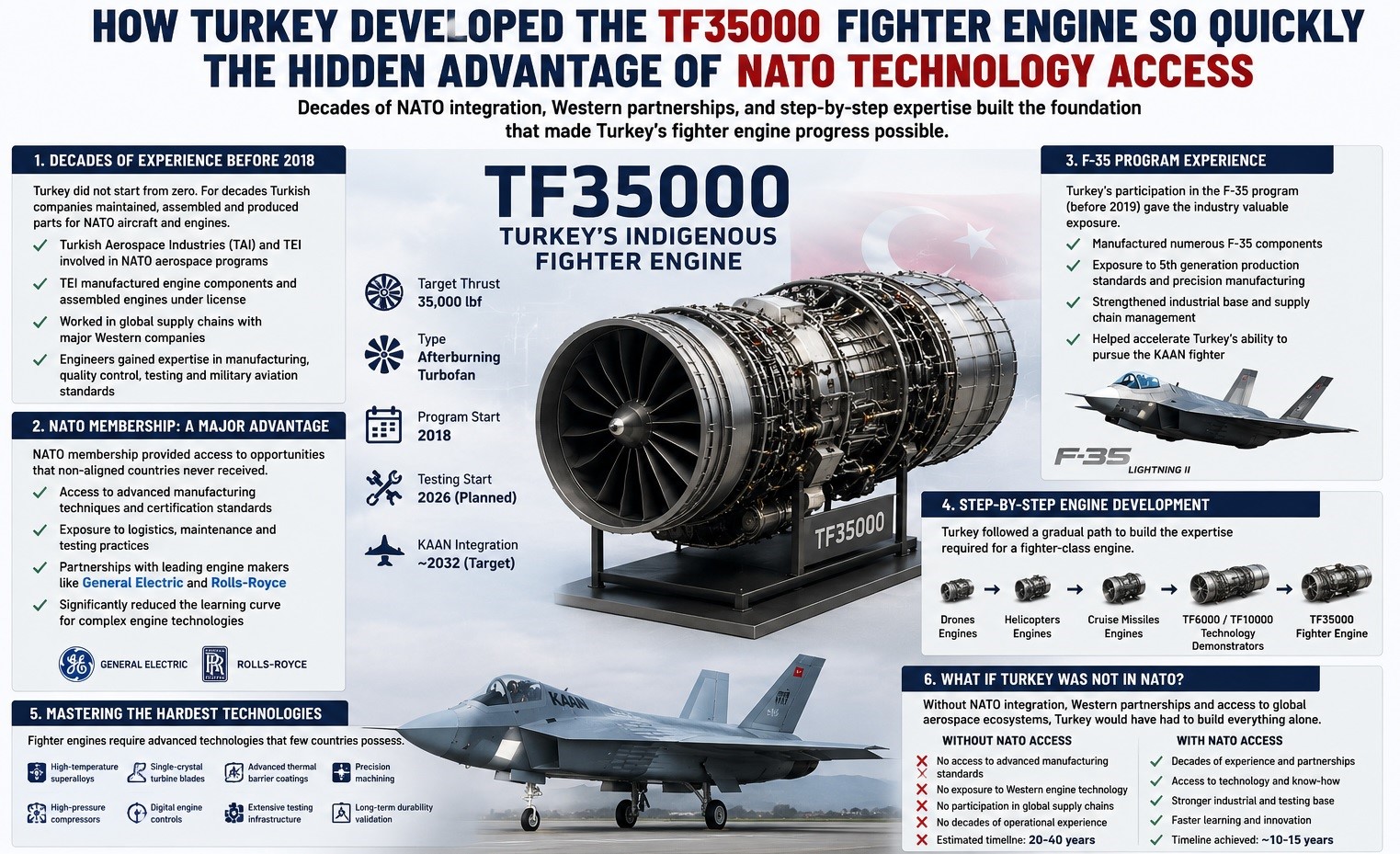
Turkey's progress toward developing an indigenous fighter jet engine has surprised many observers. The country formally launched development of a domestic engine for its KAAN fifth-generation fighter program in 2018, unveiled the TF35000 engine concept in 2025, and aims to begin testing in 2026 before eventual integration into the fighter around 2032.
On the surface, this timeline appears remarkably short for one of the most difficult technologies in aerospace. Fighter jet engines are widely considered more challenging to develop than airframes, avionics, or even radar systems. Yet Turkey's apparent speed is not the result of starting from scratch in 2018. Instead, it reflects decades of accumulated industrial experience, much of it gained through NATO integration, Western aerospace partnerships, and participation in international defense programs.
The Myth of a Sudden Breakthrough
A common misconception is that Turkey suddenly decided to build a fighter engine and rapidly mastered the technology within a few years. In reality, Turkey's aerospace industry spent decades maintaining, assembling, manufacturing, and supporting Western military aircraft and engines before launching the KAAN engine effort.
Turkish companies such as Turkish Aerospace Industries (TAI) and TEI have long been involved in NATO aerospace programs. TEI manufactured engine components, assembled engines under license, and worked within global supply chains linked to major Western aerospace companies.
As a result, Turkish engineers did not begin with zero experience. They already understood many aspects of aerospace manufacturing, quality control, testing procedures, and military aviation standards before the indigenous engine program officially began.
NATO Membership Provided a Major Advantage
Turkey's membership in NATO gave its aerospace sector access to opportunities that many non-aligned countries never received.
For decades, Turkish firms participated in the maintenance and production ecosystem surrounding NATO aircraft. Turkish engineers gained exposure to advanced manufacturing techniques, aerospace certification standards, logistics systems, and engine maintenance practices.
Turkish companies also worked alongside major Western engine manufacturers, including General Electric and Rolls-Royce. These partnerships provided valuable industrial knowledge in areas such as turbine manufacturing, materials engineering, engine assembly, and testing infrastructure.
While this did not provide Turkey with complete fighter engine technology, it significantly reduced the learning curve compared with countries attempting to build an aerospace industry in isolation.
Without decades of integration into NATO supply chains and aerospace programs, Turkey would likely have required far more time to develop the industrial foundation necessary for a modern fighter engine.
The F-35 Program Experience
Another often overlooked factor is Turkey's participation in the F-35 program before its removal from the project in 2019.
Turkish industry manufactured numerous components for the F-35 and became part of one of the world's most advanced aerospace production networks. Although participation did not provide access to sensitive engine designs or stealth technologies, it exposed Turkish companies to advanced manufacturing standards, precision production methods, supply-chain management practices, and quality requirements associated with fifth-generation aircraft programs.
This experience helped strengthen Turkey's industrial base and provided valuable knowledge relevant to future projects such as the KAAN fighter.
Similarly, experience gained through NATO aircraft support and F-35 industrial participation contributed to Turkey's ability to pursue a fifth-generation fighter program more rapidly than countries lacking comparable exposure.
Building Expertise Step by Step
Turkey's engine development strategy has followed a gradual path rather than an immediate leap toward a high-performance fighter engine.
Before attempting the TF35000, Turkish industry worked on engines for drones, helicopters, and cruise missiles. Programs such as the TF6000 and TF10000 served as technology demonstrators that allowed engineers to develop expertise in compressor design, combustion systems, turbine technology, and engine integration.
This incremental approach reduced risk and allowed Turkey to solve smaller engineering challenges before tackling a fighter-class turbofan.
The strategy mirrors the development paths followed by other aerospace powers, where smaller engine programs often precede advanced fighter engines.
The Technologies That Make Fighter Engines Difficult
Designing a modern fighter engine requires mastery of technologies that few countries possess.
These include:
- High-temperature superalloys
- Single-crystal turbine blade manufacturing
- Advanced thermal barrier coatings
- Precision machining
- High-pressure compressors
- Digital engine controls
- Extensive testing infrastructure
- Long-term durability validation
Creating an engine is not simply about generating thrust. The engine must operate reliably for thousands of hours under extreme temperatures and stresses while maintaining performance and safety.
This is why only a small number of countries can produce advanced fighter turbofans at scale.
China Shows How Difficult the Challenge Remains
China provides an important example of the difficulty involved in fighter engine development.
Despite massive state investment, access to foreign technology, and decades of research, China spent roughly three decades progressing from early indigenous engine efforts to fielding mature fighter engines. Even today, Chinese engine development remains one of the most technically demanding areas of the country's aerospace industry.
China's WS-10 and newer WS-15 programs represent significant achievements, but the country invested enormous financial and industrial resources over many years to improve durability, reliability, manufacturing quality, and service life.
For much of that period, Chinese fighter aircraft relied heavily on imported Russian engines while domestic designs matured.
The Chinese experience demonstrates that developing a powerful engine is only part of the challenge. Achieving Western-level reliability, maintenance intervals, operational lifespan, and production consistency can require decades of continuous refinement.
Turkey Has Not Yet Achieved an Indigenous Fifth-Generation Fighter Engine
Despite recent progress, Turkey has not yet fielded a fully indigenous fighter engine comparable to those powering the F-35, F-22, or the most advanced Western combat aircraft.
The KAAN prototype currently flies using imported General Electric F110 engines. The indigenous TF35000 remains under development and has not yet completed the testing and qualification process required for operational service.
The most difficult phase still lies ahead: proving reliability, durability, performance, maintainability, and production readiness.
History shows that many engine programs encounter delays during this stage, even in countries with advanced aerospace industries.
What If Turkey Had Not Been Part of NATO?
While no one can know the exact timeline, it is reasonable to conclude that Turkey's progress would have been significantly slower without NATO integration.
Without access to Western aerospace ecosystems, industrial partnerships, supply chains, and decades of operational experience, Turkey would have needed to independently develop expertise in metallurgy, turbine manufacturing, testing infrastructure, precision machining, and military aviation standards.
A timeline closer to 20–40 years would likely have been more realistic for achieving a comparable level of capability from a largely isolated starting point.
Turkey's current achievements therefore reflect not only recent investments but also decades of accumulated knowledge gained through participation in NATO programs, international aerospace partnerships, licensed production activities, and global defense supply chains.
Final Assessment
Turkey's fighter engine program did not emerge overnight. The country's rapid progress toward the TF35000 engine and the KAAN fighter is the result of decades of aerospace development, extensive government investment, international industrial cooperation, and experience gained through NATO integration.
The program represents a significant milestone for Turkey's defense industry. However, the ultimate measure of success will not be the unveiling of an engine prototype but the ability to field a mature, reliable, high-performance indigenous fighter engine capable of matching the durability, service life, and operational performance achieved by the world's leading aerospace powers.
——— End of Article ———