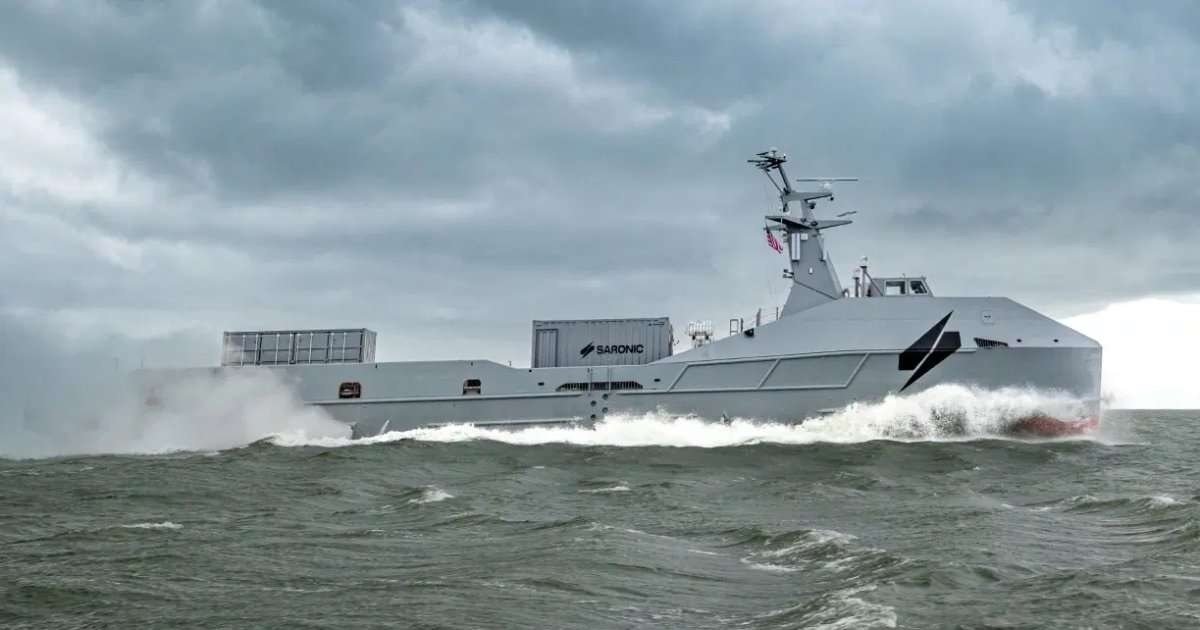
PROVIDENCE, R.I., — March 21, 2026 : Havoc AI has confirmed that its Harbinger autonomous low-profile vessel (ALPV) has completed its maiden full-power voyage, marking the initial operational demonstration of a platform developed through an accelerated design and manufacturing process. The vessel is intended for contested logistics and autonomous resupply missions in maritime environments.
The Harbinger was designed, manufactured, integrated, and launched in under 30 days, demonstrating a compressed production model enabled by large-format additive manufacturing and modular systems integration.
Accelerated Manufacturing Process
A central feature of the programme is the use of large-format additive manufacturing (3D printing) to produce the vessel’s hull. The hull was printed and delivered within nine days by manufacturing partner Haddy, using industrial-scale printing systems supplied by the CEAD Group.
These systems are capable of producing full-scale composite hull structures without the need for traditional molds or extended tooling processes. Following delivery of the hull, systems integration was completed in less than one week, allowing the vessel to be prepared for launch within the overall 30-day timeline.
Haddy operates a microfactory model incorporating robotic manufacturing systems for composite structures, while CEAD Group has developed specialized printers, including platforms designed for marine applications such as hull production up to approximately 12 meters in length.
Platform Design and Specifications
The Harbinger is a 40-foot semi-submersible vessel configured as a low-profile, low-draft platform to reduce visual and radar signatures. The vessel is currently operating as a subscale test platform, representing approximately 50 to 60 percent of the projected full-scale design, which is expected to range between 66 and 80 feet in length.
The platform is designed for fully autonomous operation, including navigation, communication, and mission execution. Its primary role is to support resupply operations in contested environments, reducing the need for crewed vessels in high-risk areas.
The vessel’s design supports covert movement and survivability in maritime environments where detection and targeting risks are elevated.
Operational Testing and Fleet Integration
The Harbinger recently completed a two-week field exercise as part of a broader fleet of autonomous systems. During the exercise, operators tested coordinated logistics operations involving multiple autonomous platforms.
From a remote command center, operators assigned mission tasks to the vessel, including:
- Autonomous navigation to designated coordinates
- Execution of resupply operations
- Cargo unloading
- Return transit to base without detection
The vessel demonstrated the ability to execute these tasks autonomously and at operational tempo, validating its role as part of a multi-vehicle logistics network.
Technology Framework and System Integration
The Harbinger operates within Havoc AI’s broader ecosystem of modular autonomous maritime systems, supported by the company’s Havoc Stack software framework, which enables collaborative autonomy across platforms.
Havoc AI’s existing portfolio includes platforms such as the Rampage autonomous surface vehicle, the Kaikoa fleet support vessel, and the Atlas medium unmanned surface vessel (mUSV), which support missions including logistics, domain awareness, electronic warfare, and strike operations.
Industry and Operational Context
The development of the Harbinger reflects a wider trend in defense technology toward rapid prototyping and on-demand manufacturing of specialized platforms. By combining additive manufacturing with autonomous systems, developers are seeking to reduce production timelines and costs associated with traditional shipbuilding.
The vessel falls within a broader category of autonomous low-profile maritime platforms being evaluated for logistics and resupply roles in contested environments. Similar capabilities are being explored by organizations such as the U.S. Marine Corps and the Defense Innovation Unit, particularly under initiatives related to distributed operations and Force Design 2030.
Programme Significance
The Harbinger serves as a surrogate testbed to validate both the structural design and autonomous operational capabilities required for future deployment. The successful completion of its maiden voyage and field exercises provides initial data on system performance and integration.
Havoc AI indicated that the platform supports ongoing efforts to develop scalable, cost-effective maritime systems capable of maintaining supply chains and operational support in environments where traditional logistics platforms face increased risk.
——— End of Article ———