WASHINGTON / ARLINGTON, VIRGINIA — April 1, 2026 : Hanwha Defense USA (HDUSA) has formally submitted its K9 Mobile Howitzer (K9MH) in response to the U.S. Army’s Mobile Tactical Cannon Request for Prototype Proposal (RPP), positioning its system as a candidate to support modernization efforts and potentially replace the towed M777 artillery fleet.
The proposal combines the company’s established 155mm artillery platform with a phased domestic manufacturing and localization strategy aimed at strengthening the U.S. defense industrial base while meeting Long-Range Precision Fires (LRPF) requirements.
System Capabilities and Operational Role
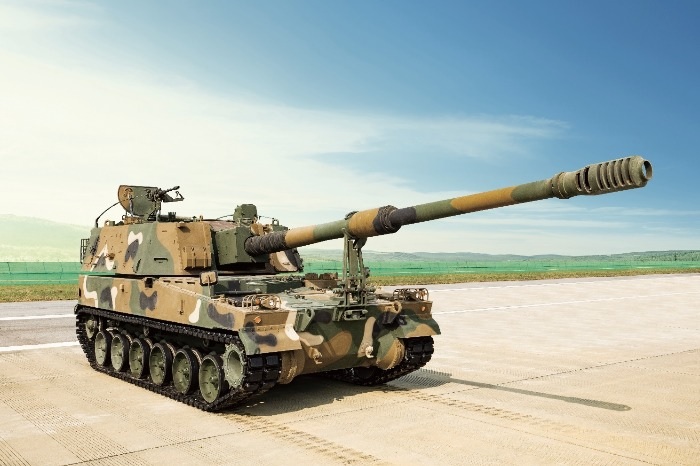
The K9 Mobile Howitzer is a 155 mm, 52-caliber artillery system adapted into a wheeled 8×8 configuration, integrating the proven automated turret of the K9 family with a mobile truck platform. The system is designed to deliver improved operational mobility compared to tracked systems while maintaining high firepower and automation.
The platform features a fully automated firing sequence and an onboard magazine capacity ranging from 40 to 48 rounds, depending on configuration. It is paired with an automated resupply solution derived from the K10 ammunition resupply vehicle, enabling sustained high rates of fire and reduced mission turnaround times.
HDUSA stated that the system supports rapid fielding with reduced program risk, emphasizing its maturity and existing operational track record. More than 2,000 K9-series systems have been fielded globally, with operators including South Korea, Poland, Norway, Estonia, Egypt, India, Finland, Australia, and Romania.
The K9MH operates under a common gun system architecture, allowing integration alongside tracked variants within a mixed fleet. This approach is intended to simplify logistics, training, and sustainment while offering flexibility across different brigade formations.
U.S. Army Program Context
The U.S. Army’s Mobile Tactical Cannon initiative is focused on acquiring a mature, wheeled 155 mm self-propelled artillery system capable of replacing the M777 towed howitzer in Infantry Brigade Combat Teams, Stryker Brigade Combat Teams, and other units.
The service has outlined a potential requirement of up to 498 systems as part of broader efforts to enhance artillery mobility, survivability, and integration with advanced fire-control and command-and-control (C2) systems.
Hanwha indicated that its submission aligns with the Army’s system-of-systems approach to artillery modernization, which includes advancements not only in platforms but also in munitions, propellants, and digital fire-control integration.
Phased Localization and Alabama Manufacturing Base
A central element of HDUSA’s proposal is a phased localization strategy to establish domestic production and long-term sustainment capabilities in the United States.
The first phase will be based in Alabama, where the company is building its initial manufacturing and support infrastructure. Planned activities include expanding production capacity, developing local supplier networks, and training a skilled workforce to support ongoing operations.
The Alabama facility is also intended to support future technology insertions, including potential upgrades such as 58-caliber gun tubes and the integration of autonomous software systems.
Company officials described localization as a continuous process rather than a one-time effort, supported by Hanwha’s prior experience establishing production ecosystems in multiple international markets.
Industrial Strategy and Leadership Statements
HDUSA executives emphasized that the proposal extends beyond platform delivery to include a broader industrial and operational framework.
Mike Smith, Chief Operating Officer and President of Land Systems at HDUSA, stated that the company’s approach reflects a system-level perspective on artillery capability development.
He noted that a “total artillery solution” encompasses not only the platform but also projectiles, propelling charges, fire-control systems, and command-and-control integration, aligning with the U.S. Army’s modernization strategy.
Michael Coulter, CEO of HDUSA, said the company’s model includes direct industrial investment as a standard practice across sectors such as shipbuilding, munitions, and combat vehicles. He added that the phased localization plan is designed to expand domestic production and long-term support capacity.
Jason Pak, Head of Land Systems for Artillery at HDUSA, identified Alabama as the starting point for the company’s U.S. expansion, with additional phases to be evaluated as the domestic footprint grows. He highlighted that Hanwha’s global supply chain and production experience form the basis for executing localized manufacturing at scale.
$1.3 Billion Munitions Investment in Arkansas
The K9 submission follows a separate major investment by Hanwha Defense USA to expand its U.S. manufacturing network.
Earlier in 2026, the company secured an Enhanced Use Lease (EUL) agreement with the U.S. Army to establish a new munitions facility at Pine Bluff Arsenal in Arkansas. Hanwha plans to invest approximately $1.3 billion in the project, which is expected to create around 200 skilled jobs.
The facility will focus on producing critical components for explosives and propellants used in 155 mm artillery ammunition, directly supporting the U.S. military’s organic industrial base and ammunition supply chain.
Program Outlook
Hanwha stated that its K9 Mobile Howitzer proposal is intended to deliver both near-term operational capability and long-term industrial value through domestic production, supply chain integration, and technology development.
Further details regarding the manufacturing network, production timelines, and program evolution are expected to be released as the U.S. Army’s Mobile Tactical Cannon initiative progresses.
——— End of Article ———