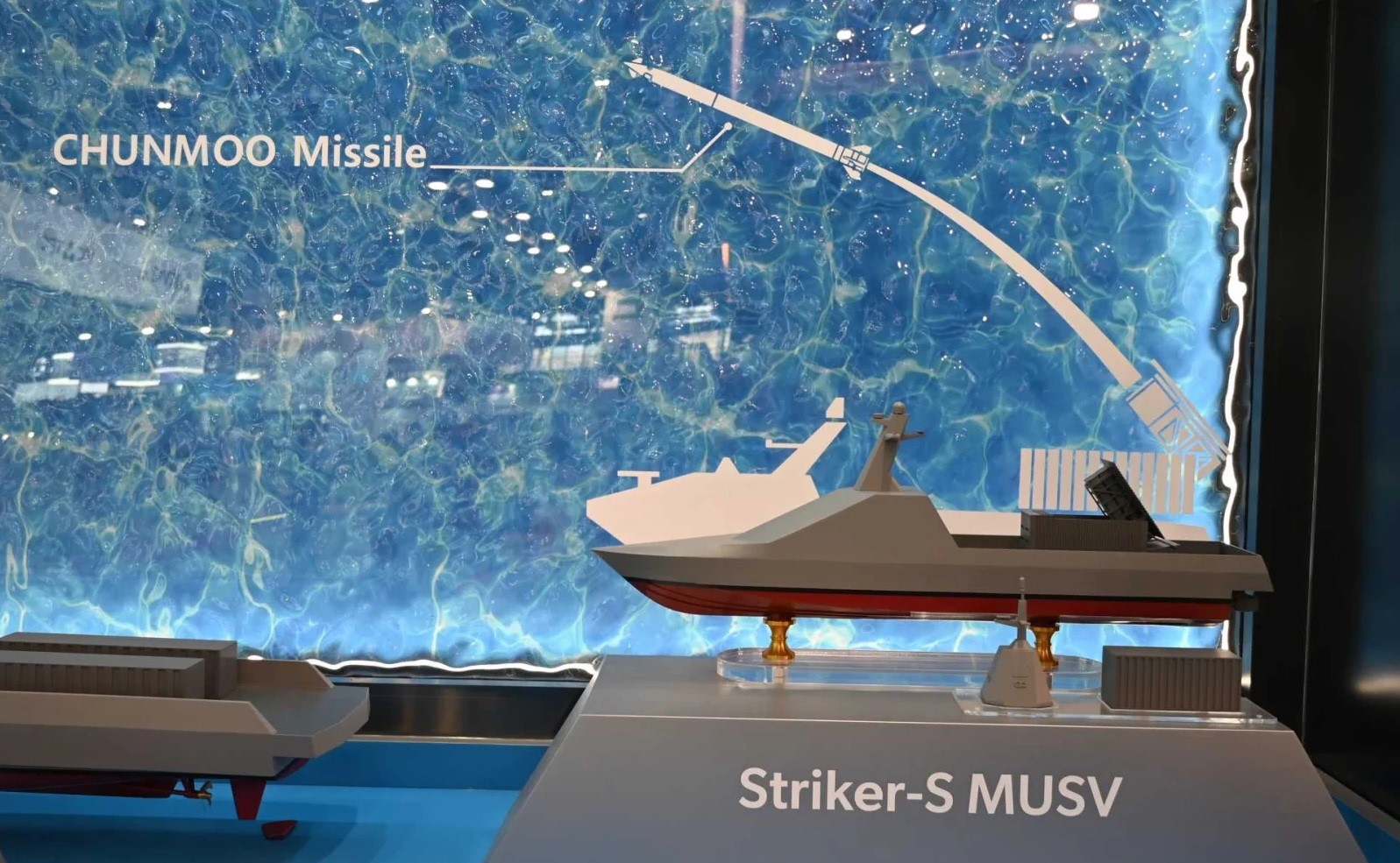
Paris, France, — June 16, 2026 : Hanwha Aerospace has unveiled its new Striker-S Medium Uncrewed Surface Vessel (MUSV) at the Eurosatory 2026 defense exhibition in Paris. The autonomous maritime platform integrates the combat-proven K239 Chunmoo multiple launch rocket system, extending long-range precision strike capabilities to unmanned naval vessels.
The Striker-S represents Hanwha’s latest effort to support distributed maritime operations by transferring missile firepower from traditional crewed warships to modular uncrewed platforms. The vessel was presented on June 15 during the defense exhibition, which runs from June 15 to June 19 at the Paris Nord Villepinte Exhibition Centre.
Vessel Design and Specifications
The Striker-S is a medium-sized autonomous surface vessel designed for multiple mission profiles. Measuring 35 meters in length with a 6-meter beam, the vessel has a displacement of 250 tons and a fuel capacity of 60 tons. It is equipped with a 20-foot containerized mission module capable of carrying payloads weighing up to 10 tons.
Unlike smaller expendable attack drones seen in recent conflicts, the Striker-S is comparable in size to a small patrol craft. Its displacement provides sufficient internal space for mission computers, communications systems, power generation equipment, datalinks, sensors, and payload-handling systems.
The vessel is fitted with an Active Electronically Scanned Array (AESA) radar and a dedicated counter-Uncrewed Aerial Systems (counter-UAS) suite, enabling it to operate in contested littoral environments while maintaining awareness of aerial threats.
Containerized Mission System
A key feature of the Striker-S is its modular mission architecture. Rather than relying on permanently installed vertical launch systems, the vessel uses a containerized payload approach. Mission equipment is housed within a removable 20-foot module, allowing operators to reconfigure the vessel for different tasks.
This design enables the platform to transition between strike, intelligence gathering, surveillance, reconnaissance, and support missions without requiring significant structural modifications. The approach also supports faster mission adaptation and simplifies future payload integration.
Chunmoo Missile Integration
The defining capability of the Striker-S is the integration of the K239 Chunmoo multiple launch rocket system, a land-based weapon system currently used by the Republic of Korea Army and exported to several European countries, including Poland, Norway, and Estonia.
By employing the Chunmoo architecture, the vessel can launch a range of standardized guided munitions, including:
- CGR-080 guided rockets with a range of approximately 80 kilometers
- CTM-MR missiles with a range of approximately 160 kilometers
- CTM-290 tactical ballistic missiles with a range of approximately 290 kilometers
Hanwha has also confirmed compatibility with Anti-Ship Ballistic Missiles (ASBM) and longer-range munitions capable of reaching distances of up to 500 kilometers in certain configurations.
The use of an existing missile family across both land and maritime platforms allows operators to utilize established production, procurement, and sustainment networks, reducing the need for separate naval missile inventories and logistics systems.
Operational Concept
The Striker-S is designed to support distributed maritime strike operations. Instead of concentrating missile firepower on large, crewed destroyers or frigates, naval forces can deploy multiple autonomous missile carriers across a wider operational area.
The vessel's onboard radar supports local situational awareness; however, engagement at maximum missile ranges depends on external targeting data. The operational concept separates the sensor from the shooter, with targeting information provided by assets such as surveillance aircraft, satellites, coastal radar stations, crewed command ships, surface combatants, or other unmanned systems.
Under this model, dispersed Striker-S vessels can launch missiles from multiple locations while remaining connected to a broader network of sensors and command systems. This increases the number of available firing positions and allows crewed warships to focus on command and control, air defense coordination, sensor fusion, and operational management.
Part of a Broader Autonomous Fleet
Hanwha positions the Striker-S within a wider family of autonomous maritime systems that includes Intelligence, Surveillance and Reconnaissance (ISR) unmanned surface vessels and the larger Striker-M MUSV. The company’s strategy centers on creating a modular fleet structure capable of conducting scouting, strike, surveillance, and support missions.
The company is also expanding its presence in the international unmanned vessel market. Hanwha's partnership with U.S.-based Magnet Defense on the 38-meter H38 MUSV reflects ongoing efforts to develop medium-sized autonomous naval platforms for global customers.
Growing Interest in Uncrewed Maritime Systems
The introduction of the Striker-S comes amid increasing global interest in autonomous naval technologies, distributed strike concepts, and containerized weapon systems. Defense planners are exploring ways to expand fleet capabilities while reducing manpower requirements and operational costs associated with traditional crewed warships.
By combining a proven missile system with an autonomous and modular vessel design, Hanwha Aerospace aims to provide navies with a flexible platform capable of supporting networked maritime operations across a range of mission environments.
The unveiling of the Striker-S at Eurosatory 2026 highlights the growing role of unmanned surface vessels in future naval force structures and the continued evolution of distributed maritime warfare concepts.
——— End of Article ———