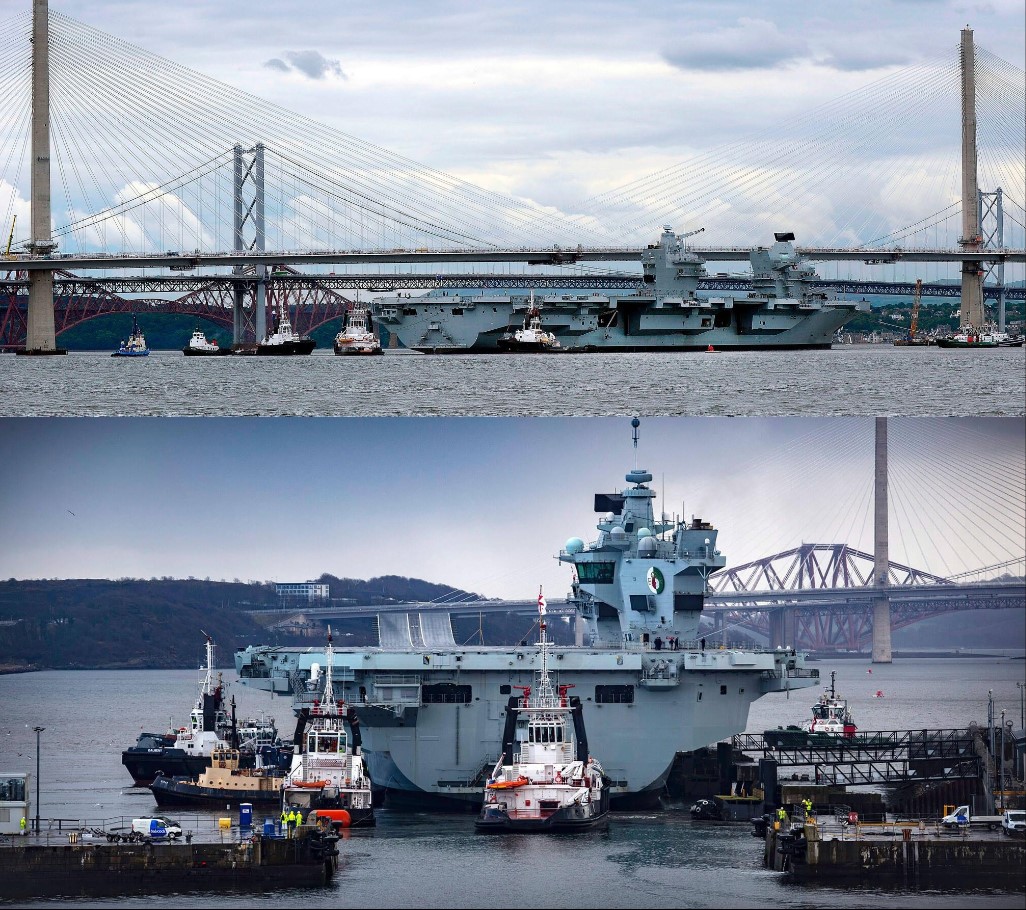
ROSYTH, SCOTLAND — April 20, 2026 : The Royal Navy’s flagship, HMS Queen Elizabeth, has departed the Rosyth dockyard following the completion of a major upkeep period and is currently anchored in the River Forth. The aircraft carrier exited the non-tidal basin on April 19 and is now awaiting a suitable tidal window to pass beneath the Forth Bridges before beginning a planned series of sea trials.
The movement marks the conclusion of an extensive maintenance and inspection cycle lasting just over eight months. The work, originally scheduled for approximately seven months, was extended to accommodate the complexity of engineering upgrades and regulatory requirements.
Maintenance Timeline and Regulatory Framework
The upkeep programme began in November 2024 while the carrier was alongside in Portsmouth. This initial phase focused on preparatory engineering work, including early upgrades to key onboard systems. On July 16, 2025, the vessel departed Portsmouth and transited to Rosyth to enter dry dock for the second phase of maintenance.
The docking formed part of a mandatory six-year inspection cycle conducted under Lloyd’s Register Rules, which govern safety certification for much of the Royal Navy fleet. These regulations require comprehensive dry-dock inspections, including structural surveys and system validation to ensure continued seaworthiness.
At Rosyth, the programme was managed by Babcock International, which described the ship’s departure as a milestone within the broader 10-year dry-dock maintenance cycle for the Queen Elizabeth-class carriers.
Engineering Work and System Upgrades
The maintenance period included a wide range of technical work covering propulsion, structural integrity, and underwater systems. Significant upgrades were carried out on the carrier’s propulsion system to improve long-term reliability following sustained operational use since entering service in 2017.
Comprehensive inspections were conducted on the hull, rudders, and propellers as part of the dry-dock survey. In addition, engineers carried out maintenance on underwater fittings, including hull valves and sea chests, which are critical for ship operations and susceptible to corrosion over time.
The vessel also underwent rigorous safety inspections required to maintain its maritime certification under Lloyd’s standards.
One planned enhancement—the installation of the “Bedford Array,” a precision visual landing aid designed to support Shipborne Rolling Vertical Landing (SRVL) operations for F-35B Lightning II aircraft—was ultimately not implemented. Officials cited cost-saving measures and the ongoing development of the Royal Navy’s hybrid aircraft carrier concept as the primary reasons for cancelling the upgrade.
Current Status and Sea Trial Preparations
Following its departure from the dockyard, HMS Queen Elizabeth remains at anchor in the River Forth. The next stage of activity will involve transiting through the narrow Rosyth lock system and passing under the Forth Bridges, a maneuver that requires precise timing due to tidal constraints and weather conditions.
Once clear of the estuary, the carrier will begin sea trials to test the performance of upgraded propulsion systems and other engineering modifications. These trials will also validate the readiness of the ship’s company after the extended maintenance period.
Upon successful completion of trials, the vessel is expected to return to its home port in Portsmouth.
Operational Outlook and Fleet Positioning
Although HMS Queen Elizabeth currently has a full complement of crew, its immediate operational schedule has not been formally confirmed. There is internal speculation that the carrier could enter a period of reduced readiness after completing sea trials, allowing the Royal Navy to balance maintenance cycles between its two carriers.
Its sister ship, HMS Prince of Wales, is currently held at five days’ notice to deploy. The vessel is expected to lead Operation FIRECREST in the coming weeks, a NATO-aligned deployment to the North Atlantic and High North regions. The operation will involve coordination with United States, Canadian, and European naval forces and is intended to support regional security objectives, including the protection of undersea infrastructure and deterrence of Russian maritime activity.
Wider Royal Navy Fleet Context
The return of HMS Queen Elizabeth to operational availability comes amid broader efforts to improve readiness across the Royal Navy’s surface fleet, particularly among frigates and destroyers.
Work is ongoing to return HMS Portland and HMS Iron Duke to active service, with challenges related to crew availability and funding. Meanwhile, HMS Sutherland has not yet resumed operational deployment following the completion of its Life Extension (LIFEX) programme in January 2025, and HMS Kent is expected to emerge from its own major upkeep period in the near term.
The Royal Navy is prioritising the availability of escort vessels to support carrier strike operations and wider NATO commitments.
Transition to Operational Status
The successful exit from Rosyth’s confined dock system represents a key milestone in HMS Queen Elizabeth’s maintenance cycle. Navigation through the dockyard lock and onward transit under the Forth Bridges is constrained by narrow tidal windows and specific weather conditions, requiring careful coordination.
Sea trials will serve as the final validation phase before the carrier returns to active operational status. These trials will confirm the performance of propulsion upgrades and other engineering work completed during the upkeep period.
HMS Queen Elizabeth, launched in 2014 and commissioned in 2017, remains central to the United Kingdom’s carrier strike capability. The completion of this maintenance cycle ensures compliance with safety regulations while preparing the vessel for future operational deployments.
——— End of Article ———