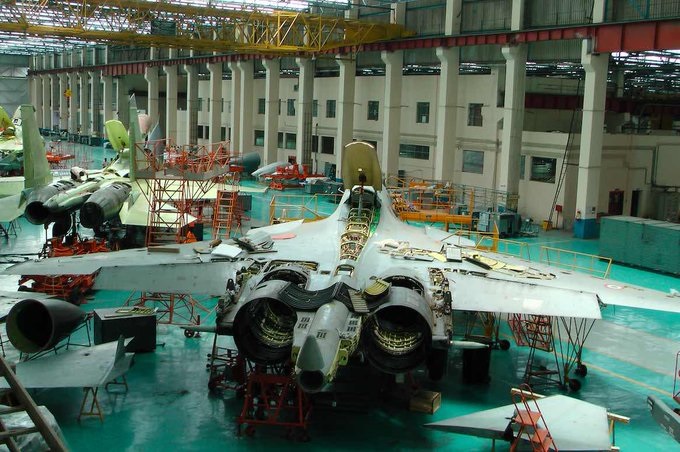
NASHIK, INDIA — April 4, 2026 : Hindustan Aeronautics Limited (HAL) has received foundational material kits from Russia for the licensed production of 12 Su-30MKI multi-role fighter aircraft at its Nashik division, marking the restart of assembly activities under a contract aimed at reinforcing the Indian Air Force (IAF) combat fleet.
The delivery supports a ₹13,500 crore (approximately $1.6 billion) agreement signed on December 12, 2024, between India’s Ministry of Defence (MoD) and HAL. According to officials, the arrival of these kits enables HAL to begin assembly operations, with the company maintaining its target to deliver all 12 aircraft to the IAF by the end of 2026.
Production Restart and Facility Role
HAL’s Nashik facility in Maharashtra will serve as the lead integrator for the program, carrying out final assembly, integration, and testing of the aircraft. The production line had remained inactive for over 12 months prior to the contract’s finalization and is now being reactivated to execute the order.
The facility has extensive experience with Russian-origin platforms and has previously produced 222 Su-30MKI aircraft under license since 2004. In total, HAL has manufactured and supported nearly 1,000 aircraft across multiple programs, including earlier MiG variants.
Indigenous Content and Industrial Contribution
The 12 aircraft will incorporate a reported 62.6 percent indigenous content, reflecting ongoing efforts under India’s Aatmanirbhar Bharat initiative to increase domestic manufacturing in defense production.
Key areas of indigenization include:
-
Mission systems and avionics: Integration of Indian-developed mission computers, avionics suites, and communication systems supplied by domestic industry partners.
-
Engine manufacturing: The AL-31FP turbofan engines are being produced at HAL’s Koraput division, with increasing use of locally sourced raw materials and forgings.
-
Weapons integration: Compatibility with indigenous systems such as the Astra beyond-visual-range (BVR) air-to-air missile and the BrahMos supersonic cruise missile.
The higher level of local content compared to earlier production batches indicates progressive replacement of imported components with domestically manufactured systems.
Fleet Role and Operational Context
The Su-30MKI remains the backbone of the IAF’s combat fleet. India has procured a total of 272 aircraft, of which 50 were delivered directly by Russia, while the remainder were assembled by HAL from completely knocked-down (CKD) kits.
Currently, the IAF operates approximately 30 to 31 fighter squadrons, below its sanctioned strength of 42. The additional 12 aircraft are intended to serve two primary purposes:
-
Attrition replacement: Replacing aircraft lost in accidents over the past decade.
-
Capability bridging: Addressing squadron shortages amid delays in the Tejas Mk-1A program linked to international engine supply constraints.
The Su-30MKI fleet accounts for nearly 60 percent of India’s combat aircraft inventory, with around 270 aircraft currently in service.
Technical Characteristics
The Su-30MKI is a twin-engine, two-seat heavy air superiority fighter designed for both air-to-air and air-to-ground missions. Its core specifications include:
-
Maximum speed: Mach 2.0 (approximately 2,100 km/h)
-
Combat radius: 1,300 km without aerial refueling
-
Radar: N011M Bars passive electronically scanned array (PESA)
-
Payload capacity: Up to 8,000 kg across 12 hardpoints
Upgrade Path and “Super Sukhoi” Program
The newly produced aircraft are expected to incorporate elements aligned with the planned “Super Sukhoi” upgrade program, valued at approximately ₹60,000 crore. This modernization effort will retrofit the existing fleet with:
-
Virupaksha active electronically scanned array (AESA) radar
-
Advanced electronic warfare (EW) suites
-
New digital cockpit systems developed by the Defence Research and Development Organisation (DRDO) and Indian private sector partners
The program aims to extend the operational lifespan of the Su-30MKI fleet by 20 to 30 years.
Strategic and Industrial Outlook
The delivery of material kits reflects the continuation of Indo-Russian defense cooperation under the licensed production framework established in 2000. At the same time, the increased indigenous content highlights India’s gradual shift toward greater self-reliance in defense manufacturing.
Following completion of this batch, HAL’s Nashik facility is expected to transition toward large-scale modernization work under the Super Sukhoi program, alongside ongoing maintenance, repair, and overhaul (MRO) activities for the existing fleet.
No detailed breakdown of delivery milestones for individual aircraft has been released. However, officials indicate that production timelines remain aligned with the scheduled completion by December 2026.
——— End of Article ———