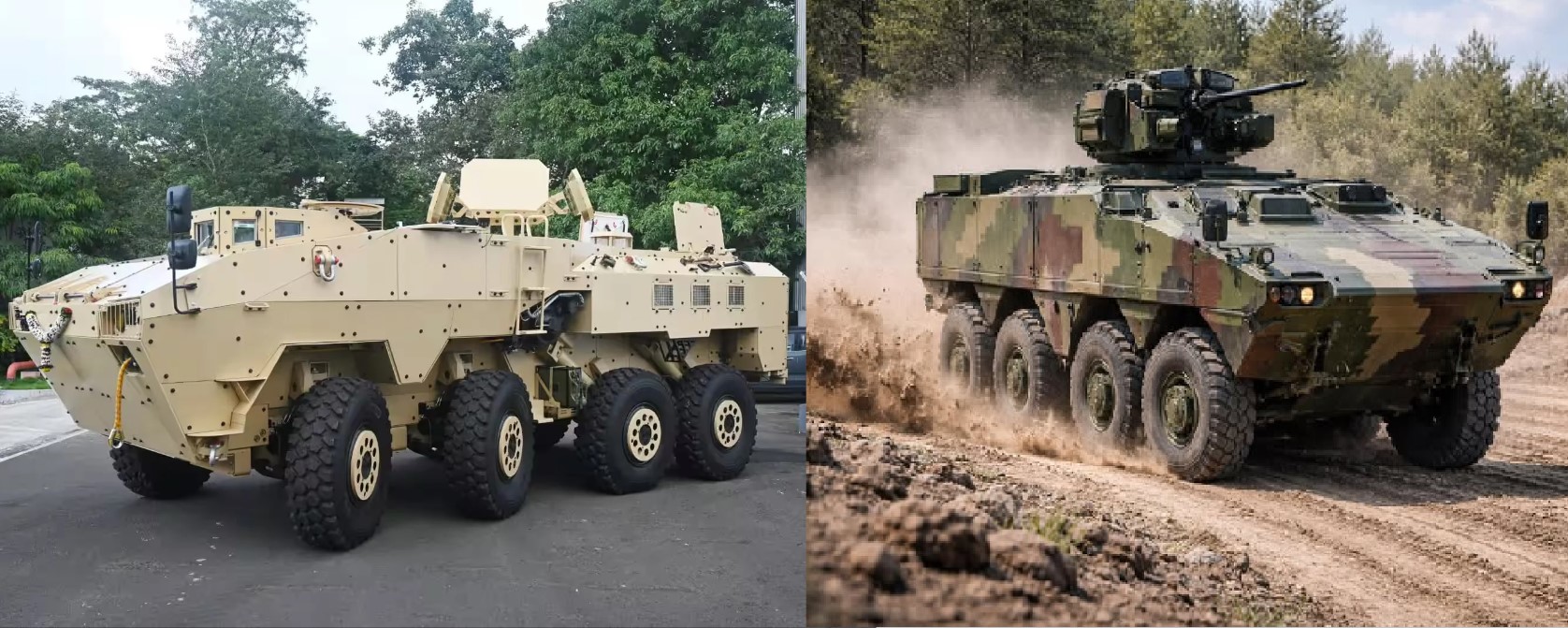
Athens — The Greek Army has formally initiated an evaluation of India’s Wheeled Armoured Platform (WhAP) 8×8 armored infantry fighting vehicle, signaling a notable shift in Athens’ approach to future armored force modernization. The move follows high-level engagements between the Hellenic Army General Staff and India’s Tata Advanced Systems, and marks the first known instance of a NATO country assessing the Indian-developed WhAP for potential frontline service.
According to defense officials familiar with the process, the evaluation phase was triggered after a December 12, 2025 meeting in Athens, where senior Greek military planners and Tata Advanced Systems executives discussed the temporary deployment of the vehicle to Greece for operational trials. While no formal procurement request has yet been issued, the assessment is widely viewed as a critical step toward expanding Greece’s options for modern wheeled armored platforms amid evolving regional security pressures.
Strategic Context Behind the Move
Greece’s decision comes as the Hellenic Army seeks to gradually replace and supplement an aging fleet of legacy armored vehicles, many of which struggle to meet contemporary standards of mobility, protection, and digital integration. With operational responsibilities spanning mainland Greece, island formations in the Aegean Sea, and riverine environments such as the Evros region, Athens has placed renewed emphasis on high-mobility, amphibious-capable wheeled platforms that can deploy rapidly and operate across mixed terrain.
In this context, the WhAP 8×8 has emerged as a platform aligned with Greece’s evolving operational requirements, particularly its ability to combine road speed, off-road endurance, and unassisted amphibious performance within a single modular design.
An Indigenous Indian Platform with Global Ambitions
The WhAP 8×8 is jointly developed by Defence Research and Development Organisation (DRDO) and Tata Advanced Systems, representing India’s first fully indigenous amphibious wheeled infantry fighting vehicle. The program originated under India’s long-running Future Infantry Combat Vehicle (FICV) initiative, launched in the late 2000s to reduce dependence on imported armored vehicles and establish a scalable, multi-role combat platform for future battlefields.
Designed around a modular architecture, the WhAP integrates STANAG Level 4 ballistic protection, scalable add-on armor, and a monocoque hull optimized for survivability. The platform can be configured with a remote weapon station or a manned 30 mm turret, depending on mission requirements, and supports additional battlefield systems such as modern sensors and battlefield management interfaces.
Mobility, Firepower, and Amphibious Capability
At the core of the WhAP’s performance envelope is a 600 horsepower Cummins ISXe diesel engine, coupled with an automatic transmission. This powertrain enables the vehicle to achieve road speeds of up to 100 km/h, while maintaining sustained off-road mobility across rough terrain. The vehicle accommodates a three-member crew and up to eight fully equipped infantry soldiers, with an internal layout designed for rapid embarkation and dismount under combat conditions.
A defining feature of the platform — and a key factor in Greek interest — is its fully amphibious capability. The WhAP employs twin water-jet propulsion systems, allowing it to conduct unassisted water crossings without external preparation, a capability particularly relevant for operations across Greece’s island chains and river crossings.
Production Status and Maturity
Although the WhAP has successfully completed extensive developmental and user trials in India, it has not yet entered full-rate mass production. As of early 2026, Tata Advanced Systems has completed a limited pre-series production run, with approximately 12 to 18 vehicles delivered for Indian Army evaluation and extended trials. Broader procurement under India’s FICV roadmap has been delayed due to evolving operational requirements and structural reforms within India’s defense acquisition framework.
Despite these delays, the WhAP remains the most mature indigenous wheeled armored IFV in India’s defense industrial pipeline, positioning it as a viable option not only for domestic forces but also for international partners exploring alternatives to traditional Western platforms.
Potential Implications for Greece–India Defense Cooperation
Greek defense analysts note that the WhAP evaluation could open the door to deeper defense-industrial cooperation between Athens and New Delhi. Beyond outright procurement, discussions may eventually extend to licensed production, localized assembly, or technology transfer, aligning with Greece’s broader objective of revitalizing its domestic defense manufacturing base.
For India, Greece’s decision to test the WhAP represents a strategic milestone, offering validation of its indigenous armored vehicle programs within a NATO operational framework. The outcome of the Hellenic Army’s trials is expected to be closely watched by both European defense planners and emerging defense exporters.
As evaluations progress in the coming months, the WhAP 8×8’s performance under Greek operational conditions may well determine whether this Indian-designed platform transitions from a promising export candidate to a tangible component of NATO-aligned armored forces.
——— End of Article ———