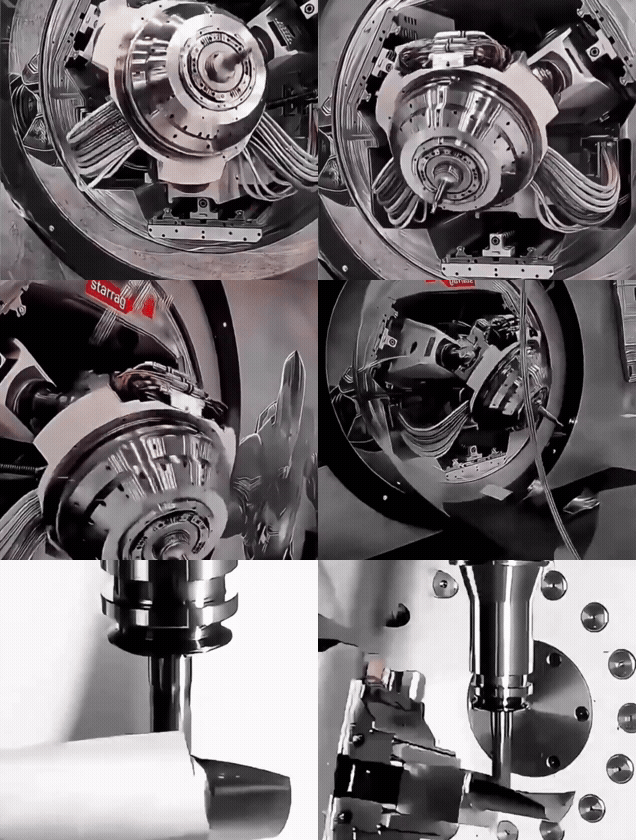
MÖNCHENGLADBACH, Germany — April 12, 2026 : Germany has introduced a newly engineered 5-axis Computer Numerical Control (CNC) machine for aerospace manufacturing, incorporating a specialized parallel kinematic head to enable high-speed machining of complex aluminium components. The system is designed to achieve a material removal rate of up to 12 liters (12,000 cubic centimeters) per minute, targeting efficiency improvements for aerospace subcontractors and original equipment manufacturers (OEMs) producing large monolithic aerostructures.
Parallel Kinematic Head Enables High Dynamic Performance
The defining feature of the machine is its parallel kinematic head architecture, based on principles similar to the Sprint Z3 concept used in advanced aerospace machining systems. Unlike conventional fork-type or trunnion-based 5-axis heads that rely on sequential rotary axis movements, the system uses three radially arranged linear drives to control spindle motion simultaneously.
This configuration allows continuous angular adjustment of the spindle within a conical working envelope of ±45 degrees without requiring large swivel movements. By reducing the moving mass and distributing loads across multiple drives, the system achieves acceleration levels of up to 1G along with high jerk values, enabling rapid directional changes during machining.
The machine is equipped with a high-power spindle capable of continuous operation at speeds of up to 30,000 revolutions per minute. Combined with the dynamic head movement, the system maintains consistent peak aluminium removal rates of 12 liters per minute while adhering to tight dimensional tolerances required in aerospace manufacturing.
Focus on Monolithic Aerostructure Production
The machine is optimized for machining large monolithic components, a standard practice in modern aircraft manufacturing where parts are milled from solid aluminium or aluminium-lithium alloy billets. This approach improves structural integrity and reduces overall weight compared to assemblies made from multiple smaller components.
Primary applications include wing ribs and spars, which define aerodynamic shape and load distribution, as well as fuselage frames and bulkheads that serve as critical load-bearing structures. These components typically involve complex pocketing operations, deep cavities, and freeform surfaces requiring simultaneous 5-axis machining.
In typical aerospace workflows, up to 90 percent or more of the original material is removed during machining. A raw billet weighing approximately 4,000 kilograms can be reduced to a finished component weighing around 120 kilograms. The machine’s high removal rate significantly reduces cycle times during these heavy roughing operations while supporting subsequent finishing processes with high surface quality.
Capability for Single-Setup Machining
The system supports full 5-axis simultaneous machining, allowing complex geometries to be produced in a single setup. This reduces the need for multiple fixtures and repositioning, minimizing alignment errors and non-cutting time. The machine is also capable of handling undercuts, curved surfaces, and deep internal features, which are common in aerospace structural parts and moulds for composite layups.
Applications extend to structural brackets, frames, engine casings, turbine-related aluminium components, and tooling used in composite manufacturing processes.
Comparison with Global Machine Tool Systems
Within the global machine tool market, the system operates in a segment defined by high-volume aluminium machining for aerospace applications.
Conventional 5-axis CNC systems from manufacturers such as DMG MORI and Hermle are widely used for high-precision machining but typically employ serial kinematic architectures, including trunnion tables or swivel heads. While highly versatile, these machines generally deliver lower peak material removal rates compared to dedicated high-volume systems.
At a comparable performance level, Japan’s Makino MAG series, including models such as the MAG1 and MAG3, provides similar aluminium machining capability. These machines use horizontal machining center configurations with high-speed spindles and optimized chip evacuation systems rather than parallel kinematic heads.
At the upper end of volumetric material removal, Sweden’s Modig Machine Tool produces the RigiMill system, which exceeds 16.4 liters (1,000 cubic inches) per minute in aluminium removal under optimized conditions. These machines achieve higher throughput using dual-spindle configurations and highly rigid structural designs.
Relation to Existing Parallel Kinematic Systems
The German system aligns with established parallel kinematic machining platforms such as the Ecospeed series developed by Starrag, which also utilizes Sprint Z3-based head technology. Ecospeed machines, in operation since 1999, are used for machining large aerostructures, including components up to 20 meters in length, and achieve comparable removal rates in aluminium.
Other parallel kinematic solutions, including pentapod-based systems such as those developed by Metrom, provide high dynamic motion with acceleration levels around 10 m/s² and feed speeds approaching 1 meter per second. These systems are typically deployed in specialized high-productivity machining environments.
Distinction from Hard Metal Machining Systems
The newly introduced CNC machine is specifically optimized for aluminium and aluminium-alloy machining. It is not designed for hard metals such as titanium or Inconel, which require different machine characteristics.
Machines intended for titanium aerospace components, including systems such as Starrag’s STC series or specialized platforms from Grob, emphasize high torque, damping capacity, and structural rigidity rather than high spindle speed and maximum material removal rate. These systems represent a separate category of machining technology tailored to different material properties.
Industry Context
The introduction of this machine reflects ongoing efforts within Germany’s machine tool sector to improve productivity, reduce machining cycle times, and support cost-efficient production of complex aerospace components. By combining high-speed spindle operation, parallel kinematic motion control, and large-scale material removal capability, the system addresses increasing demand for lightweight, high-strength aerostructures in modern aircraft manufacturing.
Further details regarding the manufacturer, model designation, and deployment timelines have not been disclosed in the initial announcement.
——— End of Article ———