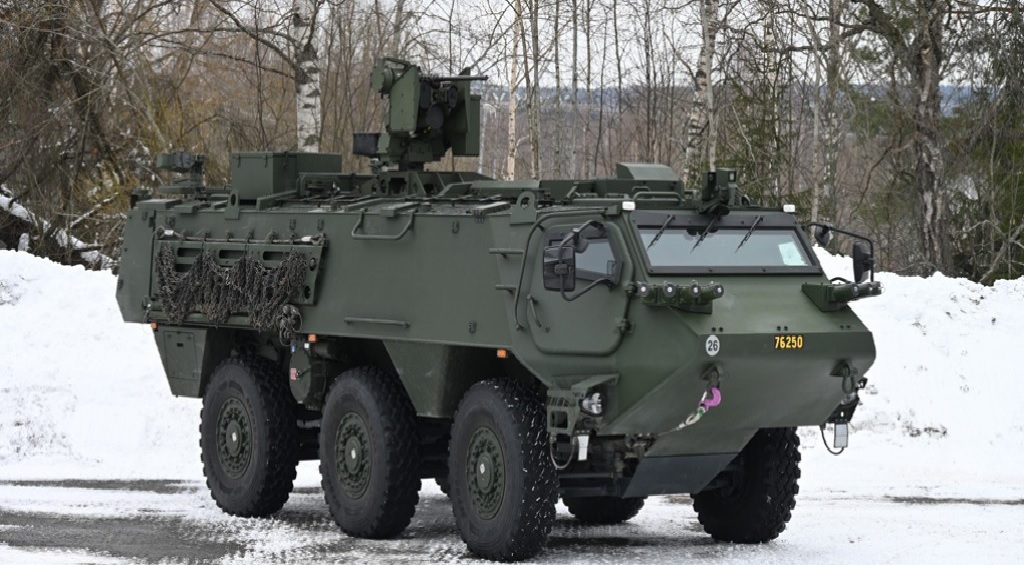
ZEITHAIN, Germany — February 23, 2026 : The German Armed Forces (Bundeswehr) have received the first five pre-series Patria 6x6 armored vehicles at the Zeithain material depot, formally initiating a €2 billion procurement program aimed at replacing the long-serving TPz Fuchs fleet. The handover was conducted by Patria Deutschland and overseen by the Federal Office of Bundeswehr Equipment, Information Technology and In-Service Support (BAAINBw).
The delivery marks the operational start of Germany’s participation in the multinational Common Armoured Vehicle System (CAVS) framework. The five vehicles are pre-production platforms configured as Swedish-style Armored Personnel Carriers (APCs) and are designated within Germany as the Transportpanzer Neuer Generation. These units will not immediately enter frontline service but are assigned for operator training, maintenance familiarization, doctrine development, and technical verification ahead of serial production.
Program Scope and Procurement Structure
Germany joined the CAVS program through a Technical Arrangement in 2023, following preliminary steps in 2022. The CAVS framework is led by the Finnish Defence Forces and includes Finland, Latvia, Sweden, Germany, Denmark, the United Kingdom, and Norway. The program remains open to additional European countries subject to mutual agreement.
In December 2025, Germany and Patria finalized two procurement contracts valued at over €2 billion, covering up to 876 Patria 6x6 vehicles across four approved variants. Within this total, an initial funded order of 296 vehicles is valued at approximately €959 million. The contracts include firm orders exceeding €1 billion, with additional options structured within the overall ceiling.
The German order represents the largest single contract in Patria’s history. Across all participating nations, Patria has received orders, including options, for nearly 2,000 Patria 6x6 vehicles and has delivered more than 300 platforms to date.
Operational Variants and Roles
The 876 vehicles are planned in four primary configurations:
-
Engineer group transport
-
Armored reconnaissance group transport
-
Heavy mortar carrier
-
Fire control vehicle
Some variants will integrate the Patria NEMO 120 mm turreted mortar system. The NEMO system provides protected, traversable indirect fire capability with direct-fire modes, Multiple Rounds Simultaneous Impact (MRSI) functionality, and a firing rate of up to 10 rounds per minute.
Other variants will be equipped with the Kongsberg PROTECTOR RS4 remote weapon station. The RS4 can mount a 12.7 mm heavy machine gun or a 40 mm automatic grenade launcher. Kongsberg has confirmed orders for RS4 systems for more than 300 CAVS vehicles.
The vehicles are intended to support engineering troops, armored reconnaissance units, and combat support elements, providing protected mobility and modular fire support in high-intensity land warfare scenarios aligned with NATO requirements.
Industrial Strategy and Technology Transfer
Initial production for Germany is being carried out at facilities in Finland and Latvia. However, the industrial framework includes phased technology transfer to German partners under an industrial teaming agreement signed in early 2024.
German companies participating in the program include FFG, JWT, and KNDS Deutschland. Serial production will progressively shift to Germany beginning in 2027, primarily at the KNDS Deutschland facility in Freisen, where production capacity is being expanded. The first fully domestically produced vehicles are scheduled for delivery in 2027.
The localized production model is designed to establish full-cycle maintenance, repair, and overhaul capability within Germany, ensuring long-term security of supply and support for potential future Bundeswehr requirements.
Technical Specifications
The Patria 6x6 is a 6x6 wheeled armored vehicle designed to provide a balance between mobility, protection, and cost efficiency.
Key specifications include:
-
Gross Vehicle Weight: approximately 24 tonnes
-
Payload Capacity: approximately 8.5 tonnes
-
Length: 7.5 meters
-
Width: 2.9 meters
-
Height: 2.5 meters
-
Engine: Scania DC09 diesel engine rated at 294 kW (400 hp)
-
Maximum Road Speed: over 100 km/h
-
Amphibious Capability: water speed approximately 8 km/h
-
Protection Level: STANAG 4569 Level 2 (ballistic and mine), upgradeable to Level 4 depending on configuration
-
Crew Capacity: typically 3 crew members plus up to 10 troops in APC configuration
The platform is designed for modular integration of mission kits and compatibility with Bundeswehr logistics systems. It provides amphibious mobility as a standard design feature.
Replacement of TPz Fuchs and Force Structure Integration
The Patria 6x6 will replace the TPz Fuchs armored personnel carrier, which has been in service since the early 1980s. The modernization effort seeks to address limitations in protection growth, payload capacity, and standardization associated with the legacy fleet.
The new vehicle bridges the capability gap between the lighter, older Fuchs platform and heavier systems such as the Boxer 8x8, which can reach up to 45 tonnes and offer higher survivability but at increased procurement and lifecycle costs.
During the selection process, the Patria 6x6 was chosen over competitors including Rheinmetall’s Fuchs Evolution upgrade and GDELS’ Pandur Evolution. Evaluation criteria emphasized modularity, amphibious capability, scalability, payload capacity, and alignment with multinational production under the CAVS framework.
NATO Alignment and Operational Context
The CAVS program emphasizes interoperability among member states, integration of mission modules, scalable protection aligned with threat environments, and distributed industrial participation. Vehicles under the program are already operational in Ukraine through Latvian deployments, demonstrating performance in environments characterized by artillery and drone threats.
Germany’s adoption of the platform supports the Bundeswehr’s objective of achieving full combat readiness by 2029. Standardizing the Patria 6x6 across engineering, reconnaissance, mortar, and fire-control units is intended to streamline training, reduce logistical complexity, and enhance deployability within NATO’s collective defense structure.
With the first five pre-series vehicles now delivered and serial production scheduled to expand through domestic manufacturing from 2027, the program transitions into its implementation phase as Germany restructures its protected mobility fleet under the CAVS framework.
——— End of Article ———