Berlin : Germany is preparing to procure at least three MEKO A-200 frigates for the German Navy under a parallel acquisition framework, as continued delays affect the F-126 Niedersachsen-class frigate program. The plan, reported by Reuters on January 21, 2026, is intended to ensure that new surface combatants enter service from 2029, preserving naval readiness while the primary program remains unresolved.
Under the proposal, the MEKO A-200 frigates would be built by Thyssenkrupp Marine Systems (TKMS) in Germany. Parliamentary budget authorities have been informed of a preliminary arrangement, and work is continuing within the federal government toward a binding construction contract. The indicative unit cost is approximately €1 billion per ship (about $1.17 billion), with deliveries scheduled to begin in 2029 and subsequent vessels following at intervals of less than twelve months.
Link to F-126 Program Delays
The alternative procurement path is directly linked to difficulties surrounding the F-126 program, which originally planned for six large multi-role frigates. That program has experienced multi-year schedule slippage and unresolved industrial and execution challenges. To mitigate the risk of a capability gap, Germany’s budget committee approved a financial framework in 2025 allowing parallel planning rather than an immediate cancellation of the F-126 effort.
This framework includes €7.8 billion earmarked for an alternative solution that can be activated if delays continue. While the F-126 program has not been formally terminated, the parallel option is tied to an operational requirement that new frigates must be delivered from 2029. Failure to meet this timeline would directly affect fleet availability, training cycles, and deployment commitments of the German Navy.
Current provisions allow for the acquisition of up to eight MEKO A-200 frigates should the F-126 program be further delayed or cancelled, providing flexibility in force-structure planning.
Contract Structure and Budget Planning
Implementation planning foresees the use of a preliminary contract mechanism to accelerate industrial preparations. An initial amount of around €50 million would be used to secure shipyard capacity, reserve production slots, order long-lead components, and advance detailed design work adapted to German Navy requirements.
If a full construction contract is not concluded by March 31, 2026, the preliminary arrangement could be extended to April 30. In that case, an additional €100 million would become payable if the project advances further. Medium-term financial planning includes €724.7 million for 2026 from special defense funds, followed by €878.2 million in commitment authority for 2027. From 2028 onward, approximately €6.2 billion in commitment authority is planned from the core defense budget, with expenditures extending through 2033.
Alongside TKMS as prime contractor, several German industrial partners are referenced for participation, including Ostseestahl GmbH (Stralsund), Renk AG (Augsburg), Stahlbau Nord (Bremerhaven), and Noske-Kaeser (Hamburg). Initial physical activities, such as steel cutting and procurement of long-lead items, are expected to begin shortly after a preliminary contract enters into force.
Platform Characteristics
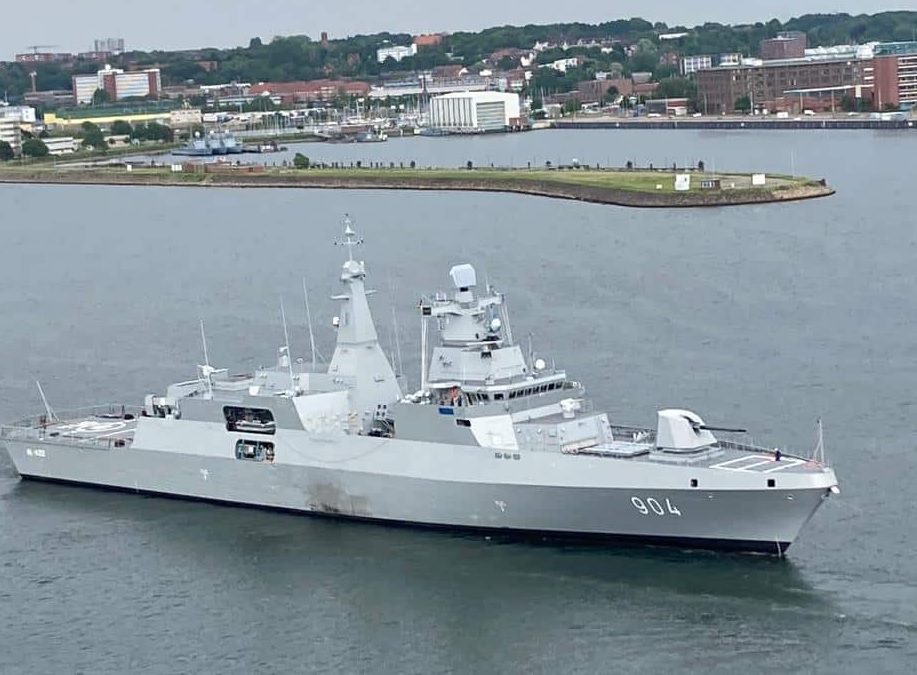
The MEKO A-200 is a medium frigate design with a length of about 121 meters, a beam of 16.4 meters, and a design draught of roughly 4.4 meters. Full-load displacement is approximately 3,950 tonnes. The standard crew complement is around 125 personnel, with accommodation for up to 49 additional embarked personnel, allowing flexibility for mission specialists, staff elements, or trainees.
Propulsion is based on a CODAG-WARP configuration (Combined Diesel and Gas – Waterjet and Refined Propellers). Two diesel propulsion chains rated at about 6 MW each are combined with a 20 MW gas turbine driving a centerline waterjet. This arrangement supports a maximum speed exceeding 29 knots and an operational range of more than 6,500 nautical miles at 16 knots, enabling long-endurance deployments.
Aviation, Boats, and Seakeeping
The aviation facilities support a broad range of mission profiles. The flight deck and hangar can accommodate two 6-ton-class helicopters or one 11-ton-class helicopter, such as the NH90, alongside up to two unmanned aerial vehicles. Boat facilities include two rigid-hulled inflatable boats of up to eight meters, deployed via side-mounted launch and recovery systems.
Seakeeping features include a forefoot skeg and active fin stabilizers, improving stability and maneuverability. Helicopter and small-boat operations are designed to be conducted up to sea state 6, supporting operations in both coastal and open-ocean environments.
Signature Reduction and Survivability
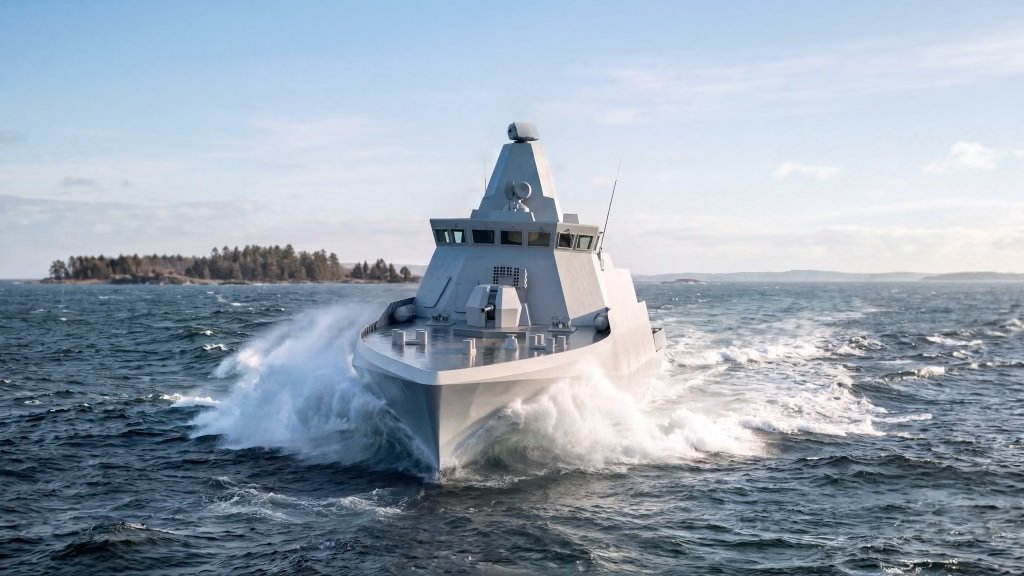
Signature management and survivability are integral to the MEKO A-200 design. The hull incorporates an X-form geometry to reduce radar reflections. Exhaust management avoids a conventional funnel, allowing gases to be cooled and discharged horizontally or below the waterline, reducing infrared and thermal signatures.
Acoustic signature reduction is achieved through machinery isolation, aft placement of propulsion components, refined propeller design, and the use of a waterjet. A tri-axial degaussing system reduces the magnetic signature. The high-tensile steel hull is subdivided into multiple watertight sections, each with independent control, power, and firefighting systems, improving damage control and combat survivability.
Operational Context and International Use
The MEKO family encompasses a wide range of frigate variants in service worldwide. The MEKO 200 series is operated by the navies of Turkey, Greece, Portugal, Australia, and New Zealand. The MEKO A-200 subfamily is in service with South Africa, Algeria, and Egypt.
South Africa operates four MEKO A-200SAN frigates, Algeria operates two A-200AN ships, and Egypt operates three A-200EN frigates, with additional units under construction following an expanded order that brings the total to six, including local construction in Egypt. Export configurations demonstrate flexibility in combat system integration, with variations in main gun calibers, vertical launch system capacities typically ranging from 16 to 32 cells, and anti-ship missile loads generally between eight and sixteen missiles, depending on customer requirements.
——— End of Article ———