BERLIN, — June 10, 2026 : The German Navy is moving forward with plans to significantly enhance the air defense capabilities of its F125 Baden-Württemberg-class frigates through the integration of the IRIS-T SLM Naval air defense system. The development was announced by Diehl Defence during the ILA Berlin 2026 Air Show, where company officials outlined plans to equip each frigate with a dedicated 32-cell missile launcher configuration.
The upgrade marks a major step in strengthening the defensive capabilities of the F125 class, which has often been viewed as lightly armed for ships of their size. Originally designed for long-duration stabilization and maritime security missions, the frigates were optimized for low-intensity operations rather than high-end naval warfare. As security requirements evolve, Germany is seeking to improve the vessels’ ability to counter modern aerial threats.
New 32-Cell Missile Configuration
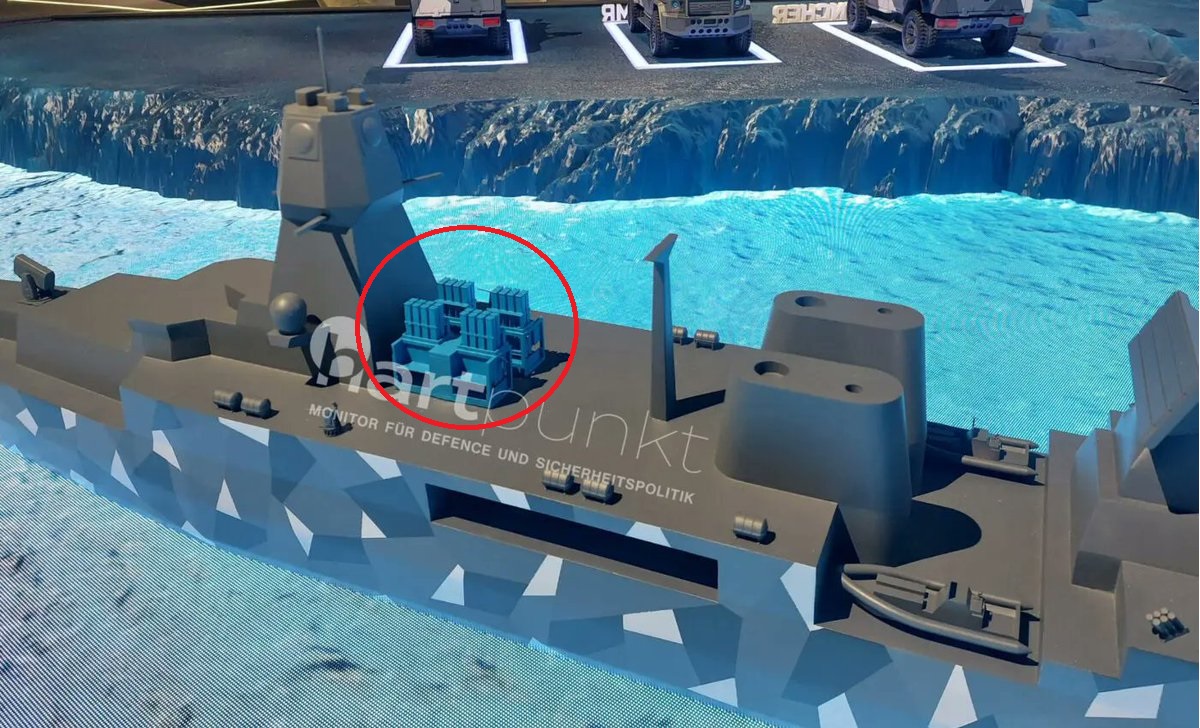
According to Harald Buschek, Chief Program Officer at Diehl Defence, each F125 frigate will receive two newly developed naval launchers. Each launcher will accommodate 16 IRIS-T SLM missiles, giving every vessel a total of 32 ready-to-fire interceptors.
The launcher has been specifically designed for naval operations and differs significantly from the truck-mounted ground-based IRIS-T SLM system currently in service. Rather than using hydraulic systems to raise launch canisters into firing position, the naval version will feature permanently installed vertical launch canisters.
The design also eliminates the stabilization supports required for land-based deployment, reducing weight and saving valuable deck space aboard the frigates. To protect the ship during missile launches, deflector plates will be installed at the base of the launcher to direct hot exhaust gases away from the deck.
Diehl Defence expects a prototype of the new launcher to be completed by 2027. Buschek indicated that the first high-seas firing test of the permanent launcher configuration could take place as early as the second quarter of next year.
Addressing a Long-Standing Air Defense Gap
The F125 class currently relies primarily on two RIM-116 Rolling Airframe Missile (RAM) launchers for air defense. While effective against close-range threats, the RAM system provides an engagement range of approximately 9 kilometers and is intended mainly for point defense.
The addition of the IRIS-T SLM Naval system will significantly expand the frigates’ defensive envelope. The missile offers an engagement range of up to 40 kilometers and can intercept targets at altitudes of up to 20 kilometers.
This capability will enable the ships to engage threats such as sea-skimming anti-ship missiles, cruise missiles, unmanned aerial vehicles, helicopters, and combat aircraft at much greater distances before they enter the RAM system’s engagement zone. The result will be a layered air defense architecture combining medium-range and short-range protection.
Integration with Future Combat Systems
Diehl Defence is currently engaged in contract negotiations with Germany’s Federal Office of Bundeswehr Equipment, Information Technology and In-Service Support (BAAINBw) regarding procurement of the launchers and associated integration work.
A central element of the program is the integration of the IRIS-T SLM Naval system with the CMS 330 combat management system, which is set to become the German Navy’s future command-and-control architecture for surface combatants.
The F125 frigates are expected to be the first vessels in the fleet equipped with CMS 330. Integration with the combat management system will allow the missiles to receive targeting information directly from the ship’s sensors and enable coordinated engagement of airborne threats.
Buschek also confirmed that discussions are underway regarding the potential future integration of IRIS-T SLM missiles into the Lockheed Martin Mk 41 Vertical Launching System (VLS), which is already used aboard several German Navy warships. Such an integration could expand the missile’s deployment across additional naval platforms in the future.
Building on Successful Sea Trials
The development of the dedicated naval launcher follows a successful proof-of-concept demonstration conducted during the Andøya 2025 maritime firing exercise in Norway.
During the exercise, a modified land-based IRIS-T SLM launcher was temporarily installed aboard the frigate Baden-Württemberg. The demonstrator successfully engaged test targets using tracking data supplied by the ship’s Hensoldt TRS-4D active electronically scanned array (AESA) radar.
The trial demonstrated the feasibility of operating the missile system from a naval platform and validated key aspects of the concept. However, the launcher was not yet connected to the CMS 330 combat management system during the exercise, highlighting the need for the integration work currently being negotiated with the BAAINBw.
Modernizing the F125 Fleet
The F125 Baden-Württemberg-class consists of four frigates: Baden-Württemberg, Nordrhein-Westfalen, Sachsen-Anhalt, and Rheinland-Pfalz. Commissioned between 2016 and 2022, the vessels are among the largest frigates in service worldwide, displacing approximately 7,000 to 7,200 tonnes when fully loaded.
Designed for extended overseas deployments, maritime security missions, crisis response operations, and support for special forces, the ships were built with a focus on endurance and operational flexibility rather than heavy air warfare capabilities.
The planned integration of the IRIS-T SLM Naval system represents one of the most significant combat capability upgrades for the class since entering service. By providing medium-range, 360-degree air defense coverage and expanding engagement ranges beyond existing point-defense systems, the modernization effort is expected to substantially improve the survivability and operational effectiveness of the F125 frigates in increasingly demanding maritime environments.
——— End of Article ———