STEISSLINGEN, Germany : SatService GmbH has secured a contract from the German Federal Ministry of Defence to deliver an advanced Q/V-band satellite ground station for the German Armed Forces. The project, coordinated through the University of the Federal Armed Forces in Munich (UniBw M), will establish new high-frequency satellite communications infrastructure designed to support both military operations and scientific research.
SatService, headquartered in Steißlingen, Germany, is a provider of satellite ground systems and operates as a subsidiary of the Canadian technology company Calian Group Ltd. Under the agreement, the company will undertake the complete lifecycle of the ground station’s development, including system design, manufacturing, integration, testing, and final delivery.
Technical Scope and System Architecture
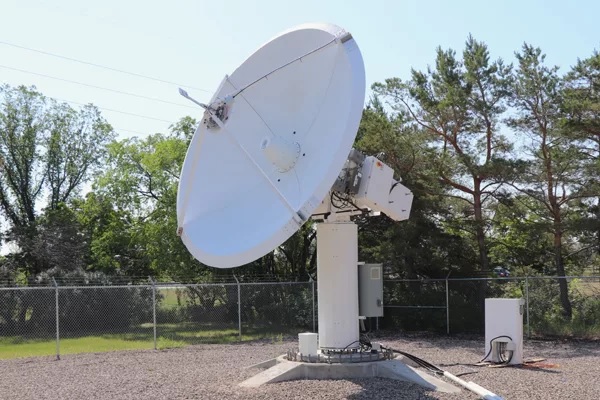
The core component of the system is a 4-meter antenna engineered to operate in the Q/V-band frequency range (approximately 40 to 75 GHz). The ground station is configured for geostationary orbit (GEO) satellite applications, enabling high-capacity feeder links and advanced data transmission capabilities.
In addition to the antenna system, the contract includes delivery of the full operational infrastructure. This comprises SatService’s proprietary “sat-nms” monitoring and control software, associated hardware components, and a cyber-secure network architecture designed to meet defense security requirements. The integrated system is intended to provide reliable, high-throughput satellite communications with secure command and control functionality.
Strategic Rationale for Q/V-Band Capability
The addition of Q/V-band capacity reflects a broader shift within European defense organizations toward higher-frequency satellite communications. As lower-frequency spectrums such as UHF, C, X, Ku, and Ka bands become increasingly congested, Q/V-band frequencies offer wider bandwidth availability and support significantly higher data rates.
Access to these higher frequency bands is considered important for sustaining modern military communications, particularly for feeder links in next-generation satellite architectures. Germany and other European Union member states have been expanding investments in sovereign satellite communication capabilities to strengthen operational independence and resilience.
Wilfried Megger, Managing Director of SatService GmbH, stated that diversified access to advanced frequency bands is an essential component of safeguarding national and European communication sovereignty.
Integration at the Munich Center for Space Communications
Once operational, the Q/V-band ground station will be incorporated into the terrestrial laboratory infrastructure at UniBw M’s Munich Center for Space Communications. The facility currently operates extensive over-the-air testing environments covering UHF, C, X, Ku, and Ka-band frequencies. Prior to this project, Q/V-band testing capability was not available at the site.
The new installation will enable research into Very High Throughput Satellites (VHTS) and next-generation GEO communication systems. It will also support direct communication links between geostationary satellites and ground-based scientific facilities, expanding the university’s research and validation capabilities in high-frequency satellite systems.
Training and Operational Applications
Beyond research functions, the ground station will serve as a training platform for German Armed Forces officer candidates and technical personnel. The system is intended to provide practical instruction in secure, high-throughput satellite communications and GEO-based network operations.
The Q/V-band infrastructure is designed to support C5ISRT functions — Command, Control, Communications, Computers, Cyber, Intelligence, Surveillance, Reconnaissance, and Targeting. By integrating high-capacity and secure satellite connectivity, the system aims to strengthen communication resilience in operational environments where spectrum congestion and electronic interference pose challenges.
The project marks an expansion of Germany’s domestic satellite communications infrastructure and introduces Q/V-band capability into the country’s military and academic research framework for the first time at UniBw M.
——— End of Article ———