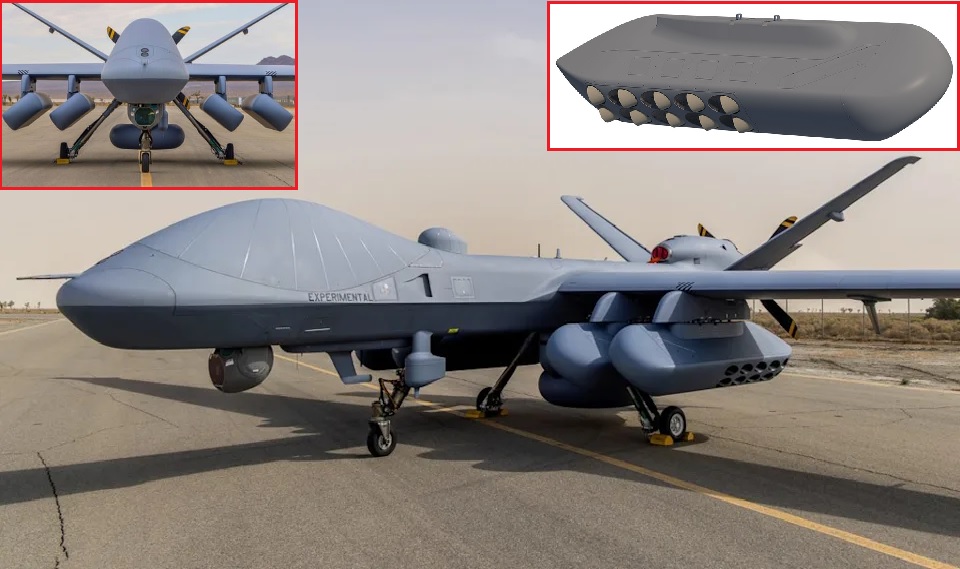
OTTAWA — May 31 2026 : General Atomics Aeronautical Systems, Inc. (GA-ASI) has unveiled an expanded anti-submarine warfare (ASW) configuration of its MQ-9B SeaGuardian Remotely Piloted Aircraft (RPA), displaying the unmanned platform equipped with four Sonobuoy Dispensing System (SDS) pods during the Canada Security (CANSEC) 2026 defence exhibition held from May 27 to May 28.
The new aircraft configuration, revealed through imagery released at CANSEC 2026, marks a development in the SeaGuardian’s maritime warfare role. Earlier public renderings, promotional material, and testing imagery had largely shown the aircraft carrying only two SDS pods. The newly displayed arrangement doubles the number of pods and expands the aircraft’s sonobuoy deployment capacity for anti-submarine missions.
Expanded Sonobuoy Payload for Maritime Surveillance
The MQ-9B SeaGuardian displayed at CANSEC 2026 features four Sonobuoy Dispensing System (SDS) pods mounted diagonally beneath its wings. In addition to the sonobuoy payload, the aircraft carries a centerline pod capable of hosting maritime surveillance radar systems, enabling simultaneous surface and subsurface monitoring during naval operations.
According to GA-ASI, the centerline payload position can integrate maritime search multi-mode radar systems including the Leonardo Seaspray 7500E V2 and the Raytheon SeaVue radar. These systems are designed to improve maritime situational awareness by detecting and tracking vessels, monitoring sea traffic, and supporting naval surveillance operations.
The addition of four SDS pods effectively doubles the sonobuoy payload previously demonstrated by the platform. Each pod can carry up to 10 U.S. Navy standard “A” size sonobuoys or 20 smaller “G” size sonobuoys. As a result, the aircraft can carry a total of 40 “A” size sonobuoys or 80 “G” size sonobuoys in a single mission configuration.
GA-ASI states that an empty Sonobuoy Dispensing System pod weighs approximately 132 kilograms, while a fully loaded pod can weigh roughly 340 kilograms depending on payload configuration. Combined with the centerline radar pod, the four-pod arrangement represents one of the heaviest maritime mission loadouts publicly shown for the MQ-9B SeaGuardian.
Sonobuoy Monitoring and Control System Integration
The Sonobuoy Dispensing System (SDS) operates alongside the Sonobuoy Monitoring and Control System (SMCS), enabling operators to remotely deploy, monitor, and manage acoustic sensors during anti-submarine warfare operations.
The integrated system allows operators to dispense sonobuoys, process underwater acoustic information, and generate submarine target tracks, including estimated speed, heading, and depth. Through this capability, the MQ-9B SeaGuardian can extend maritime surveillance beyond surface monitoring to include persistent subsurface tracking.
By combining long-endurance flight capability with remote acoustic monitoring, the aircraft is designed to maintain submarine surveillance over wide maritime areas without continuous deployment of crewed aircraft.
December 2025 Flight Testing Expanded ASW Capability
The increased sonobuoy configuration was previously employed during a December 2025 flight test conducted in cooperation with the U.S. Navy. During the trial, the MQ-9B SeaGuardian became the first unmanned aircraft to successfully deploy Multi-static Active Coherent (MAC) sonobuoys, specifically the AN/SSQ-125 underwater sensing system.
Although imagery released from the testing period publicly showed only two visible sonobuoy pods, GA-ASI indicated that the trial involved a larger sonobuoy loadout than previous demonstrations, reflecting the aircraft’s expanded ASW capability.
Multi-static Active Coherent (MAC) technology is intended to improve submarine detection across broader operational areas while reducing the number of sonobuoys required. The system works by coordinating acoustic signals between multiple deployed sensors, improving underwater detection and tracking performance.
Multiple Sonobuoy Types Tested for ASW Missions
In addition to the AN/SSQ-125 MAC sonobuoys, GA-ASI has completed testing involving several other sonobuoy systems compatible with the MQ-9B SeaGuardian’s SDS payload.
These include the AN/SSQ-36 Bathythermal sonobuoy, which provides underwater temperature profile measurements to improve sonar performance assessment; the AN/SSQ-53G Directional Frequency Analysis and Recording (DIFAR) passive sonobuoy for acoustic submarine detection; and the AN/SSQ-62F Directional Command Activated Sonobuoy System (DICASS), an active sonobuoy used for underwater target localization.
Testing conducted through January 2025 and later evaluations supported the integration of these systems into the SeaGuardian’s mission architecture, expanding the aircraft’s capability to support submarine search and monitoring operations.
Endurance and Payload Trade-Offs
The MQ-9B SeaGuardian offers an endurance ranging from approximately 24 to 40 hours depending on mission profile, payload weight, and operating conditions. However, carrying four SDS pods alongside a centerline maritime radar pod may reduce range and flight endurance because of increased weight and power requirements.
Even with such trade-offs, the aircraft’s long-duration flight capability remains central to its operational concept, enabling prolonged maritime surveillance missions across large sea areas.
Expanding Role in Maritime Operations
The development of the MQ-9B SeaGuardian for anti-submarine warfare reflects a broader shift toward employing uncrewed systems in specialised maritime missions.
Unlike operations in highly contested airspace where unmanned aircraft may face increased survivability risks, anti-submarine warfare missions are often conducted over open water, friendly territory, maritime chokepoints, and shipping lanes, allowing aircraft to operate farther from hostile engagement zones.
GA-ASI states that the SeaGuardian’s ASW mission configuration is intended to reduce personnel requirements, operational costs, equipment burdens, and mission risk compared with relying exclusively on crewed platforms.
In operational deployment, the SeaGuardian is designed to function as a networked asset alongside crewed maritime systems rather than replace them. The platform can operate in coordination with the P-8A Poseidon maritime patrol aircraft and MH-60R naval helicopters, extending surveillance coverage and deploying sonobuoy fields while crewed systems conduct response activities.
Broader Mission Expansion and Cost
The SeaGuardian’s anti-submarine warfare adaptation comes alongside broader mission expansion efforts. In a related development, GA-ASI and Saab recently announced the first flight of an MQ-9B equipped with Airborne Early Warning and Control (AEW&C) pods, indicating continued efforts to diversify the platform’s operational roles.
Depending on configuration, sensors, and payload systems, a single MQ-9B SeaGuardian is estimated to cost between approximately $16 million and $30 million.
The four-pod configuration showcased at CANSEC 2026 highlights ongoing development of the MQ-9B SeaGuardian as a long-endurance maritime surveillance platform capable of supporting anti-submarine warfare operations, although GA-ASI has not announced a timeline for operational deployment of the expanded sonobuoy arrangement.
——— End of Article ———