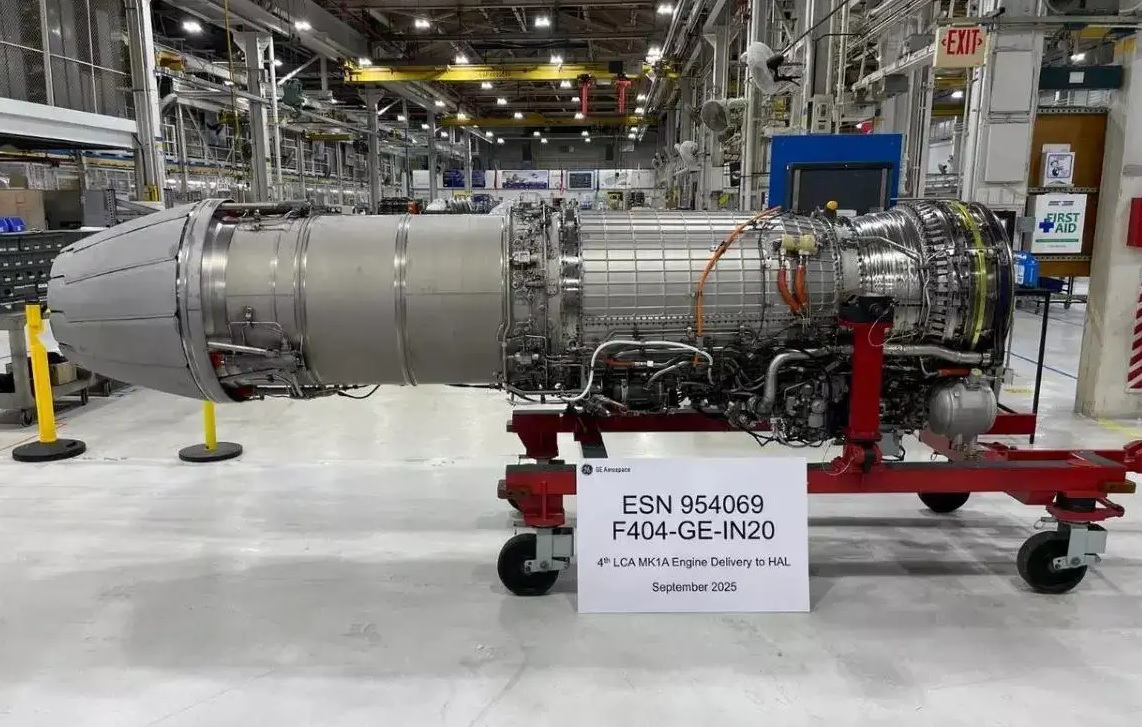
New Delhi / Bengaluru : General Electric (GE) Aerospace has committed to supplying 20 F404 fighter jet engines annually to Hindustan Aeronautics Limited (HAL) beginning in financial year 2026, a move expected to stabilise India’s flagship Tejas fighter programme and ease long-standing production bottlenecks faced by the Indian Air Force (IAF).
The assurance, conveyed as part of ongoing engagements between the US engine manufacturer and India’s state-owned aerospace major, significantly reinforces New Delhi’s ‘Make in India’ defence manufacturing initiative. It comes as the IAF races to rebuild depleted squadron strength amid delays in aircraft induction caused largely by engine supply disruptions.
Engine Supply at the Core of Tejas Delays
The GE F404-IN20 turbofan engine powers the Tejas MK-1 and MK-1A variants, which form the backbone of the IAF’s light combat aircraft fleet. While HAL has steadily expanded its airframe manufacturing capacity, engine availability has emerged as the most critical constraint, pushing back delivery schedules originally planned for 2024.
GE’s commitment of a steady annual supply from FY2026 is designed to align engine deliveries with HAL’s production targets of 16–24 Tejas MK-1A aircraft per year. Final assembly lines in Bengaluru and Nashik are being prepared for higher throughput once engine supply predictability improves.
Background of the GE–HAL Partnership
The pledge builds on a landmark 2021 agreement under which GE licensed the manufacture of F404-IN20 engines in India through HAL. The agreement includes technology transfer provisions, enabling up to 80 per cent indigenisation over time, covering components, assembly, testing and maintenance.
The F404-IN20, equipped with Full Authority Digital Engine Control (FADEC), delivers approximately 84 kilonewtons of thrust with afterburner. This provides the Tejas with its required thrust-to-weight ratio, agility, and high sortie availability for modern combat roles.
Impact on the IAF’s Modernisation Drive
The timing is critical, with the IAF having ordered 83 Tejas MK-1A aircraft under a ₹48,000-crore contract signed in February 2021. Squadron numbers, currently well below the sanctioned strength of 42, have placed mounting pressure on HAL and its suppliers.
Defence planners assess that a reliable engine pipeline from FY2026 could enable meaningful fleet induction by FY2028, provided parallel issues—such as radar integration, electronic warfare systems, and flight certification—remain on schedule.
Strategic and Industrial Significance
GE Aerospace’s renewed focus on India reflects broader strategic calculations. With global demand for fighter jet engines rising, India represents one of the largest medium-term growth markets, spanning current Tejas variants and future platforms like the Tejas MK-2 and the Advanced Medium Combat Aircraft (AMCA).
While the F404 powers existing variants, the larger F414 engine, producing around 110 kilonewtons of thrust, is planned for next-generation Indian fighters. A 2023 MoU outlines co-production of the F414 in India, widely viewed as a test case for deep technology transfer under expanding US-India defence cooperation.
Economic and Regional Effects
The expanded engine programme is expected to inject momentum into India’s aerospace ecosystem, particularly in Karnataka’s aerospace corridor. Industry estimates suggest more than 1,000 skilled jobs could be created through manufacturing, testing, overhaul and maintenance, strengthening a domestic MRO (Maintenance, Repair and Overhaul) ecosystem.
Greater localisation is also expected to reduce foreign exchange outflows, which defence officials estimate run into hundreds of millions of dollars over the life of the Tejas MK-1A programme.
Remaining Challenges
Despite the positive outlook, challenges remain. Certification of locally manufactured engine modules, access to high-temperature alloys, and building a resilient supplier base are still works in progress. GE’s on-site technical teams at HAL facilities signal a long-term industrial commitment rather than a short-term supply arrangement.
Officials familiar with the programme indicate that formal ratification of production schedules and localisation milestones could be showcased at Aero India 2026, where both companies are expected to highlight progress in engine manufacturing and indigenisation.
If executed as planned, GE’s commitment to supply 20 F404 engines per year could mark a turning point for the TEJAS programme—restoring confidence in delivery timelines, strengthening India’s defence industrial base, and reinforcing the strategic alignment between India and the United States in aerospace and defence manufacturing.
——— End of Article ———