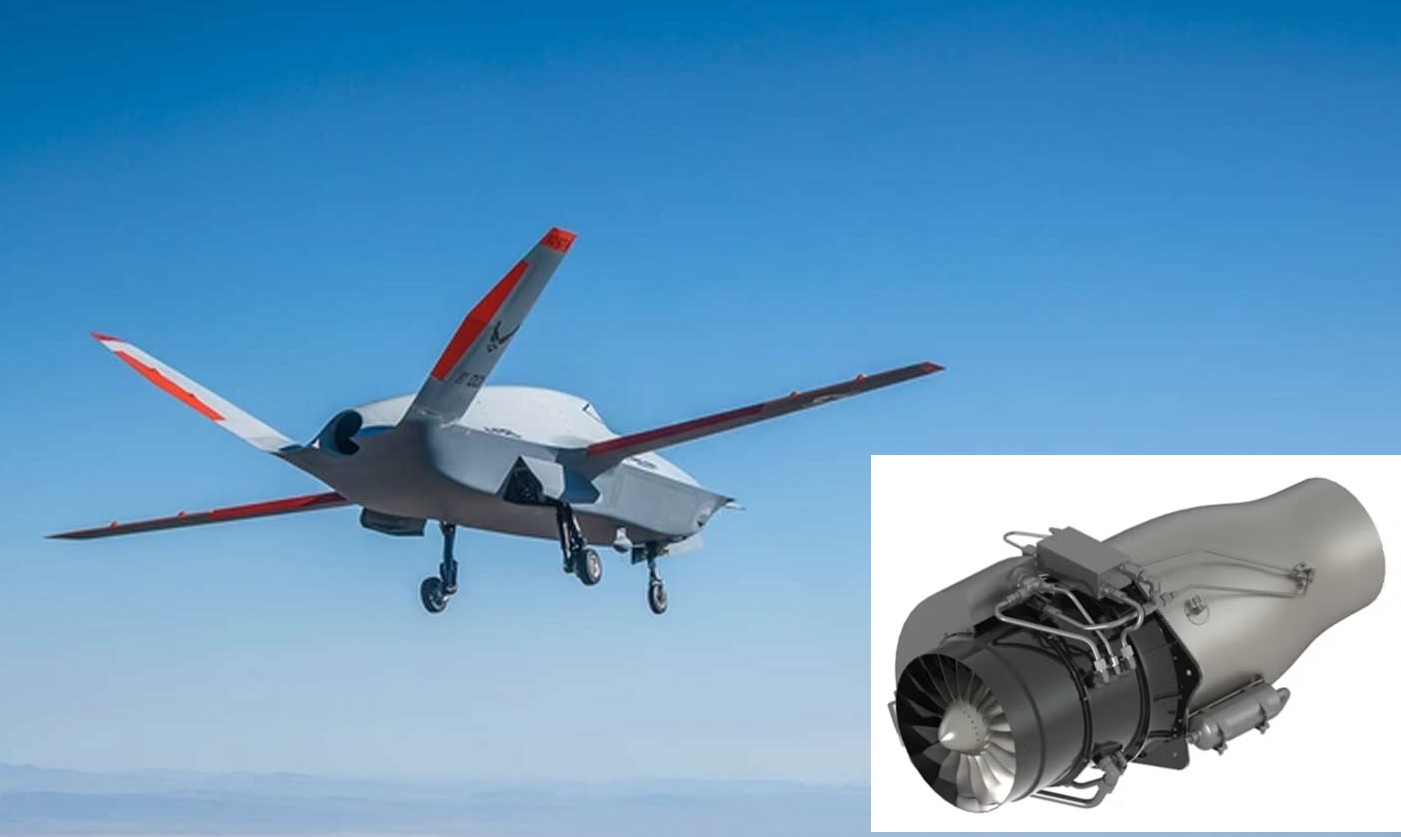
EVENDALE, Ohio — May 19, 2026 : GE Aerospace has secured a United States Air Force contract to advance the preliminary design of the GE426 turbofan engine, a new propulsion system being developed for the medium-thrust class of Collaborative Combat Aircraft (CCA) and Autonomous Collaborative Platforms (ACP) intended to operate alongside crewed fighter aircraft.
The GE426, unveiled on May 19, is designed to generate between 4,000 and 9,000 pounds of thrust. The contract award follows the successful completion of the engine program’s concept design review in August 2025 and marks the next stage in maturing the propulsion system for future Air Force autonomous combat aircraft programs.
Air Force Expands Autonomous Combat Aircraft Program
The Autonomous Collaborative Platform initiative is managed by the Air Force Research Laboratory (AFRL) and forms the technical foundation for the U.S. Air Force’s broader effort to field large numbers of artificial intelligence-enabled uncrewed aircraft. These systems are intended to operate alongside manned fighter jets and support missions including surveillance, electronic warfare, weapons carriage, strike support, and operations in contested airspace.
Rather than developing a single aircraft design, the Air Force is pursuing a family of autonomous platforms across multiple sizes and mission categories. This strategy has led the service to support several propulsion programs simultaneously in order to provide different thrust options for future aircraft requirements.
In February 2026, the Air Force awarded engine development contracts to four industry teams: Beehive Industries, Honeywell, Pratt & Whitney, and a joint team formed by GE Aerospace and Kratos Defense & Security Solutions. The awards support propulsion development efforts for CCA Increment 2 and other ACP variants under the Air Force Life Cycle Management Center’s Propulsion Directorate.
According to Air Force officials, the multi-vendor approach is intended to ensure a broad industrial base and provide multiple propulsion solutions for the evolving autonomous fleet.
GE426 Expands GE Aerospace’s Propulsion Portfolio
The GE426 is positioned in the medium-thrust category and is intended for larger autonomous combat aircraft requiring greater payload capacity, longer operational range, and increased mission flexibility compared to smaller attritable drone designs.
GE Aerospace is also developing the GEK1500 engine in partnership with Kratos. That engine produces approximately 1,500 pounds of thrust and targets smaller collaborative combat aircraft applications. The GEK1500 is derived from the GEK800 cruise missile engine, which previously powered the Valkyrie-class experimental drone.
With the introduction of the GE426, GE Aerospace now covers multiple propulsion categories within the Air Force’s autonomous combat aircraft strategy, ranging from lightweight autonomous systems to larger medium-thrust combat platforms.
The company has not disclosed the financial value of the latest Air Force contract or released detailed technical specifications beyond the engine’s thrust range. However, GE Aerospace stated that affordability, manufacturability, scalability, and operational readiness are core design priorities for the program.
Steve Russell, Vice President and General Manager of Edison Works at GE Aerospace, stated that the company intends to apply development processes used during the GEK800 program to accelerate the GE426 effort while maintaining cost and production targets required for future operational deployment.
Lessons From CCA Increment 1
The Air Force’s push for purpose-built propulsion systems follows lessons learned during the initial phase of the Collaborative Combat Aircraft program.
Under CCA Increment 1, General Atomics’ YFQ-42A and Anduril’s YFQ-44A were selected as competing prototype aircraft. General Atomics conducted the first flight of the YFQ-42A in August 2025, while Anduril flew the YFQ-44A in October 2025.
To accelerate development timelines, both aircraft used commercially available off-the-shelf engines rather than dedicated propulsion systems designed specifically for collaborative combat aircraft missions.
The prototypes are currently undergoing autonomy integration testing using mission software developed by Shield AI and Collins Aerospace.
Defense officials have acknowledged that while commercial engines enabled rapid prototype testing, they do not fully meet the long-term operational requirements of future autonomous fleets. Key concerns include durability, fuel efficiency, manufacturing scalability, sustainment costs, and low-cost mass production capability.
The GE426 and related propulsion programs are intended to address those limitations as the Air Force prepares for larger operational deployments in future CCA increments.
Affordability and Production Scale Remain Central
The Air Force’s long-term acquisition plans place significant emphasis on affordability and manufacturing scalability.
Current budget projections estimate approximately $9 billion in spending on collaborative combat aircraft programs through fiscal year 2029. The service plans to acquire at least 1,000 Increment 1 aircraft before the end of the decade, making large-scale engine production a critical requirement for all participating contractors.
Air Force officials have stated that propulsion systems requiring highly specialized manufacturing methods or exceeding strict unit cost targets could negatively affect the overall affordability model of the CCA program.
GE Aerospace stated that producibility is a central design constraint for the GE426 program, reflecting the Air Force’s focus on scalable manufacturing and rapid production capability.
Competitive Industry Development Efforts
Several other companies are advancing propulsion systems for autonomous combat aircraft under related Air Force contracts.
Honeywell is developing the SkyShot 1600 engine, which can be configured as either a turbojet or turbofan and is designed to generate between 800 and 2,800 pounds of thrust.
Beehive Industries is developing an engine in the approximately 1,000-pound thrust class using additive manufacturing techniques based on metal powder production processes.
Pratt & Whitney is also continuing propulsion development work under a separate Air Force contract focused on future autonomous aircraft applications.
According to Air Force officials, successful small- and medium-thrust engines developed under the ACP and CCA programs could eventually be adapted for additional military systems, including uncrewed aircraft, aerial targets, and missile platforms. Such expansion could increase future production demand into the thousands of units across multiple defense programs.
Next Development Phase
The GE426 preliminary design phase will refine the engine configuration in accordance with Air Force medium-thrust autonomous aircraft requirements. Future program milestones are expected to include prototype manufacturing, ground testing, and flight demonstration activities depending on program progress and future funding decisions.
GE Aerospace stated that the GE426 program remains part of the company’s broader strategy to expand propulsion technologies across small-, medium-, and large-thrust categories supporting next-generation autonomous combat aircraft operations.
——— End of Article ———