Washington / Cincinnati : GE Aerospace has achieved a significant milestone in the global push toward more-electric and fuel-efficient aviation, successfully demonstrating a hybrid-electric narrowbody turbofan engine system under a NASA-led technology program. The achievement marks one of the most advanced real-world validations to date of how electric power can be integrated directly into large commercial jet engines without relying on onboard batteries.
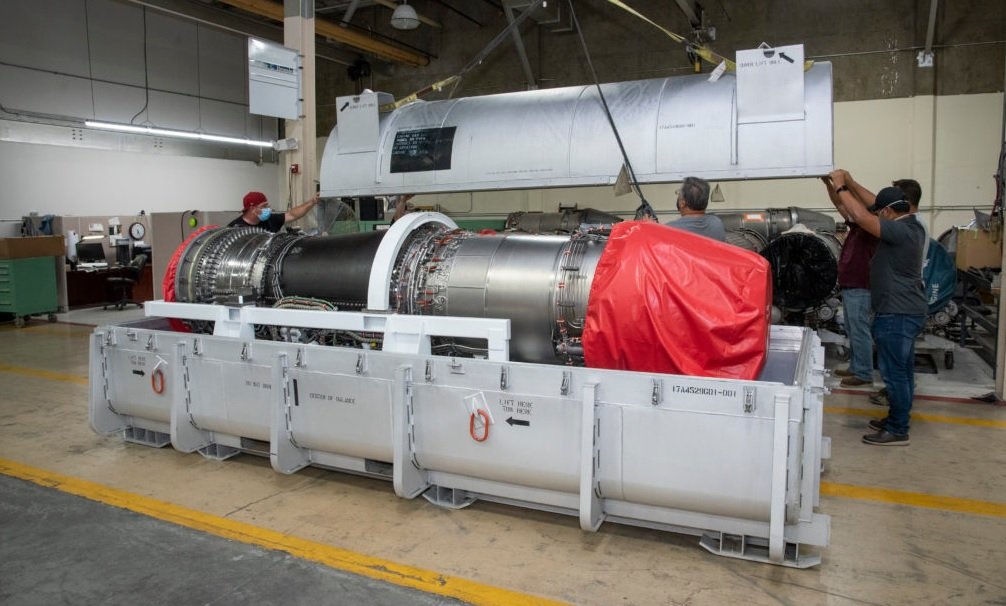
The ground-based demonstration was completed in 2025 using a modified GE Passport high-bypass turbofan engine at the company’s Peebles Test Operation in Ohio, as part of NASA’s Turbofan Engine Power Extraction Demonstration project. The tests validated the engine’s ability to extract power, transfer it across the system, and reinject it back into the propulsion cycle—key capabilities required for future hybrid-electric commercial aircraft.
A Shift From Components to Integrated Systems
Unlike earlier hybrid-electric aviation efforts that focused on isolated subsystems such as motors or power electronics, the latest tests emphasized full system integration. Engineers evaluated how the gas turbine, electric motor-generators, power management hardware, and control software function together as a single propulsion architecture across operating conditions.
According to GE Aerospace, the testing advanced understanding of hybrid-electric controls, thermal management, and power flow coordination within a commercial-scale turbofan—areas considered critical barriers to real-world adoption.
Most notably, the architecture demonstrated can operate either with or without onboard energy storage, such as batteries. This flexibility allows aircraft designers to gain efficiency benefits without incurring the weight, range penalties, and certification challenges associated with large battery systems.
How the Hybrid-Electric Turbofan Works
GE Aerospace’s narrowbody hybrid-electric concept embeds electric motor-generators directly into the turbofan engine. During flight, these machines can extract mechanical energy from the engine’s rotating shafts and convert it into electrical power. That electricity can then be redistributed within the aircraft or reinjected to supplement thrust during specific flight phases, such as takeoff, climb, or cruise optimization.
By dynamically balancing mechanical and electrical power, the system enables the engine to operate closer to its most efficient points. This reduces fuel burn, lowers thermal stress on engine components, and improves overall durability.
Because the architecture does not require batteries to function, it avoids the mass and safety challenges that currently limit battery-dependent electric propulsion in large aircraft. However, it remains compatible with future energy storage technologies should they mature.
Efficiency, Cost, and Range Benefits
NASA confirmed that the demonstration exceeded the agency’s technical performance benchmarks, which were defined in consultation with industry stakeholders. These benchmarks were designed to ensure that hybrid-electric propulsion delivers meaningful fuel cost savings for U.S. airlines while meeting the power demands of next-generation single-aisle aircraft.
For operators, the potential benefits include reduced fuel consumption, lower emissions, improved engine life, and greater operational flexibility. By offloading some propulsion demands to electric systems, engines can be optimized for efficiency rather than peak power, enabling longer range and improved performance without a proportional increase in fuel burn.
Role in the CFM RISE Program
The hybrid-electric demonstration is part of a broader technology maturation effort under the CFM International RISE program—short for Revolutionary Innovation for Sustainable Engines. Revolutionary Innovation for Sustainable Engines (RISE) is a technology demonstration program of CFM International, a 50-50 joint venture between GE Aerospace and Safran Aircraft Engines. It is not a product currently offered for commercial sale.
Launched in 2021, the RISE program represents one of the most comprehensive propulsion technology initiatives in aviation history.
To date, the program has completed more than 350 individual tests and accumulated over 3,000 endurance cycles. In addition to hybrid-electric systems, RISE is advancing open-fan propulsion, compact engine cores, advanced materials, and next-generation thermal architectures.
The program targets more than a 20 percent improvement in fuel burn compared with today’s most efficient commercial engines, while maintaining strict standards for safety, durability, and maintainability. GE Aerospace and Safran Aircraft Engines, the joint owners of CFM International, expect RISE technologies to progress toward ground and flight testing later this decade, with active collaboration underway with aircraft manufacturers on integration concepts.
A Decade of Hybrid-Electric Progress
GE Aerospace’s latest achievement builds on more than ten years of hybrid-electric propulsion research. The company conducted an electric motor-driven propeller ground test as early as 2016. In 2022, it completed the world’s first test of a megawatt-class, multi-kilovolt (kV) hybrid-electric propulsion system in simulated altitude conditions up to 45,000 feet—representative of single-aisle commercial flight.
In 2025, GE Aerospace also announced a strategic partnership and equity investment in BETA Technologies to develop a hybrid-electric turbogenerator for Advanced Air Mobility (AAM) platforms, underscoring the company’s parallel push into regional, cargo, and next-generation urban aviation markets.
Where the Technology Will Be Used
The hybrid-electric turbofan architecture demonstrated under NASA’s program is primarily aimed at future narrowbody commercial aircraft—the workhorses of global aviation that account for the majority of airline fuel consumption and emissions. These aircraft represent the largest near-term opportunity for efficiency gains without radical changes to airport infrastructure.
Beyond commercial aviation, the same core technologies are expected to influence military transport aircraft, special-mission platforms, and advanced air mobility vehicles, where efficient onboard power generation is increasingly critical.
A Measured Path to Sustainable Flight
GE Aerospace emphasizes that the RISE program and associated hybrid-electric technologies are demonstrators rather than commercial products. However, the successful power extraction and reintegration tests mark a decisive step toward practical hybrid-electric propulsion at airline scale.
As pressure mounts on the aviation sector to cut emissions while meeting rising global travel demand, the ability to electrify key aspects of jet propulsion—without sacrificing range or payload—could redefine how future aircraft are designed, powered, and operated.
——— End of Article ———