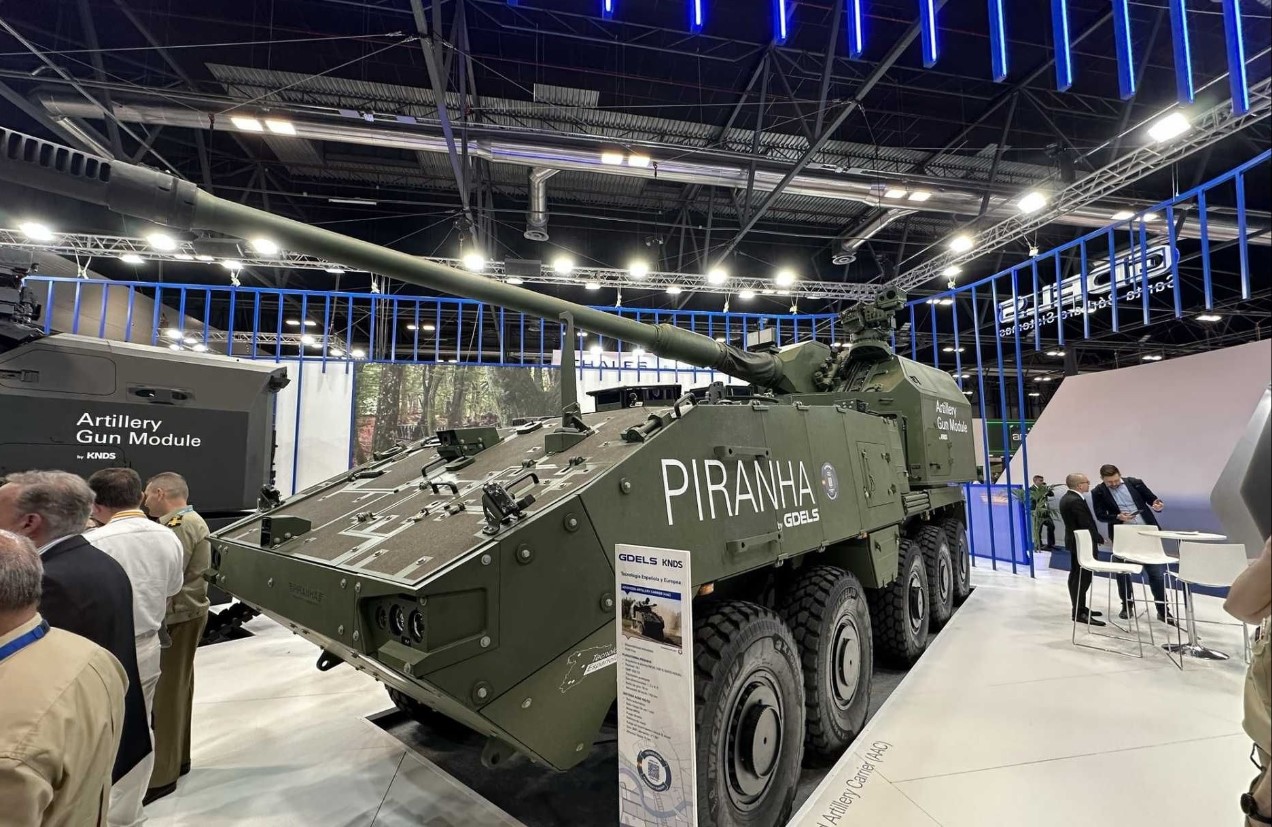
PARIS — May 30, 2026 : General Dynamics European Land Systems (GDELS) and KNDS Germany have partnered to develop a next-generation wheeled self-propelled artillery system that integrates the fully automated 155 mm Artillery Gun Module (AGM) onto the newly introduced PIRANHA Heavy Mission Carrier (HMC) 10x10 armored chassis. The platform, first unveiled during the Future Artillery Conference in Paris earlier this year, is designed to provide NATO and allied militaries with a highly mobile, protected, and long-range artillery capability suited to modern high-intensity warfare.
The joint development comes as NATO member states and allied armed forces continue to accelerate artillery modernization efforts following lessons from recent conflicts. Modern battlefields increasingly expose artillery systems to persistent drone surveillance, counter-battery radars, loitering munitions, and precision-guided strikes, creating growing demand for platforms capable of executing rapid “shoot-and-scoot” operations while maintaining high levels of protection and operational mobility.
At the center of the new artillery platform is the KNDS Artillery Gun Module (AGM), an unmanned and fully automated turret armed with a NATO-standard 155 mm/L52 cannon. The automated loading mechanism significantly reduces crew workload while enabling a high rate of fire and Multiple Rounds Simultaneous Impact (MRSI) capability, allowing multiple projectiles fired on different trajectories to strike a target simultaneously.
Depending on ammunition type, the system can engage targets at ranges exceeding 40 kilometers, while extended-range and rocket-assisted projectiles can further increase engagement distance. The artillery module supports conventional ammunition, precision-guided munitions, and future long-range projectiles, while also retaining the ability to conduct both indirect and direct fire missions against moving land and maritime targets when required.
The AGM is mounted on the newly introduced PIRANHA HMC 10x10 platform developed by GDELS specifically to support heavy mission payloads beyond the capability of conventional wheeled armored vehicles. The chassis incorporates a reinforced automotive structure and multi-link suspension system designed to carry heavy combat systems while preserving operational mobility across both road networks and off-road terrain.
The vehicle has a gross weight of up to 40 tonnes and payload capacity of approximately 17 to 18 tonnes. The platform features five axles, four of which are steerable, allowing improved maneuverability and a turning radius of less than 18 meters despite the vehicle’s size. This mobility profile enables long-distance operational redeployment without the transport burden typically associated with tracked artillery systems.
One of the system’s key engineering characteristics is its ability to fire without deploying stabilizing outriggers or vertical supports, a requirement commonly associated with many truck-mounted artillery platforms. Instead, the PIRANHA HMC chassis absorbs recoil forces directly through its structural design and suspension system.
This configuration enables 360-degree firing capability while significantly reducing setup and withdrawal times during artillery missions. The absence of external stabilizers improves responsiveness and survivability by allowing artillery crews to relocate quickly after firing, reducing exposure to counter-battery attacks and surveillance systems.
Automation plays a central role in the platform’s operational design. According to GDELS and KNDS, the system can be operated by a standard crew of only two personnel without restrictions, supported by advanced robotics, automated ammunition handling, and digital fire-control technologies. Space remains available for an optional third crew member or additional ammunition and mission equipment.
The integrated digital architecture supports autonomous navigation, fire-control calculations, targeting, and command functions, enabling artillery formations to shorten sensor-to-shooter timelines. The system is designed to receive target information from drones, surveillance systems, radars, and battlefield management networks and rapidly execute fire missions within minutes.
The PIRANHA HMC 10x10 occupies a distinct operational category between lighter wheeled artillery systems and heavier tracked self-propelled howitzers. While tracked systems often require heavy transporters for long-distance movement, the wheeled platform can rapidly redeploy using existing road infrastructure while retaining armored protection and cross-country mobility.
The system is already entering procurement pathways. In November 2024, Switzerland’s procurement agency armasuisse selected the AGM mounted on the PIRANHA IV 10x10 chassis as the future backbone of the Swiss Army’s motorized artillery force, replacing aging M109 tracked self-propelled howitzers that have remained in service for more than 50 years.
By leveraging the globally operated PIRANHA vehicle family, GDELS and KNDS seek to provide existing operators with commonality in logistics, maintenance, spare parts, and training infrastructure. KNDS also offers the AGM integrated onto the BOXER 8x8 platform, known as the RCH 155, alongside tracked variants, supporting interoperability and standardization across NATO artillery forces.
The partnership between GDELS and KNDS Germany reflects broader European defense industrial cooperation aimed at delivering mature, scalable, and interoperable artillery systems to meet growing operational requirements. As NATO members continue to invest in long-range precision fires and protected mobile artillery, the PIRANHA HMC 10x10 AGM platform is positioned as a new option for future artillery modernization programs.
——— End of Article ———