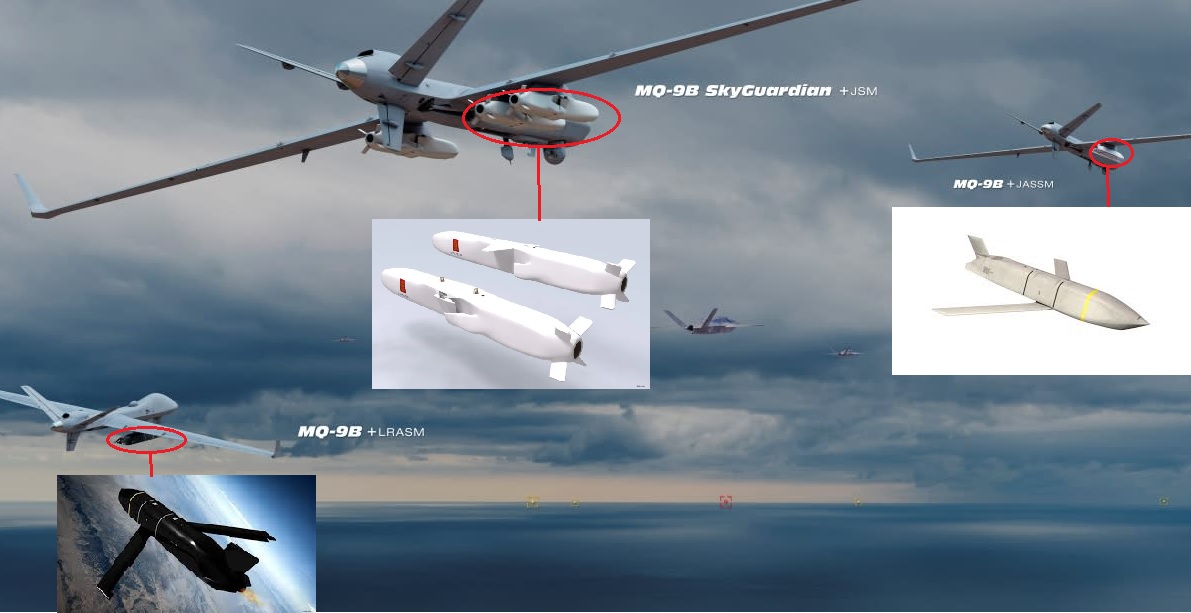
SAN DIEGO, February 23, 2026 : General Atomics Aeronautical Systems, Inc. (GA-ASI) announced that it is advancing the integration of long-range standoff weapons onto its MQ-9B SkyGuardian and SeaGuardian remotely piloted aircraft (RPA), expanding the platform’s mission set to include deep-strike and naval-strike roles. The development is intended to address operational requirements in contested theaters, including the Western and Southern Pacific.
The company confirmed that engineering work is underway to adapt the MQ-9B’s payload architecture, aerodynamic stability, stores management system, flight control margins, range performance, and mission system architecture to support extended-range precision munitions. Performance analyses conducted by GA-ASI indicate that the aircraft can carry heavier standoff weapons over operationally relevant distances while maintaining mission effectiveness.
David Alexander, president of GA-ASI, said the effort is aimed at expanding mission capability within the existing airframe’s payload limits. He noted that the MQ-9B’s available payload capacity enables integration of additional long-range strike options.
Airframe and System Modifications
The MQ-9B SkyGuardian and SeaGuardian are the latest variants of the Predator unmanned aircraft family and are certified for routine operations in non-segregated civil airspace. The aircraft incorporates a Detect and Avoid system, satellite communications for beyond-line-of-sight control, and modular payload bays designed for flexible sensor and weapons integration.
To support heavier and longer-range standoff munitions, GA-ASI engineers are adjusting the aircraft’s external stores configuration and conducting stability and flight performance assessments. Modifications focus on ensuring compatibility with larger cruise missiles traditionally deployed from crewed bombers and strike fighters.
The baseline technical specifications of the MQ-9B platform include:
-
Wingspan: 79 feet (24 meters)
-
External Payload Capacity: 4,750 pounds (2,155 kilograms) across nine hardpoints (eight wing stations and one centerline)
-
Endurance: More than 40 hours under optimal mission profiles
-
Maximum Altitude: Certified for operations up to 40,000 feet, with capability for higher operational ceilings
-
Cruise Speed: Approximately 167 knots true airspeed
-
Powerplant: Honeywell TPE331-10 turboprop engine
-
Current Payloads: Electro-optical/infrared sensors, multi-mode maritime and ground surveillance radars, and precision-guided munitions
The SeaGuardian variant includes maritime-specific mission systems such as surface-search radar, Automatic Identification System (AIS), and sonobuoy dispensing capability to support anti-submarine warfare missions. The SkyGuardian variant is configured primarily for land-based, multi-domain operations.
Standoff Weapons Under Consideration
GA-ASI confirmed that three extended-range precision weapons are under evaluation for integration.
The AGM-158 Joint Air-to-Surface Standoff Missile (JASSM), developed by Lockheed Martin, is being examined as a land-attack option. The missile features a low-observable design and a penetrator warhead intended for fixed and relocatable high-value targets. Its several-hundred-kilometer range enables launch platforms to operate outside dense integrated air defense systems.
The AGM-158C Long-Range Anti-Ship Missile (LRASM), a maritime derivative of JASSM, is designed for operations in contested electromagnetic environments. The missile incorporates autonomous target detection and classification systems and flies at low altitude in sea-skimming profiles to reduce exposure to shipboard defenses.
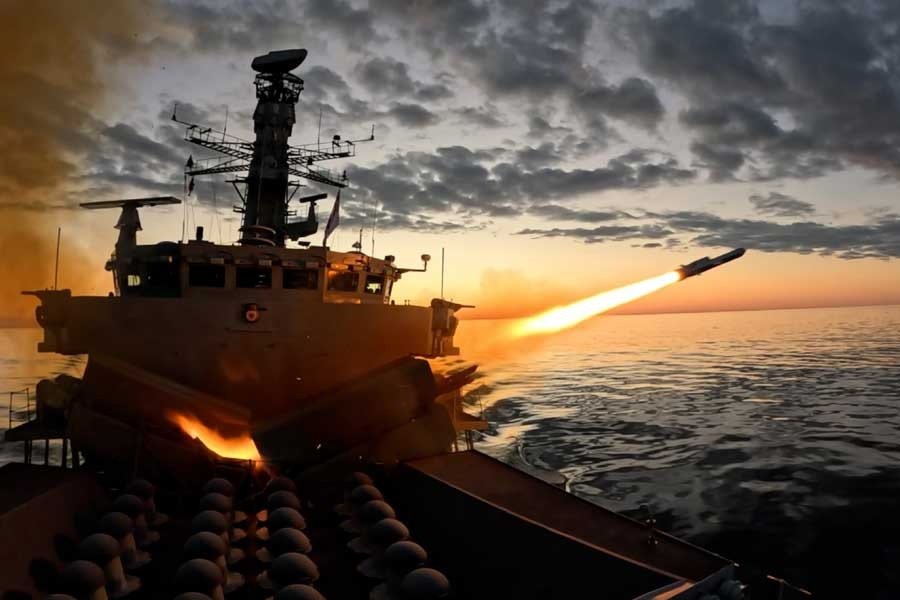
The Joint Strike Missile (JSM), developed by Kongsberg in partnership with Raytheon, is optimized for both anti-ship and land-attack missions, particularly in littoral environments. It includes an imaging infrared seeker, terrain-masking flight capability, and a two-way datalink enabling in-flight retargeting. The JSM is already integrated into allied fast-jet fleets, which may simplify multinational interoperability and logistics.
GA-ASI stated that flight trials involving at least one of these weapon systems aboard an MQ-9B aircraft are planned for later in 2026. The company is refining technical integration parameters and potential operational concepts ahead of testing.
Operational Concept
Under the proposed concept of operations, MQ-9B aircraft would launch from secure bases and transit to holding areas outside an adversary’s weapons engagement zone. From these loiter positions, the aircraft could conduct continuous intelligence, surveillance, and reconnaissance (ISR) missions while remaining available to launch standoff munitions if authorized.
The integration effectively allows the MQ-9B to function as a persistent launch platform capable of coordinating with crewed aircraft, surface combatants, and submarines. By decoupling the launch platform from the point of impact, the approach increases the number of available launch cells in a given theater without committing crewed assets to high-threat airspace.
Military planners view the development as having cross-service utility. For naval forces, it introduces an additional maritime strike layer between surface combatants and coastal defense systems. For air forces, it supplements limited bomber and fighter inventories with additional standoff launch capacity. For expeditionary land and marine units, the platform can provide overhead ISR coverage combined with strike-ready overwatch.
Strategic and Program Context
The integration of long-range cruise missiles onto a medium-altitude, long-endurance unmanned platform addresses operational challenges associated with Anti-Access/Area-Denial (A2/AD) environments. By equipping a persistent ISR aircraft with extended-range munitions, operators can hold targets at risk from outside high-threat zones.
The MQ-9B series has been selected or fielded by multiple international operators. The United Kingdom operates the platform as the Protector RG Mk1, while Japan, Australia, and other countries have selected or acquired the system. The aircraft has participated in major exercises including Northern Edge, Integrated Battle Problem, RIMPAC, and Group Sail.
GA-ASI indicated that earlier internal feasibility studies laid the groundwork for the current hardware-level integration effort. The company is continuing to expand the MQ-9B’s open-architecture design to enable integration of sovereign payloads and additional mission kits for international customers.
The latest development builds on the MQ-9B’s established intelligence, surveillance, reconnaissance, and shorter-range precision strike missions, extending its operational envelope into deep-strike and maritime strike roles while retaining its long-endurance characteristics.
——— End of Article ———