Paris / Toulon : In a decisive move to modernise naval surveillance and expand unmanned warfare capabilities, France has formally launched the next operational phase of its Shipborne Drone System for the Navy (SDAM) programme. The French defence procurement agency, Direction générale de l'armement, has signed two major contracts with Naval Group and Airbus Helicopters, paving the way for the deployment of new vertical take-off and landing (VTOL) unmanned aerial vehicles aboard frontline French Navy vessels.
The agreements, finalised in late December 2025, cover the acquisition of CAMCOPTER S-100F light reconnaissance drones for FREMM frigates and VSR700 medium rotary-wing drones for France’s new-generation logistics ships. Together, the two platforms mark a significant expansion of France’s ability to conduct persistent intelligence, surveillance and reconnaissance (ISR) far beyond the horizon.
CAMCOPTER S-100F: Extending FREMM Surveillance Reach
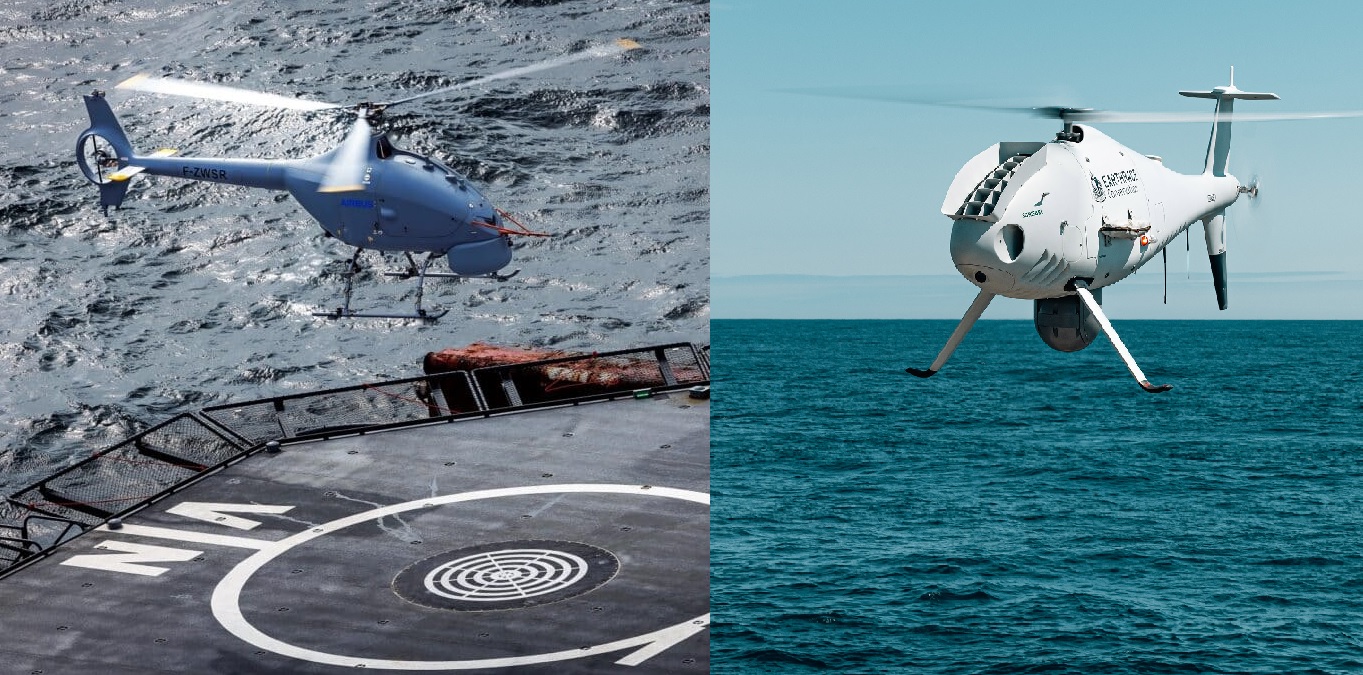
The first contract, signed on 29 December 2025, was concluded between the DGA and Naval Group and focuses on the procurement of the CAMCOPTER S-100F, a lightweight VTOL UAV manufactured by Schiebel. The S-100 is already in operational service with the French Navy aboard Mistral-class amphibious assault ships, providing a proven baseline for rapid integration.
Under the contract, Naval Group will deliver five complete S-100F drone systems, with each system comprising two aerial vehicles, ground control elements and shipboard integration solutions. These drones will be deployed aboard the French Navy’s FREMM (Frégate Européenne Multi-Mission) frigates, significantly enhancing their situational awareness.
According to French armed forces data, the S-100F offers an endurance of up to six hours and can carry a payload of approximately 50 kilograms. Equipped with wide-area optical sensors and a gyrostabilised electro-optical/infrared (EO/IR) turret, the drone enables long-range maritime surveillance, target identification and real-time intelligence transmission to the host ship.
Naval Group confirmed that the programme builds on extensive joint trials conducted with the DGA, including validated shipboard drone launch and recovery at sea using the STEERIS® Mission System, as well as land-based operations via containerised STEERIS COMMAND control centres. A first FREMM frigate is expected to receive the necessary upgrades to operate the S-100F by the end of summer 2026, with follow-on installations planned thereafter.
VSR700: Heavy ISR Capability for Fleet Support Ships
The second contract, signed on 30 December 2025, brings the VSR700 rotary-wing drone into full operational procurement. Developed by Airbus Helicopters in cooperation with the French Ministry of the Armed Forces, the VSR700 is derived from the Cabri G2 light helicopter, designed by the French SME Hélicoptères Guimbal.
The VSR700 represents a step change in payload capacity and endurance. Capable of flying for up to eight hours and carrying payloads of up to 220 kilograms, the drone is optimised for long-duration maritime ISR missions. The initial configuration ordered by the French Navy includes a maritime surveillance radar, an EO/IR sensor suite, and an AIS (Automatic Identification System) receiver, allowing comprehensive monitoring of surface traffic and potential threats.
A total of six VSR700 systems will be procured and progressively integrated aboard the Jacques Chevallier-class fleet replenishment ships, known as BRF (Bâtiments Ravitailleurs de Forces). These vessels play a critical role in sustaining French naval operations at sea and directly support the Charles de Gaulle Carrier Strike Group.
Naval Group will oversee the full integration of the VSR700 into the ships’ combat and information systems, again relying on the STEERIS® Mission System for automated take-off and landing, mission planning and real-time data fusion. The drones are designed for fully automatic deck operations, a capability validated during recent deck-landing trials conducted off the coast of Brittany.
Strategic Impact of the SDAM Programme
From a data-driven perspective, the SDAM programme reflects a broader shift within European navies toward persistent, unmanned maritime surveillance as a force multiplier. By deploying VTOL drones from both combatants and logistics vessels, the French Navy significantly expands its ISR footprint without increasing crew size or risking manned aircraft.
The combination of S-100F light drones for tactical frigate operations and VSR700 medium drones for strategic, long-endurance missions creates a layered unmanned capability. This architecture allows continuous monitoring of sea lanes, early threat detection and improved protection of high-value naval assets, including aircraft carriers and supply ships.
Both contracts fall under the framework agreement signed at the Paris Air Show 2025 in Le Bourget, underscoring France’s long-term commitment to indigenous and European defence technologies. As deliveries and integrations progress through 2026 and beyond, the SDAM programme is set to become a cornerstone of France’s future naval air operations — quietly reshaping how maritime power is projected in contested waters.
——— End of Article ———