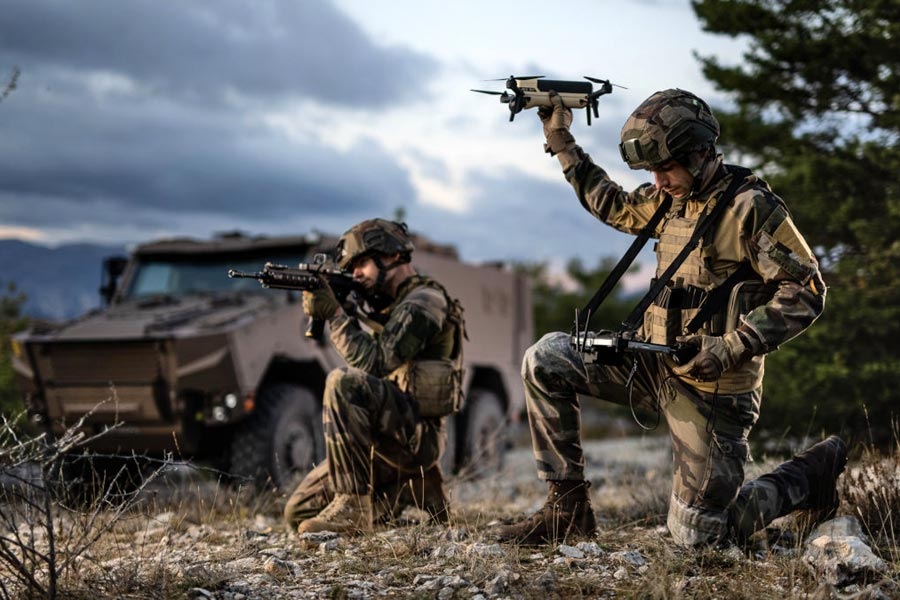
PARIS, France — April 8, 2026 : The French Army has formally declared its first dedicated Unmanned Aerial Vehicle (UAV) company fully operational, establishing a new organizational model designed to integrate reconnaissance and strike drone capabilities directly into ground combat formations.
The unit, officially designated as the Escadron de Drones de Chasse (hunter-killer drone squadron), operates within the 1er Régiment d’Infanterie de Marine (1er RIMa) based in Angoulême. It represents the Army’s first permanent UAV-focused company and was formed through the restructuring of a former armored squadron previously equipped with AMX-10RC reconnaissance vehicles. This conversion reflects a broader shift in force structure, enabling the unit to function as a self-contained element capable of supporting brigade- and battalion-level operations.
Integrated Reconnaissance-Strike Network
The UAV company combines reconnaissance platforms, strike drones, and loitering munitions into a single operational framework. This integrated system enables continuous target detection, real-time data transmission, and immediate strike execution without reliance on external air or artillery assets.
Its equipment includes fixed-wing intelligence, surveillance, and reconnaissance (ISR) UAVs for persistent observation, vertically launched first-person-view (FPV) drones configured for rapid engagement, and loitering munitions designed for precision strikes. The system prioritizes mobility, low visibility, and cost-controlled deployment, allowing the unit to operate within conventional maneuver formations while maintaining flexibility in contested environments.
Validation Through NATO and National Exercises
The operational readiness of the unit has been validated through multiple field exercises. It participated in NATO’s Exercise Hedgehog 25 in Estonia, where it operated against allied mechanized forces in a simulated combat environment. More recently, the unit served as an opposing force (FORAD) during training rotations at the Centre d’Entraînement au Combat (CENTAC) in Mailly-le-Camp.
These exercises confirmed the effectiveness of coordinated UAV employment across reconnaissance, target designation, and synchronized strike roles, demonstrating the ability to compress the sensor-to-shooter cycle at the tactical level.
Alignment with France’s Military Programming Law
The establishment of the UAV company aligns with France’s 2024–2030 Military Programming Law (LPM), which allocates approximately €5 billion toward drone development, acquisition, and counter-UAS (C-UAS) systems. The program emphasizes both high-end platforms and scalable, lower-cost systems suitable for distributed operations.
Among the systems integrated into the broader UAV ecosystem is the Safran Patroller, a medium-altitude long-endurance (MALE) UAV designed for extended ISR missions. In parallel, the Army is incorporating loitering munitions such as the MX-10 Damocles and MV-25 OSKAR, developed in cooperation with European defense firms including KNDS and Delair. These systems are engineered to operate in contested electromagnetic environments, including scenarios involving electronic warfare and GNSS denial.
Ongoing development efforts also include research into autonomous drone swarming and artificial intelligence-enabled coordination, aimed at enhancing survivability and operational effectiveness against advanced air defense systems.
Structural and Doctrinal Transformation
The creation of a dedicated UAV company reflects a structural evolution in the French Army’s approach to combined-arms warfare. By embedding unmanned systems directly within land units, commanders gain immediate access to aerial reconnaissance and precision strike capabilities that were previously dependent on higher-level or external assets.
This transformation extends beyond operational deployment. The Army is concurrently establishing dedicated logistics infrastructure, maintenance facilities, and specialized training programs to support sustained UAV operations. The goal is to institutionalize unmanned systems as a standard component of tactical-level combat formations.
Expansion Plans and Future Development
The 1er RIMa’s UAV squadron is intended to serve as a prototype for wider implementation. French Army leadership has confirmed plans to replicate the structure across five additional regiments within the 1st Division, with those units expected to achieve operational status by 2027.
The prototype unit itself is scheduled to reach its final configuration by June 2026, following additional training cycles and operational refinement.
Broader Implications
The declaration of full operational readiness underscores the French Army’s ongoing adaptation to evolving battlefield conditions, particularly the increased role of unmanned systems observed in recent conflicts, including the war in Ukraine. By integrating real-time reconnaissance and strike capabilities at the unit level, the Army is standardizing the use of UAVs as a core element of land warfare rather than a supplementary capability.
This development marks a measurable shift in operational doctrine, emphasizing decentralized decision-making, rapid targeting cycles, and the combined use of manned and unmanned systems within a unified combat framework.
——— End of Article ———