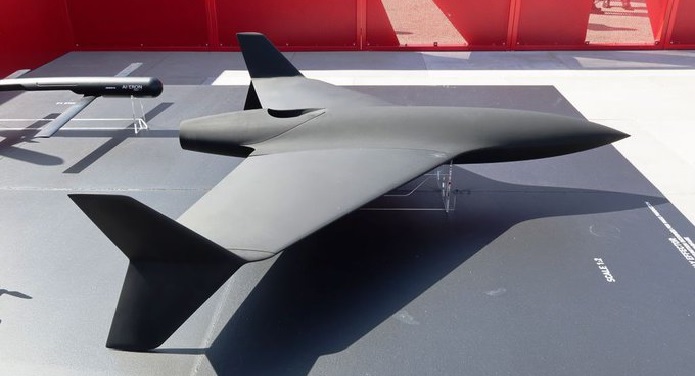
PARIS : The French Army is set to introduce a new long-range loitering munition into its arsenal, marking a significant shift in how France prepares for high-intensity, attritional warfare. The system, known as the One-Way Effector, will be acquired from European defense manufacturer MBDA, according to defense planning information released this week.
First unveiled publicly by MBDA at an international defense exhibition last year, the One-Way Effector reflects a growing European push to field low-cost, mass-producible strike drones capable of penetrating deep behind enemy lines. Its planned induction comes as NATO militaries reassess their force structures in light of lessons drawn from the war in Ukraine, where loitering munitions have played a decisive role on the battlefield.
A Jet-Powered Loitering Munition
Visually, the One-Way Effector bears a resemblance to Iran’s Shahed-series drones that have been widely used in recent conflicts. Like those systems, it is designed as a one-way, expendable platform intended to strike fixed or semi-fixed targets at long range.
The French system, however, is jet-powered rather than propeller-driven. MBDA states that the munition has an operational range of up to 500 kilometers and a cruising speed of approximately 400 kilometers per hour, allowing it to reach targets rapidly while remaining difficult to intercept. The total takeoff weight is around 100 kilograms, with 40 kilograms allocated to the warhead, giving it a destructive capacity comparable to that of traditional air-delivered munitions.
Guidance And Strike Profile
The One-Way Effector is equipped with a satellite navigation system combined with inertial guidance, enabling it to operate in contested electronic warfare environments where GPS signals may be degraded or jammed. Once launched, the munition can follow a pre-programmed flight path toward its target area before executing a terminal dive attack.
French defense officials describe the system as intended for use against high-value targets, including logistics hubs, air defense assets, command-and-control nodes, and critical infrastructure. While it is not designed for recovery or reuse, its simplified guidance architecture is meant to balance accuracy, resilience, and affordability.
Simplified Design For Mass Production
A defining feature of the One-Way Effector is its deliberately simplified design, which MBDA says has been optimized for rapid, large-scale production. In a notable departure from traditional missile development, the warhead is based on a standard 155-millimeter artillery shell, a widely produced NATO caliber munition.
This design choice significantly reduces costs, leverages existing ammunition stockpiles, and eases supply-chain constraints during prolonged or high-consumption conflicts. Defense analysts view this approach as a direct response to the realities of modern industrial warfare, where production capacity can be as decisive as technological superiority.
Timeline And Strategic Context
According to MBDA, production of the One-Way Effector is scheduled to begin in 2027, with initial deliveries to the French Army expected shortly thereafter. The system forms part of a broader French military modernization effort aimed at strengthening deep-strike, stand-off attack, and force-protection capabilities without exposing pilots or high-value aircraft to enemy defenses.
The acquisition underscores France’s strategic recognition of the evolving character of warfare, where loitering munitions, autonomous strike systems, and attritable platforms are increasingly central to deterrence and battlefield dominance. By investing in a domestically produced, mass-manufacturable kamikaze drone, Paris is positioning itself to confront future conflicts with greater operational flexibility and industrial resilience.
As European militaries adapt to a more volatile and contested security environment, the One-Way Effector is likely to emerge as a key reference model for how Western armed forces integrate low-cost, long-range strike drones into conventional military doctrine.
——— End of Article ———