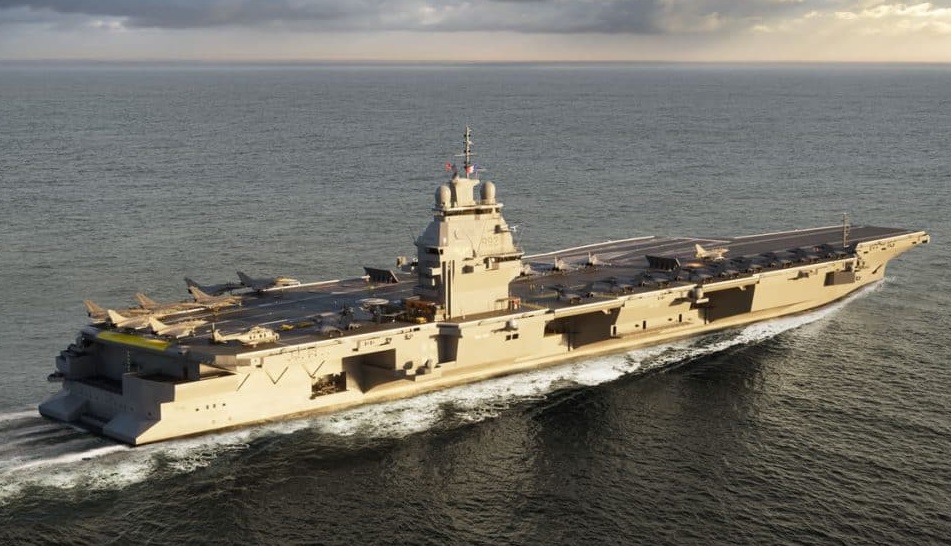
NANTES-INDRET, France — March 20, 2026 : Emmanuel Macron has officially announced that France’s next-generation nuclear-powered aircraft carrier, previously developed under the Porte-Avions de Nouvelle Génération (PANG) program, will be named “France Libre.” The announcement was made during a formal ceremony at a Naval Group facility near Nantes, where key components of the vessel, including its nuclear propulsion system, are being prepared.
The naming decision links the future flagship of the Marine Nationale to the historical legacy of the Free France movement, led by Charles de Gaulle following the fall of France in June 1940. According to Macron, the name reflects national independence, strategic autonomy, and continuity with France’s historical doctrine of sovereign military capability.
Program Authorization and Industrial Framework
The naming follows the French government’s decision in December 2025 to move the program into its realization phase, concluding more than five years of design and development work. The effort is led by the MO Porte-Avions industrial joint venture between Naval Group and Chantiers de l’Atlantique, with TechnicAtome responsible for reactor development.
The France Libre program represents a major national industrial undertaking with an estimated total cost of approximately €10 billion. It is expected to support up to 14,000 jobs across the French defense sector and involves a supply chain of around 800 companies, approximately 80 percent of which are small and medium-sized enterprises. More than 90 percent of procurement is sourced from domestic suppliers, reinforcing France’s strategic objective of maintaining an independent defense industrial base.
Ship Design and Propulsion System
The future carrier will be significantly larger than France’s current flagship, the Charles de Gaulle, which has been in service since 2001 with a displacement of approximately 42,000 tonnes.
The France Libre will have a full-load displacement of around 80,000 tonnes, an overall length of 310 meters, and a beam of approximately 90 meters. The design incorporates a single integrated island superstructure and a fully electrified onboard architecture.
Propulsion will be provided by two K-22 pressurized water reactors developed by TechnicAtome, each generating approximately 220 megawatts of thermal power. These reactors will supply energy to turbo-alternators and three electric propulsion motors driving three shaft lines, enabling speeds of up to 27 knots and providing effectively unlimited operational range.
The ship’s total complement, including its embarked air wing, is expected to be approximately 2,000 personnel. Internal systems include two 40-tonne aircraft elevators positioned on the starboard side and munitions storage designed to sustain high-intensity operations for more than seven days without resupply.
Flight Deck and Launch Systems
A key technological feature of the France Libre is the adoption of the Electromagnetic Aircraft Launch System (EMALS) and Advanced Arresting Gear (AAG), supplied by General Atomics under a Foreign Military Sales agreement with the United States.
The carrier will feature a 17,200 square meter angled flight deck, equipped with three EMALS catapult tracks and three AAG arresting wires. This configuration enables simultaneous launch and recovery operations, a capability not available on the Charles de Gaulle.
The flight deck is designed to support a sortie generation rate of approximately 60 sorties per day during high-tempo operations.
Air Wing Composition and Future Integration
The France Libre is designed to operate an air wing of approximately 30 combat aircraft. Initial deployments will focus on the Dassault Rafale M in its F5 configuration, supported by three E-2D Advanced Hawkeye airborne early warning aircraft produced by Northrop Grumman.
The air group will also include up to six NH90 Caïman helicopters, used for roles such as anti-submarine warfare, search and rescue, and logistical support.
The platform is designed with future growth in mind. It will be capable of integrating unmanned combat aerial vehicles (UCAVs) and is expected to support the Next Generation Fighter (NGF) under the Future Combat Air System (FCAS) program by the mid-2040s.
Defensive Systems and Survivability
The carrier’s self-defense suite will include Sylver A43 vertical launch systems capable of deploying Aster 15 surface-to-air missiles, along with 40 mm RAPIDFire cannons, 20 mm remotely operated guns, and 12.7 mm machine guns for close-in protection against aerial and asymmetric threats.
Construction Timeline and Service Entry
The construction schedule outlines a phased development process:
-
2032: Hull assembly begins at Chantiers de l’Atlantique shipyard in Saint-Nazaire
-
Mid-2035: Transfer to the naval base in Toulon for final outfitting and nuclear fueling
-
2036: Commencement of sea trials
-
2038: Planned commissioning into the Marine Nationale
The entry into service of the France Libre is intended to coincide with the gradual withdrawal of the Charles de Gaulle from frontline operations.
The vessel is expected to remain in service for approximately 45 years, forming the core of France’s naval aviation capability through the mid-21st century.
Strategic Role
The France Libre program is designed to ensure continuity of France’s carrier-based power projection capability while enhancing interoperability with allied naval forces. The integration of advanced launch systems, nuclear propulsion, and future air combat platforms positions the carrier as a central element of France’s long-term defense strategy.
The program also reinforces France’s emphasis on strategic autonomy, combining domestic industrial capacity with selective international cooperation in key technologies such as EMALS.
——— End of Article ———