PARIS, — April 12, 2026 : France is advancing the development of a low-cost, long-range remotely operated munition known as “Chorus,” in collaboration with automotive manufacturer Renault and defence firm Turgis Gaillard. The project, supported by the Directorate General of Armaments (DGA), is part of a broader effort to strengthen domestic production of unmanned strike systems while maintaining cost efficiency and industrial scalability.
Chorus Program: Design, Performance, and Cost Objectives
The Chorus munition is designed as a long-range, one-way attack system capable of delivering a 500 kg warhead over distances of up to 3,000 km. The platform is expected to operate at speeds of approximately 400 km/h. A key requirement of the program is to limit unit costs to around €100,000, reflecting an emphasis on affordability alongside operational reach.
The DGA has allocated €35 million to support development. Initial system design has been led by Turgis Gaillard, while Renault is responsible for industrialisation and large-scale manufacturing processes. The automaker contributes expertise in high-volume production, quality control, and cost management—capabilities drawn from its civilian automotive operations.
Production planning includes assembly at Renault’s facility in Le Mans and engine manufacturing at its Cléon plant. The program aligns with French government efforts to leverage civilian industrial capacity to accelerate defence production timelines and reduce reliance on foreign suppliers.
Industrial Strategy and Production Approach
French authorities have indicated that Chorus is not intended for immediate large-scale procurement. During a Senate hearing on February 26, 2026, DGA General Delegate Patrick Pailloux stated that the system is being developed primarily to establish industrial readiness rather than to build substantial stockpiles.
He noted that rapidly evolving technologies in unmanned systems could render such platforms obsolete in a short timeframe. Instead, the program aims to ensure that Renault can scale production quickly if operational requirements change. Discussions around potential production capacity have suggested output levels of several hundred units per month once industrial scaling is achieved.
Earlier reports have referenced the possibility of a multi-year production agreement valued at approximately €1 billion, although no final contract value or confirmed quantities have been publicly disclosed.
Benchmarking Against Ukrainian “Flamingo” System
During the same February 26, 2026 hearing, Pailloux compared the Chorus concept to the Ukrainian “Flamingo” missile developed by FirePoint. The Flamingo system is reported to offer a similar range of 3,000 km but with significantly higher performance parameters.
It can carry a 1,150 kg warhead and is powered by an AI-25TL turbojet engine, enabling cruising speeds between 850 and 900 km/h and operations at altitudes up to 16,000 feet. French officials acknowledged that Chorus would have more modest specifications but emphasized that the program prioritizes cost control and manufacturability over maximum performance.
Parallel Procurement: MBDA and Aviation Design OWE Program
In parallel with Chorus development, the French Ministry of the Armed Forces awarded a contract at the end of January 2026—following an order placed in late December 2025—to a consortium comprising MBDA and Aviation Design. The contract covers an initial batch of long-range remotely operated munitions designated as the “One Way Effector” (OWE).
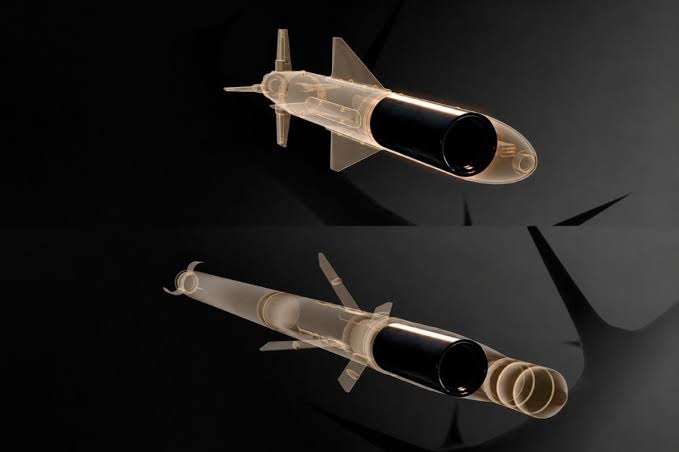
The OWE system features a flying-wing configuration powered by a turbojet engine. It is designed to carry a 40 kg military payload and engage targets at ranges of up to 500 km while maintaining speeds of around 400 km/h. The munition is engineered to operate effectively in contested electromagnetic environments, including scenarios involving signal jamming.
Deliveries of the OWE systems to the French Armed Forces are scheduled for mid-2027.
Operational Role and Manufacturing Concept for OWE
According to the Ministry, the OWE is intended for deep tactical strike missions targeting command posts, logistical infrastructure, and other high-value assets. The system is also designed to support saturation tactics, in which multiple low-cost munitions are deployed simultaneously to overwhelm and exhaust adversary air defence systems.
MBDA has committed to implementing manufacturing approaches that support high production volumes. In operational use, the OWE could function as a diversionary asset, drawing defensive responses and enabling higher-value cruise missiles to reach designated targets.
This concept mirrors operational patterns observed in recent conflicts, including the use of Geran-2 (Shahed-derived) drones by Russian forces in Ukraine.
Strategic Context and Long-Term Planning
The Chorus and OWE initiatives represent complementary elements within France’s broader defence strategy. While the OWE focuses on near-term operational deployment and mass production, Chorus is oriented toward long-term industrial preparedness and cost-efficient scaling.
Renault’s involvement follows earlier requests from the Ministry of the Armed Forces for the company to support the development of a domestic drone sector. The integration of civilian industrial capabilities is intended to accelerate production cycles and expand manufacturing capacity.
Both programs are aligned with objectives outlined in France’s military programming law, which calls for a significant increase in inventories of drones and loitering munitions by 2030. The effort reflects lessons drawn from recent conflicts, particularly the growing role of low-cost, long-range unmanned systems in modern warfare.
Work on the Chorus program continues alongside OWE procurement, with both initiatives contributing to France’s goal of enhancing sovereign capabilities in reconnaissance and strike systems while reducing dependence on external suppliers.
——— End of Article ———