KYIV : France has taken a significant step in deepening its military-industrial support for Ukraine by delivering the first batch of Rodeur 330 unmanned aerial systems, a long-range loitering munition designed to counter Russia’s expanding drone warfare campaign. The delivery marks the operational debut of the Bordeaux-based EOS Technologie’s flagship interceptor drone in Ukraine, nearly four years into Kyiv’s defense against Moscow’s full-scale invasion.
The shipment represents the first confirmed transfer of Rodeur 330 systems to Ukrainian forces and forms part of a wider strategy to replenish Ukraine’s drone stockpiles while aligning European industrial output with the realities of a high-intensity, attritional conflict. French and Ukrainian officials view the move as both an immediate battlefield reinforcement and a testbed for next-generation European unmanned systems under real combat conditions.
A Response to Russia’s Drone Saturation Strategy
The delivery comes as Russia continues to rely heavily on mass-produced unmanned systems, with Western intelligence estimates indicating that Moscow is capable of manufacturing roughly 1,000 drones per day. These systems, ranging from reconnaissance platforms to one-way attack drones, have become central to Russia’s strategy of saturating Ukrainian air defenses and exhausting interceptor stocks.
According to Agence France-Presse (AFP), the French initiative is explicitly aimed at countering this numerical advantage by deploying comparatively inexpensive but capable loitering munitions in large numbers. The Rodeur 330 is intended to intercept, disrupt, or destroy hostile assets while preserving higher-end air defense systems for critical threats.
Jean-Marc Zuliani, president of EOS Technologie, described the system as a “shield” for the Ukrainian Armed Forces, emphasizing its dual role in intelligence gathering and precision strike missions. In practice, Ukrainian operators are expected to employ the platform both for deep reconnaissance and as a kamikaze drone against high-value targets.
From Evaluation to Battlefield Deployment
The current delivery follows a confirmation in December 2025 that EOS Technologie would supply Ukraine with long-range loitering munitions for military evaluation. That announcement included both the standard Rodeur 330 and a rocket-powered variant designed for higher-speed missions, signaling France’s willingness to expose advanced systems to frontline testing.
Ukrainian forces, whose drone operators are now regarded by Western militaries as among the most experienced in the world, are expected to provide detailed feedback on performance under intense electronic warfare, GPS jamming, and air defense pressure. For French defense industry planners, the deployment offers rare insight into how European systems perform against a peer adversary.
Zuliani has noted that Ukraine’s battlefield experience now exceeds that of any NATO country, making the operational data generated by the Rodeur’s use as valuable to Western manufacturers as it is to Ukrainian commanders.
Technical Profile of the Rodeur 330
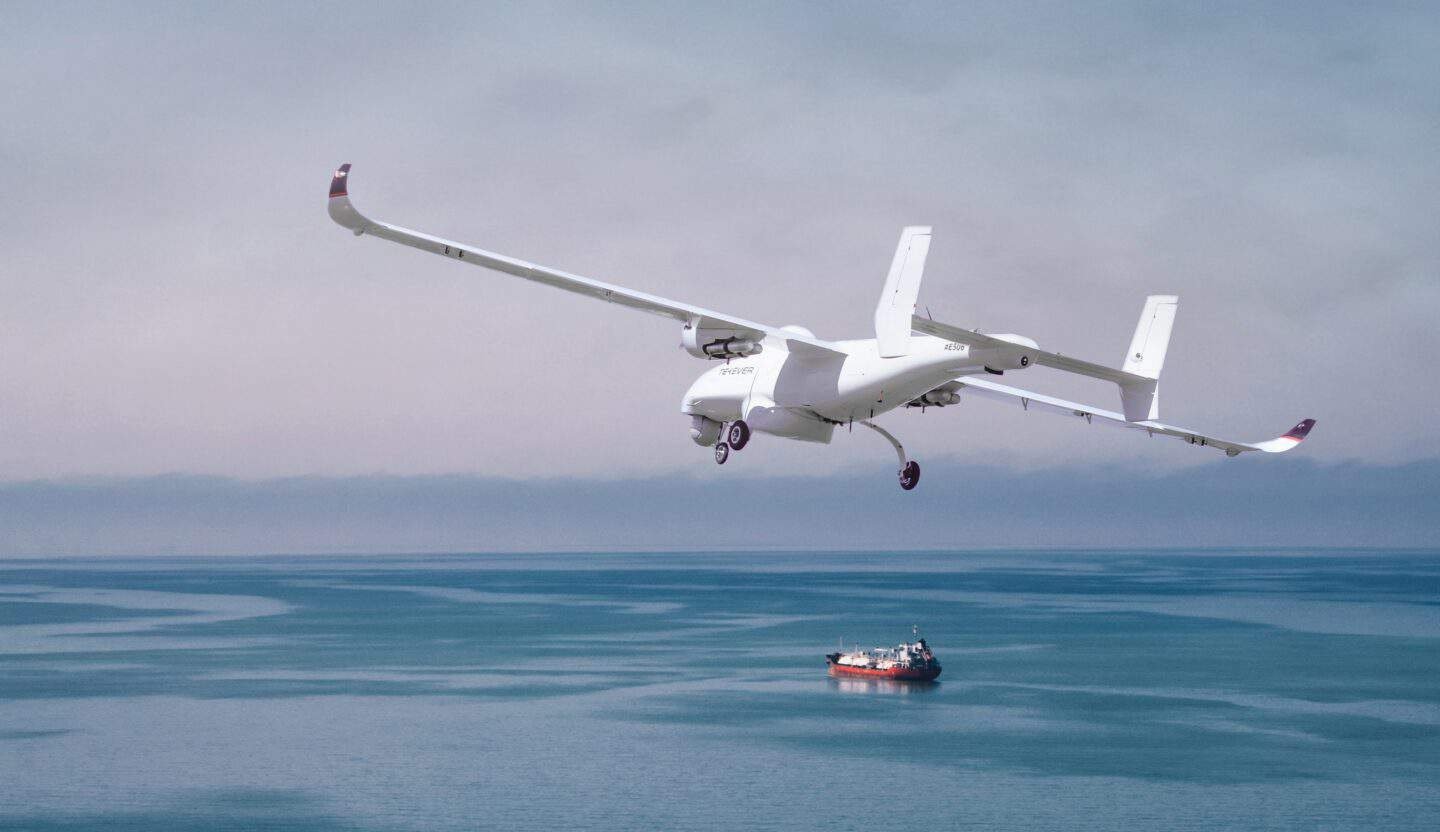
The Rodeur 330 is a fixed-wing loitering munition designed for long endurance and extended reach rather than short-range tactical strikes. Weighing 25 kilograms (55 pounds), the drone features a three-meter wingspan and is optimized for rapid deployment by small teams.
It carries a four-kilogram payload, sufficient for a high-explosive warhead or specialized sensor package, and can remain airborne for up to five hours. With a maximum operational range of 500 kilometers, the system is capable of reaching logistics hubs, command centers, and airfields well behind the front line.
The drone is catapult-launched, removing the need for prepared runways, and can operate at altitudes of up to 5,000 meters with a top speed of 120 kilometers per hour. EOS Technologie has emphasized the system’s simplicity, noting that assembly takes about three minutes and that operators and maintenance personnel can be trained within one week.
Control is conducted via a ruggedized laptop and gamepad interface, reflecting lessons learned from Ukraine’s extensive use of first-person-view (FPV) drones. Each system is delivered as a complete package, including a reinforced flight case, radio control transmitter, and antenna set designed to maintain link integrity in contested electromagnetic environments.
Proven Capabilities and Automation
Prior to its delivery to Ukraine, the Rodeur 330 underwent a series of tests intended to demonstrate both its manual and autonomous strike capabilities. According to the Ukrainian defense outlet Militarnyi, the drone successfully destroyed a tank during trials using an FPV control mode, highlighting its precision against armored targets.
In additional demonstrations, the system reportedly engaged simulated threats while operating in a fully automated mode, identifying and attacking targets without continuous human input. Such functionality is considered increasingly important as electronic warfare conditions make direct control more difficult and as operators are forced to manage multiple systems simultaneously.
These capabilities place the Rodeur 330 within a growing class of semi-autonomous loitering munitions that blur the line between reconnaissance platforms and strike weapons.
Strategic and Political Implications
Beyond its immediate military value, the delivery underscores a broader shift in European support for Ukraine. Rather than relying solely on stockpiles of legacy weapons, countries like France are increasingly integrating their defense industries directly into Ukraine’s war effort.
By supplying systems that are relatively low-cost, scalable, and adaptable, Paris aims to help Ukraine sustain a high operational tempo without exhausting scarce high-end munitions. At the same time, the cooperation strengthens long-term industrial ties between France and Ukraine, potentially laying the groundwork for joint production or technology transfer in the future.
As the war continues to evolve into a contest of endurance, innovation, and industrial capacity, the arrival of the Rodeur 330 highlights how unmanned systems have become central to modern warfare — and how Ukraine remains the proving ground shaping their future.
——— End of Article ———