PARIS — March 5, 2026 : French drone manufacturer DIODON Drone Technology has launched Vigilansea, a three-year development program focused on enabling persistent autonomous maritime surveillance operations using coordinated uncrewed surface vehicles (USVs) and uncrewed aerial vehicles (UAVs). The initiative is funded by the France 2030 investment plan and aims to support repeated high-sea missions without direct human intervention.
The project will develop systems that allow aerial and surface drones to operate cooperatively at sea for surveillance, inspection, and security tasks. According to the company, the program is designed to expand maritime monitoring coverage and automate mission execution across large maritime zones.
Program Structure and Partners
The Vigilansea program is led by DIODON in cooperation with SeaOwl Technology Solutions and ISAE-SUPAERO, both of which will contribute specialized technical capabilities to the project.
SeaOwl Technology Solutions is responsible for developing a dedicated USV platform designed specifically to support autonomous UAV deployment at sea. The vessel will be engineered to host onboard drone infrastructure and maintain continuous operations in offshore environments.
ISAE-SUPAERO will provide expertise in aerodynamic optimization and advanced flight control systems, focusing on improving UAV performance, stability, and operational reliability in maritime conditions.
Core Technological Components
The Vigilansea program centers on the development and integration of two key systems designed to enable UAV-USV interoperability.
The first component is a new-generation maritime UAV designed for long-endurance operations in open-sea environments. The platform is intended to operate as an airborne sensor deployed from an unmanned vessel, expanding the surveillance range of the surface platform.
The second component is DIODON REEF, an onboard UAV station integrated directly into the USV. The system is designed to manage the full operational cycle of the aerial platform, including automated launch, recovery, battery recharging, and mission readiness. This capability is intended to allow repeated drone operations at sea without human operators onboard.
By integrating the UAV with the USV platform through the REEF system, the architecture allows the aerial drone to function as a remote sensor for the surface vessel, enabling extended monitoring coverage and faster identification of maritime activity.
Maritime Drone Design Requirements
DIODON’s UAVs are specifically engineered for maritime environments and incorporate several physical and operational characteristics necessary for sea deployment. These include watertight construction, positive buoyancy for water recovery, structural durability, and resistance to corrosion, sea spray, wind, and wave exposure.
The company’s existing systems already reflect these design principles. One example is the DIODON HP30, a lightweight amphibious drone designed for maritime surveillance and rescue operations. The platform weighs under two kilograms and has an operational endurance of approximately 23 minutes, a maximum speed of about 60 km/h, and a control range of around two kilometers. The drone is rated at IP46 for water and environmental protection.
Integration and Testing Background
The Vigilansea program builds on DIODON’s previous work integrating aerial and surface unmanned systems.
In 2024, the company participated in Dronathlon 2024, where it demonstrated successful command-and-control integration between UAVs and USVs. The demonstration used onboard communication systems, including satellite connectivity installed directly on a surface vessel, enabling remote control and data transmission during maritime drone operations.
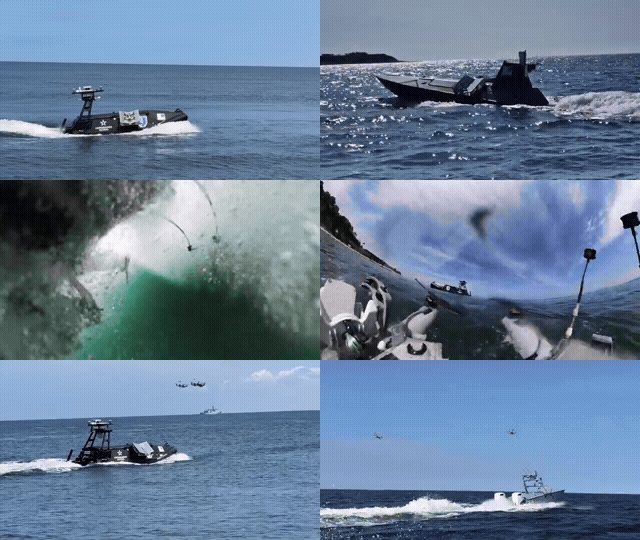
Further integration work was carried out in 2025 during NATO Task Force X Baltic. During the exercise, DIODON introduced the DIODON LAUNCHER, a system capable of deploying the HP30 maritime UAV from a USV platform. The demonstration confirmed the feasibility of hardware integration between the company’s drones and unmanned maritime vessels.
Operational Objectives
The primary operational objective of the Vigilansea program is to create a persistent maritime monitoring system that combines the endurance of USVs with the aerial observation capabilities of UAVs.
In this configuration, the surface vessel acts as a mobile base station capable of launching and managing aerial drones while remaining at sea for extended periods. The UAV provides aerial reconnaissance, enabling detection and identification of activities over a wider area than the surface vessel alone could observe.
The system is designed to operate through autonomous mission management and resilient communication architectures that support real-time coordination between the aerial and surface platforms.
Intended Applications
The integrated UAV-USV architecture is intended to support a range of maritime missions.
Potential applications include maritime surveillance and counter-trafficking operations, protection of critical coastal and offshore infrastructure, monitoring of sensitive maritime areas, environmental inspection and pollution detection, and maritime safety and security missions across large ocean zones.
By automating drone deployment and recovery at sea, the system is expected to reduce the need for crewed vessels or direct human involvement in potentially hazardous operational environments.
Executive Statement
Antoine Tournet, CEO and co-founder of DIODON Drone Technology, said the initiative reflects the growing complexity of monitoring maritime domains.
“The control of maritime spaces has always been a central strategic challenge,” Tournet stated. “Today, however, the scale of the areas to be monitored and the intensity of maritime activities make it a challenge of an entirely different magnitude. Ensuring extended and sustained coverage requires complementing human assets with collaborative, integrated robotic solutions.”
Strategic Context
The Vigilansea program aligns with France’s broader push to expand the use of unmanned systems in maritime and defense applications. Programs funded under the France 2030 framework aim to accelerate innovation in naval drones, maritime surveillance technologies, and autonomous systems for both civilian and military use.
Over the next three years, the Vigilansea project will focus on system development, testing, and operational experimentation to validate the combined UAV-USV architecture in real maritime environments.
——— End of Article ———