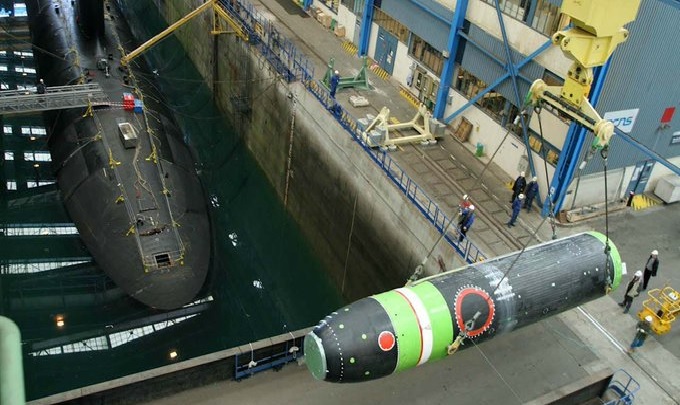
L’Île Longue, France — March 2, 2026 : President Emmanuel Macron has announced that France will increase the number of nuclear warheads in its military arsenal, marking the first expansion of the country’s stockpile since reductions began in the early 1990s. The decision represents a shift in France’s long-standing policy of maintaining a strictly limited deterrent force.
Speaking at the Île Longue naval base in Brittany, home to France’s ballistic missile submarine fleet, Macron confirmed that the current stockpile of fewer than 300 warheads will be expanded. He did not specify the target number and stated that France will no longer publicly disclose the size of its nuclear arsenal.
Policy Announcement at Strategic Submarine Base
The announcement was delivered at the primary operational hub of France’s sea-based nuclear deterrent. Macron said he had ordered an increase in the number of nuclear warheads and described the step as necessary in light of current geopolitical conditions. He emphasized that the core objective remains ensuring that France’s nuclear deterrent maintains what he called its “assured destructive power.”
Macron also confirmed a change in transparency policy. France, which has periodically provided approximate figures about its stockpile in the past, will now cease communicating numerical data regarding its nuclear forces.
Launch authority over nuclear weapons will remain exclusively with the French president. There are no plans to share decision-making authority with European partners.
Strategic Rationale Behind the Expansion
French officials link the decision to shifts in the international security environment. The move comes amid Russia’s ongoing war in Ukraine, broader nuclear modernization programs by major powers, and uncertainty surrounding long-term U.S. security commitments to Europe.
France is currently the only nuclear-armed member state of the European Union. Although the United Kingdom possesses nuclear weapons, it is no longer part of the EU. French policymakers have increasingly framed the country’s nuclear deterrent within a wider European security context.
Macron stated that evolving strategic risks require adjustments to France’s posture. Officials argue that maintaining credibility in deterrence requires adapting capabilities to reflect technological and geopolitical developments.
European Security and “Advanced Deterrence”
As part of the updated doctrine, France will pursue what Macron described as “advanced deterrence,” a framework involving closer coordination with European partners. France has initiated cooperation discussions with several countries, including Germany, the United Kingdom, Poland, the Netherlands, Belgium, Greece, Sweden, and Denmark.
The plan includes joint exercises and integrated security consultations. It also provides for the potential temporary deployment of French nuclear-capable aircraft to allied territories. However, operational control and launch authority would remain solely under French national command.
German participation is expected to play a significant role in the framework, reflecting Berlin’s central position in European defense planning.
Current Structure of France’s Nuclear Forces
France’s nuclear deterrent, known as the force de frappe, is structured around a two-component system:
-
Sea-based deterrent: Four Triomphant-class ballistic missile submarines equipped with submarine-launched ballistic missiles (SLBMs). At least one submarine is maintained on continuous patrol at sea.
-
Air-based deterrent: Air-launched cruise missiles carried by Rafale fighter aircraft operated by both the French Air and Space Force and the French Navy.
France dismantled its land-based nuclear ballistic missile systems in the 1990s and has not maintained ground-based nuclear missiles since.
Current independent estimates place France’s stockpile at approximately 290 deployable warheads, making it the world’s fourth-largest nuclear power after Russia, the United States, and China.
France conducted its first nuclear test in 1960 and its last in 1996. It subsequently signed the Comprehensive Nuclear-Test-Ban Treaty and ended explosive nuclear testing. Since then, modernization efforts have focused on delivery systems, warhead safety, and reliability without increasing stockpile numbers—until this latest policy shift.
Budgetary and Industrial Implications
Following the presidential address, Defense Minister Sébastien Lecornu confirmed that the government will implement the expansion through adjustments to defense planning and budget allocations. The program will include warhead production increases, modernization of delivery systems, and reinforcement of the national defense industrial base.
France has steadily increased defense spending in recent years, with nuclear modernization already accounting for a significant portion of long-term military investment planning.
Historical Context
After the end of the Cold War, France began a systematic reduction of its nuclear arsenal starting around 1992. The drawdown reduced the stockpile by roughly half over three decades and eliminated the land-based component entirely. The policy was based on maintaining what French doctrine calls “strict sufficiency,” meaning a deterrent sized only to guarantee credible retaliation rather than numerical parity with other nuclear powers.
Monday’s announcement represents a departure from that three-decade trajectory. While France continues to describe its strategy as defensive and deterrent in nature, the increase in warhead numbers marks a structural change in force planning.
Officials have not provided a timeline for the expansion or the projected final size of the arsenal.
The announcement forms part of a broader update to France’s nuclear doctrine, positioning its deterrent within a more integrated European security framework while maintaining exclusive national control over nuclear decision-making.
——— End of Article ———