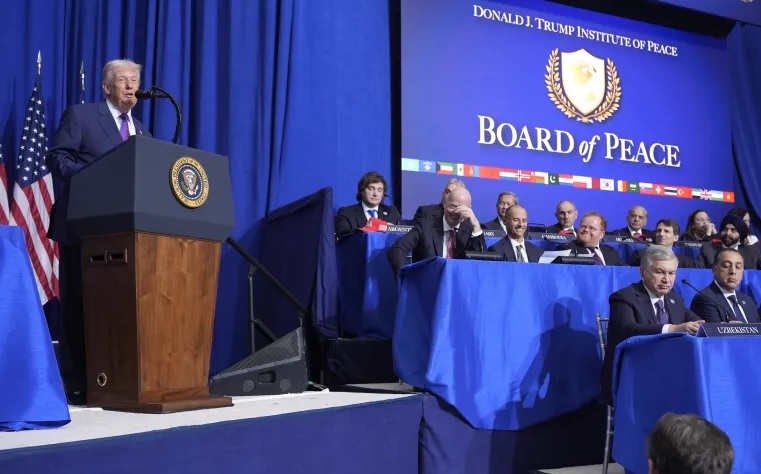
WASHINGTON, D.C. : Five countries have formally committed troops to a newly established International Stabilization Force (ISF) for the Gaza Strip, marking the first structured multinational security arrangement following the October ceasefire. The commitments were announced during the inaugural Board of Peace meeting held in Washington on Thursday.
Indonesia, Morocco, Kazakhstan, Kosovo, and Albania confirmed participation in the force, which is designed to provide security support during the early stages of reconstruction in Gaza. The ISF will operate separately from existing United Nations peacekeeping missions and will carry a defined non-combatant, humanitarian-focused mandate.
ISF Structure and Deployment Framework
The stabilization plan outlines a total deployment of 20,000 international soldiers and 12,000 police officers. The force will be commanded by U.S. Army Major General Jasper Jeffers and will coordinate its activities with civilian reconstruction authorities.
Initial deployment will begin in Rafah, identified as the primary location for early infrastructure rehabilitation efforts. Rafah has been designated as the starting point for phased stabilization and reconstruction activities.
Under the agreed structure, the ISF’s responsibilities will include securing border areas, protecting reconstruction sites, and ensuring safe conditions for humanitarian operations. The mandate does not authorize offensive combat operations and is focused on maintaining order during rebuilding phases.
Indonesia’s Contribution and Command Role
Indonesia has pledged the largest individual contingent among participating countries and will serve as deputy commander within the ISF structure. President Prabowo Subianto reaffirmed Indonesia’s commitment, stating: "We reaffirm our commitment to contribute a significant number of troops, up to 8,000 or more if necessary; we are prepared to contribute the troops to take part actively in the International Stabilization Force."
Morocco, Kazakhstan, Kosovo, and Albania will also contribute military personnel under the agreed deployment framework. Specific troop numbers from these countries were not disclosed during the announcement, but all five nations confirmed readiness to proceed with planning and coordination.
Parallel Palestinian Police Training Program
Alongside the international military deployment, a separate initiative is underway to establish a new Palestinian domestic police force in Gaza. The security force will be composed entirely of personnel from the Gaza Strip but will be affiliated with and paid by the Palestinian Authority based in Ramallah.
Egypt and Jordan are leading the training program. Egypt has already begun training hundreds of Palestinian cadets at facilities in Cairo, where recruits are undergoing intensive two-month police training courses.
The target strength for the domestic security force is 10,000 personnel. Half of the force will consist of newly trained recruits from Egypt and Jordan, and the remainder will be drawn from vetted, existing police personnel in Gaza.
Oversight will be managed by a technocratic committee approved by participating Palestinian factions.
Financial Commitments and Reconstruction Funding
The troop deployments coincide with major financial pledges aimed at rebuilding the territory's decimated infrastructure, which carries an estimated total reconstruction cost of $70 billion.
During Thursday's summit, nine member nations — Kazakhstan, Azerbaijan, the United Arab Emirates, Morocco, Bahrain, Qatar, Saudi Arabia, Uzbekistan, and Kuwait — collectively pledged $7 billion toward an initial relief package. Concurrently, the United States announced an additional $10 billion pledge for the Board of Peace's stabilization efforts.
The combined $17 billion in announced funding will support early-phase reconstruction, stabilization logistics, humanitarian assistance, and administrative coordination.
Next Steps
The member nations are scheduled to continue coordinating deployment timelines and logistical frameworks in the coming weeks before the first advance guards arrive in the territory.
The ISF deployment represents the first structured multinational security initiative implemented in Gaza under the current ceasefire framework, operating in coordination with regional training programs and reconstruction funding commitments.
——— End of Article ———