TEHRAN / WASHINGTON / LONDON, — April 4, 2026 : Maritime tracking data and defense analysis have revealed a series of shipments of suspected missile fuel precursor chemicals from China to Iran, raising new concerns among Western officials about the resilience of Iran’s ballistic missile supply chain during an active conflict with the United States and Israel.
Shipping Data Points to Coordinated Deliveries
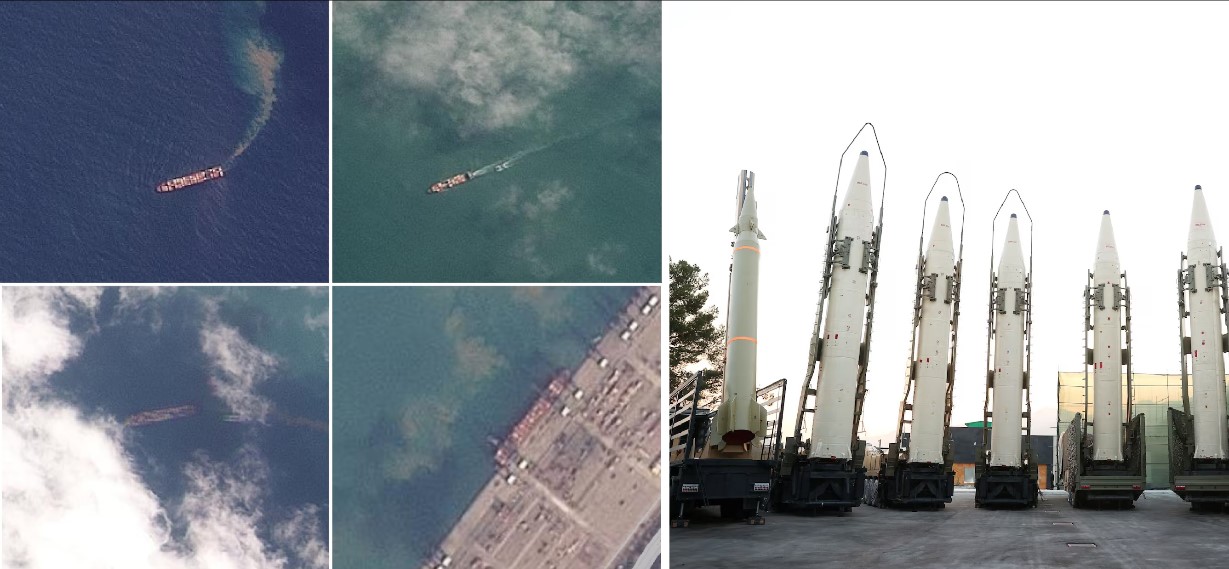
According to vessel-tracking information from MarineTraffic and corroborated by multiple analytical reviews, at least five Iran-linked ships departed from Gaolan port in Zhuhai, China, and either docked at Iranian ports or loitered offshore in recent weeks.
The vessels — Hamouna, Barzin, Shabdis, and Rayen — have already arrived at Iranian ports since 22 March 2026, while a fifth ship, Zardis, was observed waiting near Iranian territorial waters in early April, pending clearance to dock, with an expected arrival around April 2, 2026. Each vessel is operated by the Islamic Republic of Iran Shipping Line Group (IRISL), a state-owned entity under sanctions from the United States, United Kingdom, European Union, and Switzerland.
The Hamouna, previously operating under the name Canreach, departed China on February 19, 2026 — roughly one week before the start of large-scale U.S.-Israeli military operations — and arrived in Bandar Abbas on March 26 after a voyage lasting approximately five weeks, including delays attributed to regional instability.
Cargo Linked to Missile Propellant Production
Experts assessing shipping patterns and cargo characteristics believe the vessels are carrying sodium perchlorate, a chemical oxidizer used as a precursor to ammonium perchlorate, which is a critical component in solid-fuel rocket propellants.
Ammonium perchlorate forms the basis of propulsion systems used in many of Iran’s short- and medium-range ballistic missiles. The continued flow of this material suggests that Iran retains access to essential inputs required for sustaining missile production despite ongoing strikes on its military-industrial infrastructure.
The shipments originated from Zhuhai’s Gaolan port, a major hub for liquid chemical storage and export, further reinforcing assessments that the cargo consists of industrial chemical feedstock rather than finished weapons.
Scale Suggests Significant Replenishment Effort
Analysts have emphasized the scale of the current deliveries, noting that the vessels involved are approximately twice the size of those used in comparable transfers during 2025.
Earlier shipments in early 2025 — involving the IRISL vessels Golban and Jairan — carried sufficient sodium perchlorate to support the production of an estimated 102 to 157 ballistic missiles, according to assessments by nonproliferation experts.
Based on the increased capacity of the five vessels tracked in the current cycle, analysts estimate that the combined cargo could enable the production of approximately 785 additional missiles. At an operational level, this volume of propellant could sustain launch rates of between 10 and 30 missiles per day for roughly one month, depending on launcher availability and operational conditions.
Context of Ongoing Military Operations
The deliveries coincide with an active phase of hostilities following the launch of coordinated U.S. and Israeli air campaigns on February 28, 2026, conducted under Operation Epic Fury and Operation Roaring Lion, respectively.
These operations have targeted Iranian nuclear facilities, missile production sites, air defenses, and command infrastructure. Israeli officials have stated that approximately 330 out of Iran’s estimated 470 ballistic missile launchers have been destroyed or rendered inoperable. However, U.S. intelligence assessments indicate that up to half of Iran’s launcher inventory may remain functional.
Despite sustained strikes, the arrival of precursor chemicals indicates continued logistical throughput into Iran’s missile supply chain. Miad Maleki, a former U.S. Treasury official and current adviser at the Foundation for Defense of Democracies, assessed that the shipments reflect an effort by Iran to address shortages in missile fuel stocks during ongoing combat operations.
Sanctions Evasion and Maritime Concealment
Tracking data also highlights the use of established sanctions evasion techniques by Iranian shipping operators. Several vessels intermittently disabled their Automatic Identification Systems (AIS), limiting real-time tracking visibility during transit.
In addition, discrepancies were identified between declared and actual destinations. At least two vessels reported Vietnam as their intended destination, while tracking data confirmed their routes toward Iranian ports. Renaming practices were also observed, with Hamouna previously operating under a different identity to avoid detection in sanctions databases.
Cargo unloaded at Bandar Abbas and, in at least one case, Chabahar, can be transported inland via established logistics networks to missile production and storage facilities across Iran.
Historical Precedent and Safety Concerns
The handling of sodium perchlorate in Iran has previously been associated with significant safety incidents. In April 2025, an explosion at the Port of Shahid Rajaee in Bandar Abbas resulted in 57 fatalities and more than 1,000 injuries. Analysis of the incident, including the presence of reddish smoke plumes, indicated the involvement of sodium perchlorate or related compounds.
Following that Event, the United States imposed additional sanctions targeting networks involved in procuring missile-related chemicals between China and Iran.
Diplomatic Implications and Dual-Use Trade
The continued shipment of such materials has drawn attention to China’s role in supplying dual-use goods. While sodium perchlorate is not classified as a finished weapon, its application in missile production places it under scrutiny during periods of active conflict.
Analysts note that by exporting raw chemical inputs rather than weapon systems, China maintains that it is engaged in legitimate commercial trade. However, some experts argue that the decision to allow shipments to proceed during ongoing hostilities reflects a calculated policy stance.
Isaac Kardon of the Carnegie Endowment for International Peace stated that such shipments could have been halted at port, suggesting that their continuation indicates a deliberate decision rather than regulatory oversight.
Interdiction Challenges Persist
Efforts to interdict such shipments remain constrained by operational and legal limitations. Western naval forces deployed in the region face challenges in identifying and seizing dual-use cargo at sea, particularly when documentation classifies shipments as civilian industrial materials.
As a result, analysts describe the situation as an continuation of a long-standing “cat-and-mouse” dynamic, in which sanctioned entities adapt shipping practices to maintain supply flows despite international restrictions.
——— End of Article ———