COLUMBIA, South Carolina — March 12, 2026 : FN America has received a $9.9 million contract from the U.S. Department of Defense to deliver additional M240B 7.62×51 mm NATO medium machine guns for the U.S. Army and the U.S. Navy, continuing production of one of the longest-serving infantry support weapons in the American military inventory.
The contract, announced in early March 2026, ensures ongoing manufacturing of the M240 platform at FN America’s production facility in Columbia, South Carolina, where the company has produced firearms for the U.S. military since 1981. The award reflects continued demand for the M240B variant as part of the U.S. military’s broader management of its medium machine-gun capability across multiple services.
System Design and Technical Characteristics
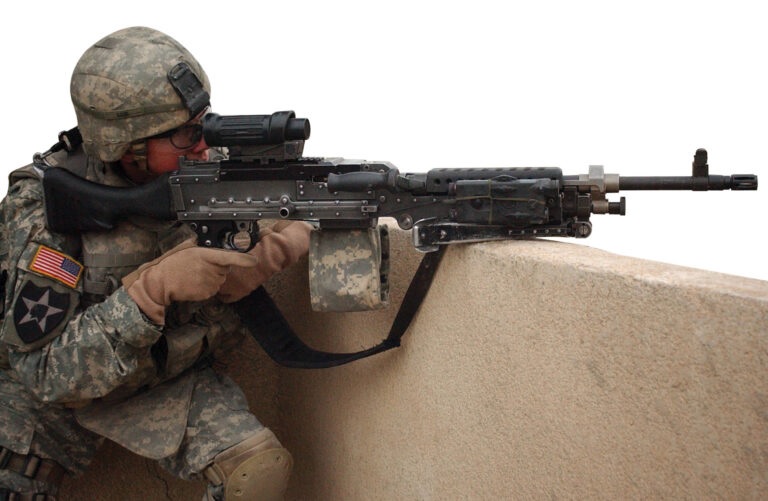
The M240B is a belt-fed, gas-operated medium machine gun chambered for the 7.62×51 mm NATO cartridge. It fires from the open-bolt position, a configuration intended to reduce heat accumulation during prolonged firing and minimize the risk of cartridge cook-off under sustained fire conditions.
The weapon uses fixed headspace and timing, eliminating the need for adjustment during operation and simplifying maintenance procedures for troops in the field. The system incorporates a machined steel receiver, a quick-change cold hammer-forged barrel with a hard-chromed bore, and a single-port gas regulator to manage the cycling rate.
The gun features a composite polymer trigger grip, a machined steel front sight assembly, and MIL-STD-1913 Picatinny rails to allow mounting of optics and other accessories. A hydraulic recoil buffer integrated into the buttstock, combined with the weapon’s overall mass, improves controllability during sustained bursts and reduces recoil impulses transmitted to the operator.
Performance Specifications
The M240B is designed for sustained suppressive fire in infantry support roles. Its principal technical characteristics include:
-
Caliber: 7.62×51 mm NATO
-
Operating System: Belt-fed, gas-operated, open-bolt
-
Rate of Fire: 550–650 rounds per minute
-
Muzzle Velocity: Approximately 2,750–2,800 feet per second
-
Barrel Length: 21.7 inches
-
Overall Length: 48.5 inches
-
Height: Approximately 11.6 inches
-
Weight (Gun Only): About 27.1–27.4 pounds
-
Weight (Complete System): Approximately 47.4 pounds including spare barrel case, tripod, pintle, and traversing-and-elevating mechanism
Operational range parameters include:
-
Effective Range (Point Targets): 800 meters
-
Effective Range (Area Targets): 1,800 meters
-
Grazing Fire: Up to 600 meters
-
Maximum Range: 3,725 meters (about 12,221 feet)
The quick-change barrel system allows crews to replace overheated barrels during extended firing sequences, maintaining operational readiness during sustained engagements.
Tactical Role in Infantry Operations
Within U.S. infantry formations, the M240B serves as a medium machine gun bridging the capability gap between lighter 5.56 mm squad automatic weapons and heavier .50-caliber heavy machine guns.
The system provides long-range suppressive fire, increased penetration, and sustained firing capability, supporting maneuver operations at the platoon and company level.
When deployed with its integrated bipod, the M240B functions as a mobile support weapon accompanying maneuver elements. Mounted on a tripod equipped with a traversing-and-elevating mechanism, the weapon becomes a deliberate fire-control system capable of precisely managing beaten zones and engaging pre-planned targets across defensive sectors.
Although heavier than lighter automatic weapons due to its steel receiver and robust barrel design, the weight contributes to durability, thermal management, and stability during sustained fire.
Procurement Background and Variant Use
The $9.9 million award is part of a broader U.S. Department of Defense procurement framework maintaining multiple variants of the M240 machine-gun family.
Different versions of the system are fielded based on operational requirements:
M240B:
Retained as the primary medium machine gun in many units where durability, reliability, and logistical commonality take priority.
M240L:
A lightweight variant designed for dismounted infantry mobility, featuring a titanium receiver that reduces the weapon’s weight by approximately five pounds (about 18 percent) while maintaining the same ballistic performance and range.
Recent Procurement Activity
Recent defense contracts related to the M240 platform include:
-
July 2025: U.S. Army contract valued at $4.9 million for additional M240L lightweight machine guns.
-
March 2025: Defense Logistics Agency contract worth up to $39.6 million for replacement barrels for M240 and M249 machine guns.
-
June 2021: U.S. Army contract valued at up to $92.1 million covering multiple M240-series variants and spare receivers, with production scheduled through 2026.
These procurement actions indicate continued lifecycle support for the M240 platform and sustained logistics planning around 7.62 mm ammunition commonality across multiple U.S. military branches.
Production History
The M240 platform has been in U.S. military service since the late 1970s, evolving from earlier designs into multiple variants tailored to infantry, vehicle-mounted, and aviation roles.
The original M240 program was FN America’s first major U.S. military contract and the first weapons program manufactured at the company’s South Carolina facility. Since then, the Columbia plant has served as a long-term production and support center for several U.S. military small-arms systems.
According to FN America, continued contracts for the M240 series reflect the platform’s established role in providing reliable medium-machine-gun capability for U.S. ground forces.
Delivery and Operational Support
Weapons produced under the current $9.9 million contract will be supplied to both U.S. Army and U.S. Navy units, supporting operational requirements for force protection, expeditionary operations, and sustained infantry fire support.
The award ensures continued production of the M240B as part of the U.S. military’s mixed fleet of medium machine guns, maintaining capability for range, endurance, and sustained volume of fire within infantry formations.
——— End of Article ———