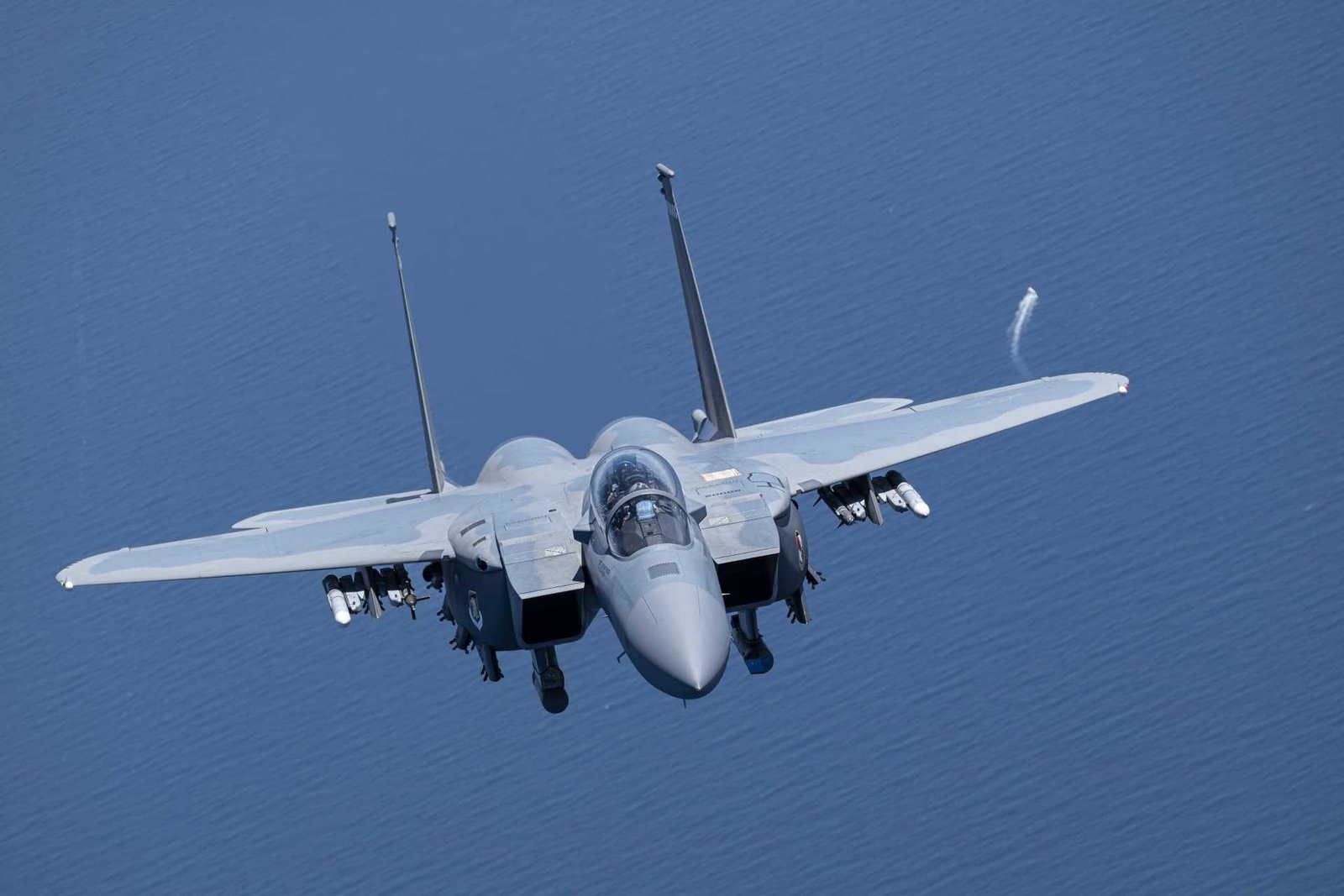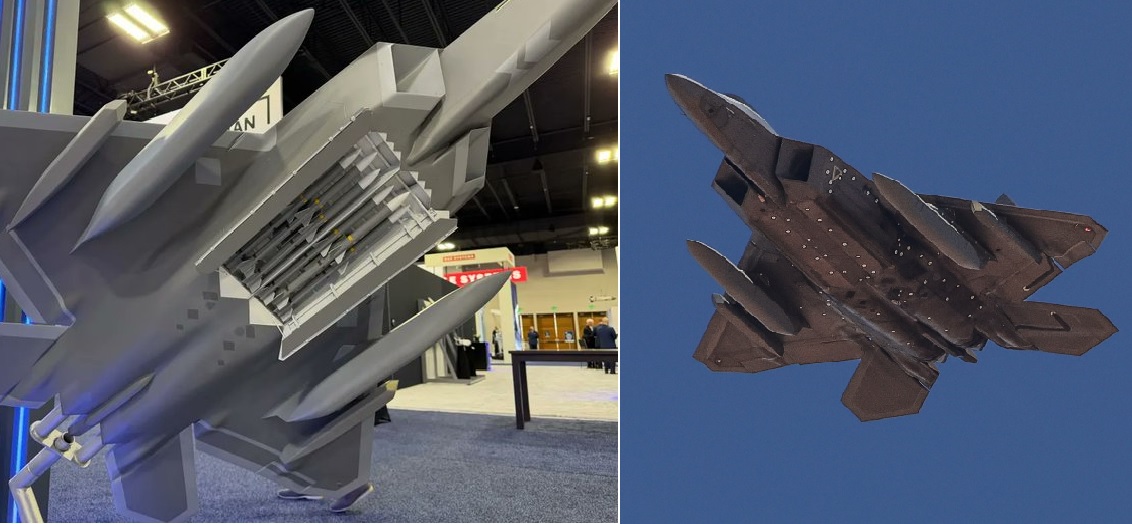
EDWARDS AIR FORCE BASE, Calif. — March 22, 2026 : New imagery captured on March 21, 2026, shows a F-22 Raptor operating with low-observable external fuel tanks and faceted mission pods during a test flight, marking a significant step in ongoing modernization efforts for the U.S. Air Force’s air-superiority platform.
The photographs, taken by aviation photographer Jarod Hamilton, provide the clearest public view to date of the configuration previously observed only in concept models presented by Lockheed Martin in February 2026. The aircraft was also observed refueling mid-air from an NKC-135R Stratotanker, a specialized tanker used in developmental flight testing.
Reference markings visible on the aircraft indicate that the platform is actively engaged in test and evaluation activities.
Low-Observable External Fuel Tanks
The newly observed configuration includes redesigned stealth-shaped external fuel tanks, intended to address one of the F-22’s longstanding operational constraints—limited combat persistence.
Traditional external drop tanks used by the F-22 increase radar signature and are typically reserved for transit or lower-threat environments. Even when jettisoned, the mounting pylons can contribute to residual radar visibility.
The new low-observable tanks are designed to remain attached during combat operations, allowing the aircraft to maintain its low observable profile while carrying additional fuel. The tanks provide extended range—estimated at approximately 850 nautical miles of additional reach—while preserving aerodynamic performance and enabling full manoeuvrability.
The extended fuel capacity supports longer time on station, increased mission endurance, and greater flexibility in route planning. This is particularly relevant in operational environments where tanker aircraft must remain at extended distances due to threats from long-range air defence systems.
Faceted Sensor and Mission Pods
In addition to the fuel tanks, the aircraft was observed carrying two faceted external pods, mounted under the wings. One of the pods features a forward transparent section consistent with an infrared search and track (IRST) or electro-optical sensor aperture.
The F-22 originally lacked an integrated IRST system due to earlier budget constraints, relying instead on radar and data-linked targeting. The addition of external sensor pods provides a passive detection capability, allowing the aircraft to identify and track targets without emitting radar signals.
This capability enhances survivability in contested environments where electronic warfare and emission control are critical considerations.
The pods are designed to preserve the aircraft’s radar signature and may also support additional functions, including electronic warfare payloads or networking capabilities for integration with emerging systems such as collaborative combat aircraft.
Testing Background and Development Progress
The configuration was first publicly displayed as a scale model during the Air & Space Forces Association Warfare Symposium in Denver in February 2026. Earlier sightings of similar components were reported in 2024 near the Mojave Air and Space Port during early development stages.
Development of the stealth fuel tanks began following ground and wind tunnel testing completed in 2023, with initial flight evaluations conducted in early 2024. The current imagery indicates that testing has progressed into a more advanced phase, involving integrated flight operations and aerial refuelling.
The sensor pods continue to undergo evaluation, with further testing phases expected to lead into operational assessment during the 2026 fiscal cycle.
Operational Role and Capability Enhancements
The combined use of stealth fuel tanks and sensor pods is intended to enhance two key aspects of the F-22’s operational profile: range and passive sensing capability.
Extended endurance enables the aircraft to sustain offensive and defensive counter-air missions, including long-duration patrols and escort operations. The passive sensing capability provided by IRST-type systems allows detection of targets without compromising the aircraft’s stealth characteristics.
These enhancements are particularly relevant in environments involving long-range surface-to-air missile threats, contested airspace, and dispersed basing requirements. In maritime theatres such as the Pacific, the increased range supports operations across extended distances without continuous reliance on aerial refuelling.
Integration with Broader Modernization Efforts
The new configuration aligns with ongoing modernization initiatives led by Lockheed Martin and the U.S. Air Force to extend the operational relevance of the F-22.
These efforts include integration with distributed sensor networks and the development of the Infrared Defensive System, a programme aimed at improving survivability and situational awareness through advanced infrared sensing technologies.
The combination of enhanced range, passive detection, and networked capabilities is intended to support the F-22’s role in high-end conflict scenarios, particularly in the early phases of operations where air superiority is critical.
Current Status
The latest imagery confirms that the stealth tank and sensor pod configuration has moved beyond conceptual design into active flight testing, with continued evaluation expected before any potential operational deployment.
No official timeline has been announced for full integration across the F-22 fleet, though the progression of testing indicates ongoing efforts to refine the aircraft’s capabilities in response to evolving operational requirements.
——— End of Article ———