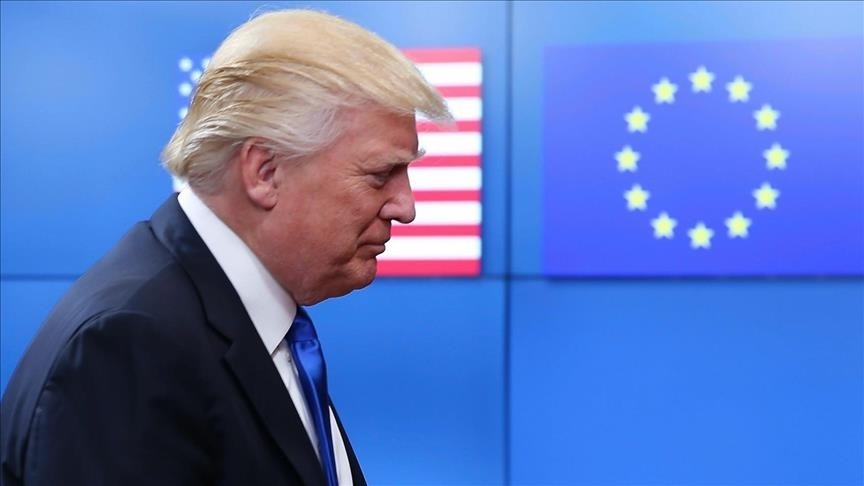
Brussels / Stockholm / Copenhagen : European institutional investors have sold nearly $9 billion worth of U.S. Treasury securities in recent days, despite a public warning from U.S. President Donald Trump urging the European Union not to divest from American debt. The move, led by major Scandinavian pension funds, represents a rare instance of U.S. sovereign debt being sold explicitly for political rather than economic reasons.
According to disclosures by the funds, Sweden’s government-backed pension fund AP7 and Denmark’s AkademikerPension have collectively offloaded approximately $8.9 billion in U.S. Treasury holdings. AP7 accounted for the vast majority of the divestment, selling about $8.8 billion, while AkademikerPension sold roughly $100 million.
Fund representatives have emphasized that the decision was driven by concerns over political risk, governance, and U.S. foreign policy conduct under the current administration, rather than expectations about returns, interest rates, or dollar stability.
Funds Cite Rule of Law and Political Predictability
AP7 stated that its decision was based on a reassessment of long-term political risk associated with U.S. assets. The fund cited reduced predictability in U.S. policymaking, concerns related to the rule of law, and growing institutional uncertainty. Despite acknowledging that U.S. Treasuries remain financially liquid and profitable, AP7 concluded that they no longer met its criteria for politically neutral, low-risk holdings.
Denmark’s AkademikerPension confirmed a separate sale of U.S. Treasuries worth approximately $100 million. While the fund publicly referenced concerns about U.S. government finances, individuals familiar with the decision said broader political considerations were central. These included unease over U.S. diplomatic pressure on European countries and tensions linked to Washington’s statements regarding Greenland.
A source close to the Danish fund said the assessment focused on the political environment surrounding U.S. assets, noting that financial performance alone was no longer sufficient to justify continued exposure.
Departure From Long-Standing Investment Practice
European pension funds have traditionally treated U.S. Treasuries as risk-free assets and a cornerstone of conservative, long-term portfolios. They have historically been viewed as politically neutral instruments, insulated from diplomatic disputes and policy disagreements.
The recent divestments represent a departure from this long-standing approach. By citing political and institutional concerns rather than market fundamentals, the funds have broken with decades of precedent in European asset management.
Analysts note that this shift is significant because pension funds typically operate with long time horizons and avoid decisions driven by short-term political developments. The move suggests a reassessment of how geopolitical risk is priced into even the most established financial instruments.
Broader Context of Transatlantic Tensions
The divestment comes amid heightened political friction between the United States and Europe. Recent tensions have included U.S. statements on NATO burden-sharing, comments questioning alliance commitments, and renewed discussion by President Trump regarding U.S. interest in Greenland. European officials have also expressed concern over what they view as increasingly coercive U.S. diplomatic tactics toward allies.
President Trump had warned European governments against selling U.S. debt, framing such actions as economic retaliation. The subsequent sell-off by European pension funds, though limited in absolute size, appears to directly contradict that warning.
Implications for the Dollar and Global Debt Markets
In purely quantitative terms, the $8.9 billion sale represents a small fraction of the approximately $28 trillion U.S. Treasury market. However, its symbolic significance is widely noted by market observers.
Until now, political divestment from U.S. assets has been primarily associated with countries pursuing de-dollarization strategies, such as China and Russia within the BRICS grouping. Europe’s participation marks a notable shift. As a bloc, the European Union holds an estimated $1.6 trillion in U.S. debt, making it the largest collective foreign holder, ahead of Japan and China.
While there is no indication of a coordinated EU-wide policy to reduce exposure to U.S. Treasuries, analysts say the actions of AP7 and AkademikerPension could influence how other institutional investors assess political risk tied to U.S. assets.
Trust and Financial Neutrality Under Review
Market analysts emphasize that the significance of the move lies less in its immediate financial impact and more in the signal it sends. The divestment suggests that trust in the political neutrality of U.S. sovereign debt is being reassessed, even among close allies.
For now, U.S. Treasuries remain central to global finance, and there has been no broad-based sell-off by European governments. However, the decision by major pension funds to act on political criteria introduces a new factor into global bond markets, one that could shape future discussions on reserve assets, financial sovereignty, and geopolitical risk management.
——— End of Article ———