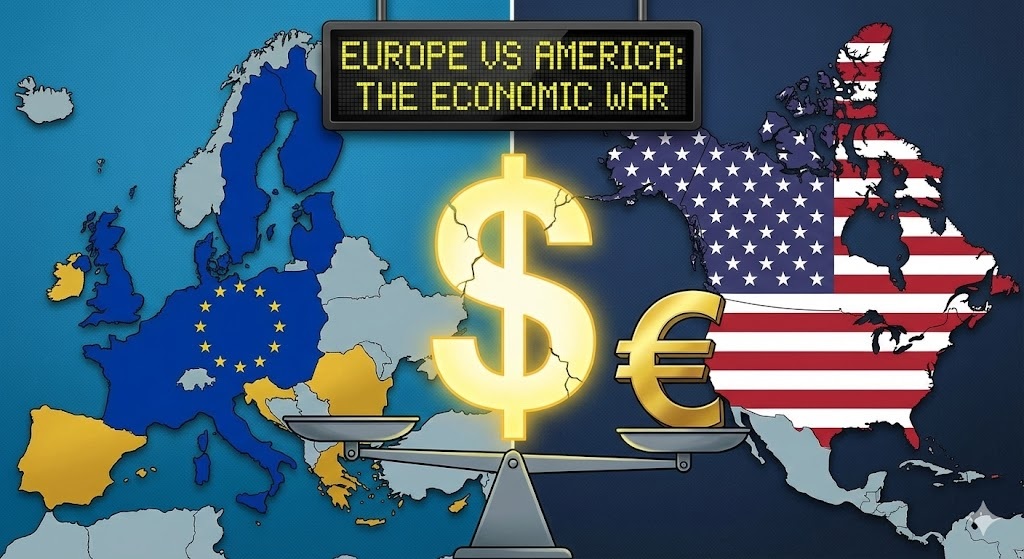
World : As economic tensions escalate between Washington and its global partners, the long-standing trade relationship between the United States and the European Union is undergoing one of its most severe strains in decades. What was once the world’s largest bilateral economic partnership—valued at over €1.6 trillion ($1.7 trillion) in goods and services in 2024—has been pushed to the brink of a full-scale trade conflict amid tariff threats, diplomatic disputes, and strategic economic shifts that extend beyond Europe alone.
Rising Trade Frictions and the “Trade Bazooka”
The immediate flashpoint stems from recent actions by the U.S. administration to use tariffs as a lever in diplomatic disputes, including threats of up to 25–30% tariffs on European imports tied to geopolitical issues with Denmark and Greenland. In reaction, the European Parliament has suspended ratification of a pending trade deal with the United States, condemning the U.S. approach as coercive. Brussels is also preparing retaliatory tariffs on as much as €93 billion of U.S. goods and weighing activation of its newly adopted Anti-Coercion Instrument (ACI)—popularly dubbed the EU’s “trade bazooka.”
The ACI, in force since December 2023, gives the EU the legal authority to counter economic coercion through measures ranging from tariffs and export controls to restricting access to European public procurement and services sectors. That capability marks a departure from past EU trade policy, when unanimous consent among all 27 member states often slowed rapid response; the ACI now operates on qualified majority rules.
Brussels has not yet deployed the ACI against Washington, but French and German leaders have insisted that the EU will not be “blackmailed” by tariff threats. EU finance officials affirmed unity in standing up to what they describe as inappropriate pressure from a key ally.
Economic Interdependence: Leverage and Vulnerabilities
Despite the rhetoric of confrontation, Europe and the U.S. remain deeply interlinked. According to European Commission data, trade in goods and services across the Atlantic amounts to roughly €4.2 billion per day, with EU and U.S. firms having invested more than €5 trillion in each other’s markets. This interdependence has historically served as a buffer against escalation, given the potential costs on both sides.
Yet the balance of trade remains a point of contention. Though exact current surplus figures vary by source, the EU regularly records a sizeable goods surplus with the U.S., a statistic Washington often cites in its tariff rhetoric. Economists see such trade positions as leverage for Brussels rather than “theft,” noting the integration of European manufacturers into U.S. supply chains—from German automakers to French luxury producers. (Comprehensive latest surplus data across all sectors are still evolving in 2026 reporting.)
Beyond Europe — The U.S.’s Multi-Front Economic Strategy
The transatlantic dispute occurs against the backdrop of broader U.S. economic confrontations:
China: A prolonged tech-centric trade war continues, with Washington imposing targeted tariffs and export controls on semiconductor technologies. China has responded by diversifying sources of energy and agricultural imports away from the U.S. and by reducing its holdings of U.S. Treasury securities to the lowest levels in nearly two decades while boosting gold reserves.
Russia: Comprehensive sanctions, coordinated with EU allies, have immobilized hundreds of billions in Russian foreign reserves, significantly impairing Moscow’s economy and limiting its access to global markets.
Other Economies: Secondary sanctions and tariff threats against nations engaging in trade with sanctioned states—such as Russia—have broadened the scope of U.S. trade policy, targeting energy and mineral imports from some partners like India.
Analysts warn that sustaining economic pressure on multiple major economies simultaneously may stretch U.S. policy effectiveness and diplomatic capital, potentially incentivizing rival coalitions to pursue alternatives to dollar-centric trade and finance. (Experts have compared these dynamics to historical shifts in global monetary leadership.)
Can Europe Undermine the U.S. Dollar?
One of the most debated questions is whether the EU could help weaken the U.S. dollar’s dominant role in the global financial system. Today, the dollar remains the premier international reserve currency, accounting for roughly 58%-plus of global foreign exchange reserves, with its use pervasive in invoicing and settlement of trade worldwide. This status grants the U.S. “exorbitant privilege” to borrow cheaply and project power through sanctions.
Short-term realities suggest the euro is unlikely to supplant the dollar imminently. Safe-haven inflows typically strengthen the dollar in times of global economic stress—which a full-scale trade war would certainly trigger. Even as the euro occupies a significant niche in trade invoicing alongside the dollar, both currencies together dominate over 80% of global trade settlements.
However, longer-term trends point to gradual diversification, with central banks increasingly holding a mix of currencies and gold rather than relying solely on U.S. dollar assets. Close cooperation between Brussels and other major economies pursuing dedollarization could incrementally erode dollar dominance over time, but such a shift would unfold over years or decades, not months.
Global Economic Risks and Outlook
Economists and international institutions have warned that an unchecked escalation of trade conflict—particularly between the world’s two largest economic blocs—could undermine global growth prospects. IMF and independent analyses highlight the risks of recession, significant job losses, supply-chain disruption, and inflationary pressures as tariffs ripple through global markets.
For now, both Brussels and Washington face strategic choices between competitive escalation and negotiated restraint. With the EU signaling a readiness to defend its economic sovereignty and the U.S. juggling multiple geoeconomic fronts, global markets are watching closely for whether transatlantic rivals turn competition into cooperation—or erupt into prolonged conflict.
——— End of Article ———