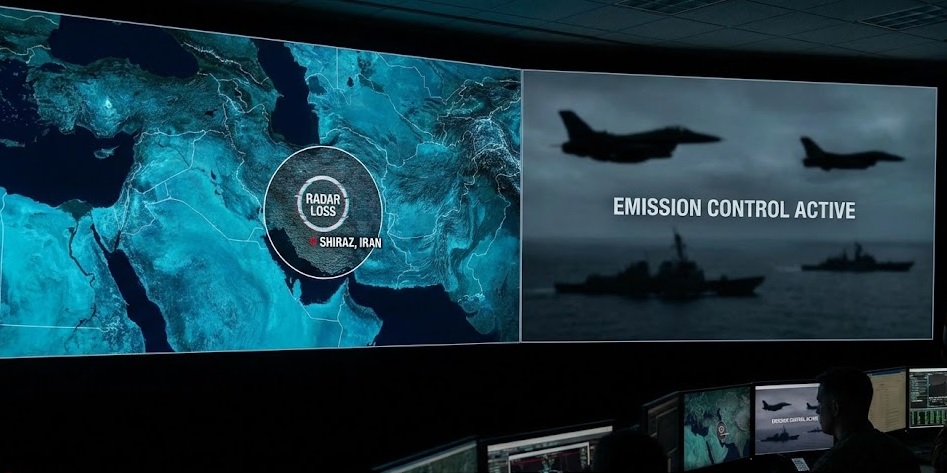
WASHINGTON / TEHRAN : A sudden failure of key Iranian radar systems in the southern city of Shiraz, disclosed through an official aviation notice (NOTAM) early Thursday (22 january 2026 ), has triggered intense speculation among regional defense analysts that a new phase of electronic warfare may be unfolding in the long-simmering standoff between Iran and the United States and its allies.
The development comes as U.S. military movements across the Middle East accelerate, including sustained heavy airlift operations into Jordan and an unusual electronic silence from American naval forces operating at sea. Together, the signals have fueled concern that the region may be entering what some defense observers describe as a “lights-out” preparatory phase preceding possible military action.
A NOTAM That Set Off Alarms
At the center of the latest escalation is a Notice to Airmen (NOTAM), numbered A0285/26, issued by Iranian authorities and effective through the evening of January 22. The notice states that the Monopulse Secondary Surveillance Radar (MSSR) serving Shiraz is “not available,” warning that radar services in multiple sectors of the Area Control Center (ACC) could be disrupted.
Shiraz is not an ordinary provincial city. Strategically positioned as a gateway to southern and central Iran, it also sits near facilities long associated by Western intelligence agencies with Iran’s military-industrial and electronic warfare sectors. For that reason, the abrupt loss of secondary radar coverage there has been interpreted by several analysts as more than a routine technical malfunction.
The timing has sharpened those suspicions. The radar outage coincides with reports of U.S. naval forces in the region sharply reducing their electronic emissions — a posture commonly referred to as operating in “dark mode.” In military doctrine, the combination of radar disruption on one side and emission control on the other is often associated with cyber or electronic warfare operations designed to degrade situational awareness before kinetic action.
Iranian authorities have offered no public explanation for the radar failure beyond the NOTAM itself, leaving open questions about whether the outage is the result of technical degradation, deliberate shutdown, or external interference.
The Silence of the Skies
Adding to the uncertainty is the apparent absence of U.S. E-3G Airborne Warning and Control System (AWACS) aircraft from publicly observable flight activity in the region. Traditionally, these aircraft provide wide-area surveillance and command-and-control during major air operations.
Some analysts suggest the absence may be deliberate. Rather than exposing large, easily detectable platforms, the U.S. military could be relying on a distributed sensor network that includes F-35 stealth fighters, carrier-based E-2D Advanced Hawkeye aircraft, and ground-based radar systems operated by regional partners in Jordan, Saudi Arabia, and Israel.
Others interpret the lack of visible AWACS as an indication that any future operation would rely primarily on long-range missiles and standoff strikes, rather than sustained aerial combat requiring complex airspace management.
Either interpretation points to a shift away from overt signaling toward a lower-visibility posture, complicating efforts to read Washington’s intentions.
Jordan’s Growing Role
While some assets appear to have gone quiet, activity at Muwaffaq Salti Air Base in eastern Jordan has been anything but subtle. Flight-tracking data and regional aviation monitoring indicate a steady stream of U.S. Air Force C-17 Globemaster III transport aircraft landing at the base over recent days.
The sustained airlift suggests Jordan has become a central logistical hub for U.S. operations, effectively functioning as a forward platform for both defensive and offensive missions. The base’s location allows coverage of airspace stretching from Iraq to western Iran, while reinforcing missile and air defenses oriented toward Israel’s eastern approaches.
Defense officials in Amman have not commented publicly on the nature of the deployments, but the scale and persistence of the airlift point to preparations extending beyond routine military exercises.
Political Signals From Washington
Military movements have been accompanied by increasingly blunt political rhetoric. Former U.S. President Donald Trump, speaking recently at a campaign event, reiterated that Iran “will not have nuclear weapons,” using language that appeared to blur past and future action.
Statements such as “we hit hard” and “it will happen again,” though unspecific, have been widely interpreted as reinforcing a doctrine centered on physical dismantlement of Iran’s nuclear and missile capabilities, rather than negotiated restraint.
Analysts note that such language, even when delivered outside formal office, can influence strategic calculations in Tehran by reinforcing perceptions that the United States is willing to escalate beyond economic pressure.
Shiraz and the Question of Intent
Beyond its geographic importance, Shiraz is often cited in open-source intelligence assessments as a hub for Iran’s electronic and air defense manufacturing sectors. That association has led some observers to frame the radar outage as a possible “blinding” operation — an attempt to suppress sensors in an industrial center before any strike aimed at production facilities themselves.
Others caution against drawing firm conclusions. Iran’s radar network includes many aging systems affected by years of sanctions, and maintenance-related outages are not uncommon. Still, the issuance of a NOTAM acknowledging radar unavailability effectively clears civilian air traffic from affected sectors, reducing the risk of misidentification during periods of heightened military tension.
A Region Holding Its Breath
By Thursday morning, the picture that had emerged was one of converging signals rather than definitive proof of imminent conflict. Radar disruptions in Iran, heavy U.S. airlift activity in Jordan, electronic silence at sea, and increasingly uncompromising political language together suggest a period of intense preparation — whether for deterrence, coercive diplomacy, or something more direct.
For now, skies over parts of southern Iran remain partially blind, American transport aircraft continue to arrive in Jordan, and regional capitals are watching closely for the next sign that the balance has tipped from pressure to action.
——— End of Article ———