HAIFA, Israel — February 24, 2026 : Elbit Systems Ltd. has announced it will supply its Helmet Display and Tracking System (HDTS) to the Israeli Air Force for installation across its fleet of UH-60 Black Hawk helicopters, locally designated “Yanshuf.” The upgrade is intended to enhance operational capability and flight safety across the medium-lift helicopter fleet.
The Yanshuf fleet consists of approximately 48 UH-60A/L Black Hawk helicopters used for troop transport, search and rescue, special operations support, and general utility missions. The HDTS will be integrated into the existing avionics and sensor architecture of these aircraft without requiring major structural modifications, reflecting the system’s modular and open-architecture design.
System Overview and Capabilities
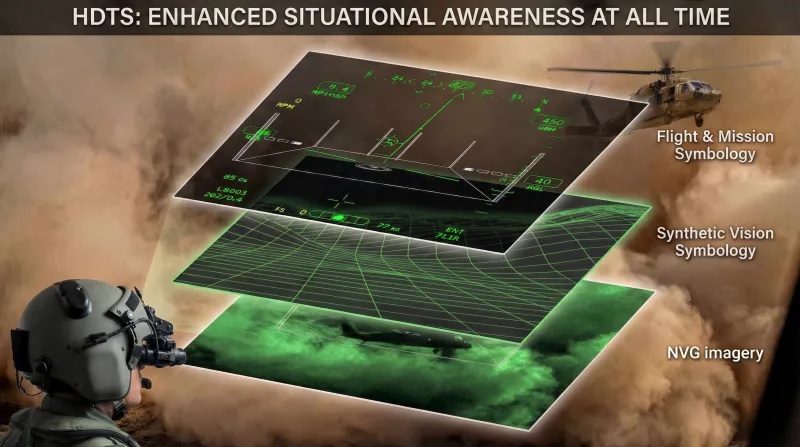
The HDTS, also designated ANVIS/HUD-24T, is an operationally deployed helmet-mounted system that combines legacy helmet display technology with day head-up display (HUD) capability and precise Line-of-Sight (LOS) head tracking. The system projects advanced three-dimensional Synthetic Vision Symbology (SVS) directly into the pilot’s field of view.
The synthetic vision presentation depicts terrain contours, physical obstacles, and active flight-plan data in real time. By overlaying this information onto the pilot’s viewing axis, the system supports aircrew situational awareness in degraded visual environments, including dust, precipitation, fog, smoke, and night operations.
According to the company, the HDTS has accumulated more than 2.5 million operational flight hours across over 7,000 helicopters on 25 different platforms worldwide. It is designed for utility, multi-role, assault, and maritime helicopter applications and can be installed on both eastern and western aircraft platforms.
Support During Approach and Landing
A primary operational focus of the HDTS is approach and landing, phases of flight that present elevated risk in low-visibility conditions. The system provides real-time decision support by maintaining continuous terrain and obstacle awareness even when external visual references are limited or temporarily lost.
In “brownout” scenarios—when rotor wash lifts dust or sand during landing—the HDTS generates a synthetic landing-zone display. This allows the crew to retain spatial orientation and maintain defined flight safety margins during ground proximity operations. Brownout conditions are a recognized hazard in desert and unprepared landing zones, where visual cues can be significantly degraded within seconds.
Line-of-Sight Tracking and Crew Coordination
The helmet incorporates Line-of-Sight (LOS) head-tracking technology that continuously aligns projected symbology with the pilot’s exact viewing direction. This ensures that flight, navigation, and sensor data remain spatially consistent with where the pilot is looking.
The LOS functionality also supports coordinated crew operations. By synchronizing viewing references and mission data across cockpit crew members, the system contributes to improved task distribution and reduced potential for human error during dynamic missions.
Multi-Sensor and ISR Integration
Built on an open and modular digital architecture, the HDTS is engineered to integrate with multiple onboard and external systems. These include Intelligence, Surveillance, and Reconnaissance (ISR) payloads, thermal imaging sensors, obstacle-detection systems, navigation and positioning equipment, and external video feeds.
The integration framework allows real-time fusion of sensor inputs into the helmet display, supporting continuous operations in day and night conditions and across varying weather environments. The modular structure enables compatibility with existing helicopter systems without extensive redesign of platform avionics.
Operational Context
The Israeli Air Force’s Yanshuf helicopters form a core component of its rotary-wing transport capability. The aircraft conduct domestic and operational missions, including personnel movement, casualty evacuation, special operations insertion, and logistical support.
The HDTS upgrade applies across the existing fleet and aligns with the Air Force’s ongoing modernization of aircrew systems and mission avionics. By incorporating synthetic vision, head-tracking precision, and multi-sensor data fusion into a single helmet-based platform, the program reflects a transition from basic helmet-mounted display technology to integrated aircrew operational systems.
Company Statement
Yoram Shmuely, General Manager of Elbit Systems Aerospace, stated that the agreement continues the company’s longstanding cooperation with the Israeli Air Force.
“We are proud to continue our longstanding and successful cooperation with the Israeli Air Force,” Shmuely said. “Elbit Systems is a global leader in helmet system technologies, supplying advanced head-mounted solutions for a wide range of aircraft platforms worldwide. This program further strengthens Elbit’s position as a next-generation provider of integrated aircrew solutions, marking the transition from basic helmet-mounted displays to a fully operational system that unites display, precise head-tracking, synthetic symbology, and multi-sensor integration.”
All details are based on the official announcement issued by Elbit Systems Ltd. on February 24, 2026.
——— End of Article ———