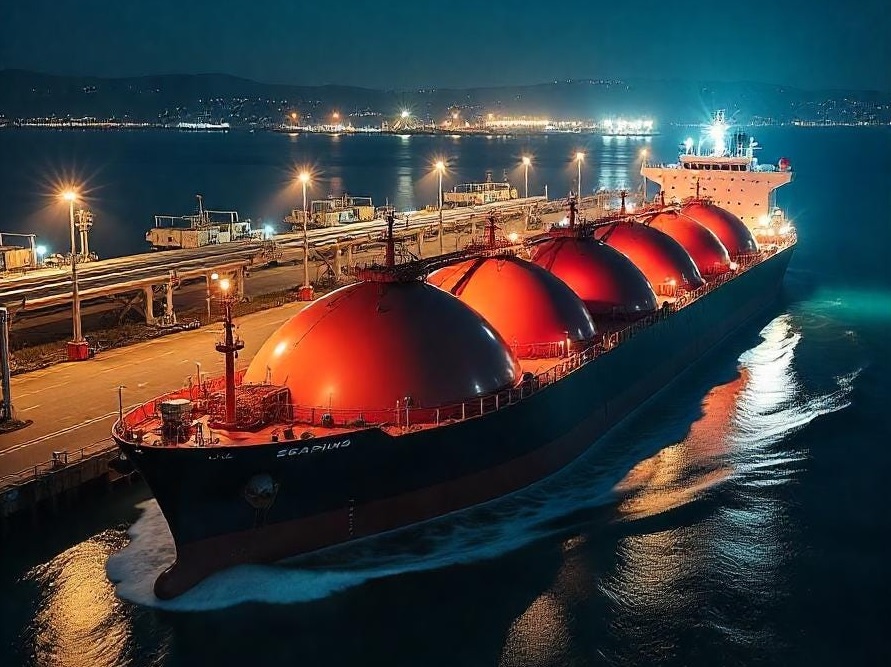
Brussels : European Union imports of Russian liquefied natural gas (LNG) rose to a historic high in January 2026, even as the bloc has formally adopted a legally binding framework to fully end Russian gas imports by 2027. The surge reflects a short-term increase in deliveries ahead of phased restrictions that will progressively limit and ultimately prohibit Russian LNG and pipeline gas.
According to data compiled by the Bruegel analytical center, the EU imported 2.276 billion cubic meters (bcm) of Russian LNG in January. This marked an 11 percent year-on-year increase from 2.05 bcm in January 2025 and was also slightly higher than December 2025, making it the highest monthly intake on record.
Imports Rise Ahead of Regulatory Deadlines
The increase follows the EU Council’s final approval of Regulation (EU) 2026/261, which establishes a phased prohibition on Russian natural gas. Market participants indicate that European buyers are continuing to lift contracted volumes to replenish storage and meet contractual obligations before restrictions take effect.
Under the regulation, key deadlines include:
-
April 25, 2026 — Ban on Russian LNG under short-term contracts
-
January 1, 2027 — Full ban on all Russian LNG, including long-term contracts
-
September 30, 2027 — Completion of the phase-out of Russian pipeline gas
Analysts note that the January increase aligns with pre-sanctions purchasing patterns, where imports temporarily rise ahead of regulatory cutoffs.
Arctic LNG Dominates Supply
The majority of Russian LNG delivered to the EU in January originated from the Yamal LNG project in the Arctic. Approximately 93 percent of Yamal LNG exports during the month were directed to EU ports, reinforcing the bloc’s role as the project’s primary market during the transition period.
France, Belgium, and Spain remained the leading importers. France’s Montoir-de-Bretagne terminal and Belgium’s Zeebrugge terminal recorded notable year-on-year increases, while Spain continued to receive Russian cargoes at several regasification facilities.
Impact of Transshipment Restrictions
A separate EU ban on the transshipment of Russian LNG through EU ports, introduced in March 2025, was designed to prevent re-exports to third countries. However, industry data suggests the measure has altered logistics rather than reduced volumes. Terminals such as Zeebrugge have increasingly retained LNG within the EU market, contributing to elevated reported imports.
Russia’s Position in the EU Gas Market
Despite diversification efforts since 2022, Russia remains the EU’s second-largest LNG supplier, after the United States. Russian gas—combining LNG and residual pipeline flows—accounts for approximately 13 to 15 percent of the EU’s total gas consumption, down from more than 40 percent prior to the Ukraine war.
This shift has been driven by higher U.S. LNG imports, expanded non-Russian pipeline supply, and lower gas demand linked to efficiency measures and renewable energy deployment.
Enforcement Measures Under REPowerEU
The EU’s REPowerEU framework includes strict enforcement provisions to ensure compliance with the 2027 exit from Russian gas. Companies violating the ban face financial penalties of at least €40 million or 3.5 percent of global annual turnover, whichever is higher.
From February 2026, member states must implement mandatory verification of gas origin for all imports. In addition, all EU countries are required to submit national diversification plans by March 1, 2026, outlining how remaining Russian volumes will be replaced through alternative suppliers, infrastructure upgrades, or demand reduction.
EU LNG Import Profile in January
In January 2026, total EU LNG imports reached 12.20 bcm, up 1.3 percent month on month. The United States remained the largest supplier with 8.00 bcm, reflecting an 18 percent monthly increase. Russian LNG ranked second at 2.276 bcm, followed by Africa (0.772 bcm) and the Middle East (0.571 bcm), both broadly stable.
While Russian LNG flows are expected to decline as regulatory deadlines approach, January’s data highlights the EU’s continued reliance on transitional supplies as it moves toward a complete ban by the end of 2027.
——— End of Article ———